


Dear readers: The previous parts of this journal can be found at the following links: I, II, III, IV, V, VI, VII, VIII, VIX, X, XI, XII, XIII, XIV, XV, XVI, XVII, XVIII. The journal concludes today.
Earlier in this journal, when I was writing from Syracuse, I said I was glad to see a basketball court by the water. I see one by the water in Palermo too. But the thing is: the court is astroturf. Which is a little odd.
Still, long live hoops.
***
Another sight glimpsed along the water: a huge graffito that says, “Tourism kills the city.” Is that true? I imagine there are arguments either way. I imagine that tourism both helps and hurts the city.
Where does the balance lie?
***
Italy is great for food, and Sicily is particularly great for food, and Palermo? Best of all, some people say. I am not a “foodie” (though I’m an appreciative eater). I am not a connoisseur. But I know a few, and I’ve read a few.
Palermo is famous for arancine, which are rice balls, or rice croquettes, filled with this and that. Is it “arancine” or “arancini”? Well, it depends on where you are. In Palermo and western Sicily, you eat arancine, and in the east of the island, you eat arancini. (The respective singulars are “arancina” and “arancino.”)
Moreover, arancine in the west are spherical whereas arancini in the east are conical.
To a Michigander like me? They all go down good …
Palermo is also famous for cannoli. I have had a few of these in my time. But not until I got to Palermo did I realize how a cannolo ought to be: light, not heavy; sweet but moderately so.
What a delicious dessert …
Speaking of which: they have setteveli ice cream here. It’s available in almost every parlor. I will quote an online source for a description:
Setteveli is a gelato flavor inspired by the eponymous cake from Palermo. The cake combines chocolate sponge, praline crunch, hazelnut cream, and chocolate mousse. … “Setteveli” translates as “seven veils,” and both the cake and the gelato flavor were named after the Dance of the Seven Veils that Salome performed before Herod.
***
I see “Libreria Dante”—“Dante Bookstore.” A good name for a bookstore, right? (True, libreria looks like “library,” but it means bookstore, and a library is a “biblioteca.”)
***
In the center of Palermo is a memorial, and a kind of museum, called “No Mafia.” It commemorates the victims of the Mafia. It explains what the Mafia is, as contrasted with popular mythology.
Before I proceed, let me share a picture:
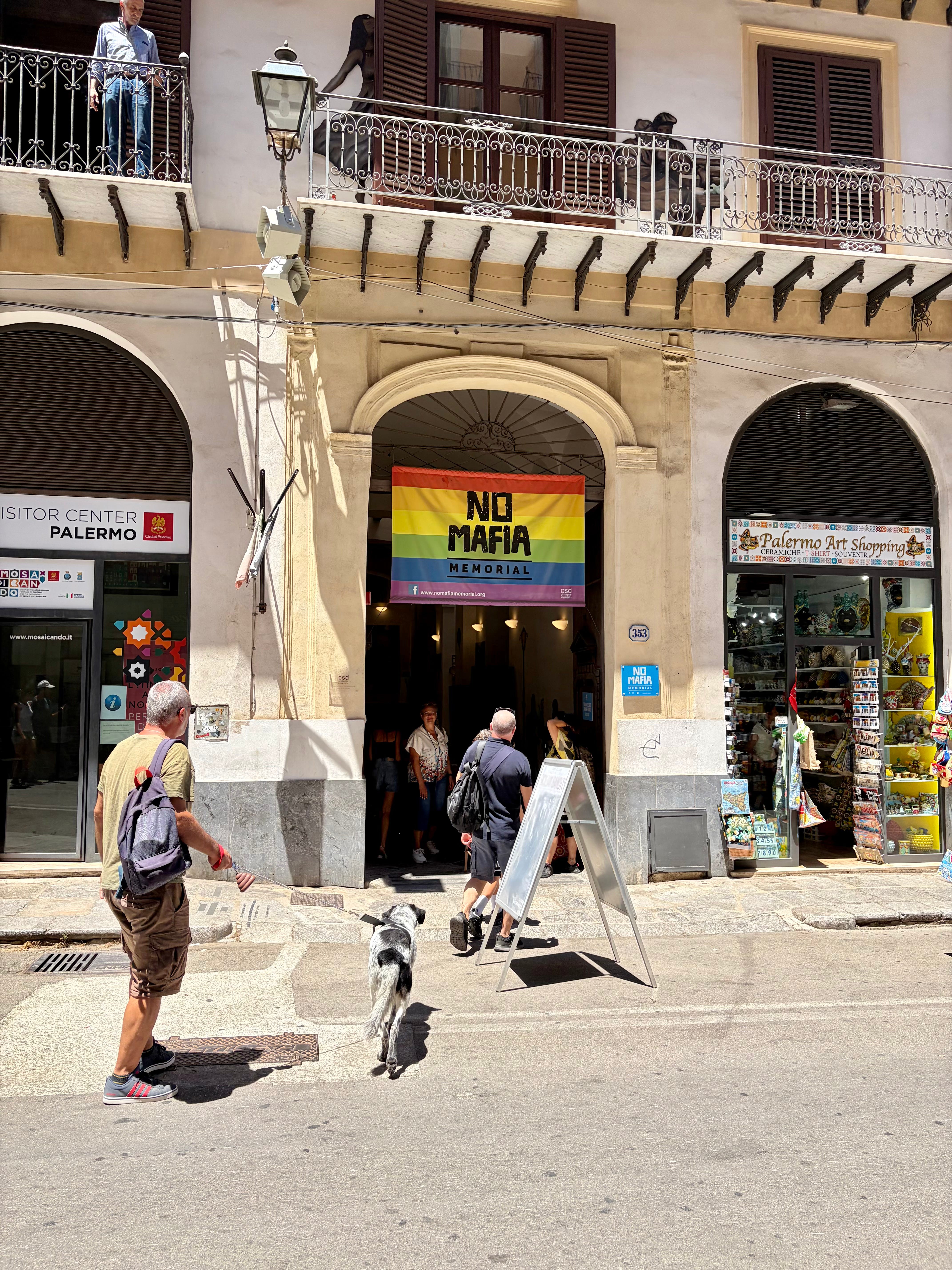
I stand at the entrance, hesitating to go in. Meanwhile, I have a nice chat with the young woman who is welcoming visitors.
Finally, I say to her, “Would you know what I meant if I said the following? I’m glad that No Mafia exists for other people. But I myself don’t need it.”
For a moment, she is perplexed, but she then says, “Ah, what you mean is: you know how bad the Mafia is and don’t need to be instructed on the subject.” Yes. What’s more, I know that an engagement with the memorial would incense me.
In yesterday’s installment, I wrote, “Later in this journal, I will unload on the Mafia and all of its romanticizers and rationalizers. The Mafia are evil incarnate.”
Today, I’ve realized that I have more like a separate article to write about this. If I began, it would take over, and overwhelm, this final installment of my journal.
Let me record this, however: I tell the young woman at No Mafia that I remember very well the murders of Falcone and Borsellino. These murders were committed before she was born.
Giovanni Falcone and Paolo Borsellino were judges from Palermo—incredibly brave. They devoted themselves to upholding the rule of law in their city. The Mafia murdered Falcone on May 23, 1992, and murdered Borsellino about two months later, on July 19.
The murder weapon in each case was a car bomb. While murdering Falcone, they also murdered his wife, Francesca Morvillo, who was also a judge. In addition, they murdered three police officers assigned to protect the couple: Rocco Dicillo, Antonio Montinaro, and Vito Schifani.
While murdering Borsellino, they also murdered five officers in his security detail: Agostino Catalano, Walter Cosina, Vincenzo Li Muli, Claudio Traina, and Emanuela Loi.
The last of these was the first Italian policewoman to be killed in the line of duty. She was 24.
I could go on but should stop.
***
I’m glad to see a high school—a liceo scientifico, a science academy—named after Benedetto Croce. He was an interesting liberal, and Liberal: a member of the Italian Liberal Party, now defunct. Indeed, for three years he was the leader of it. Croce was a philosopher, a historian, a politician—all those things.
***
I am very, very glad to see a street named after Abraham Lincoln.
***
And I’m amused to see Via delle Case Nuove—“Street of the New Houses.” I wonder how old those houses are. I think of New College, Oxford—founded in 1379.
***
The Teatro Massimo is the largest opera house in Italy. Let’s have a quick look:
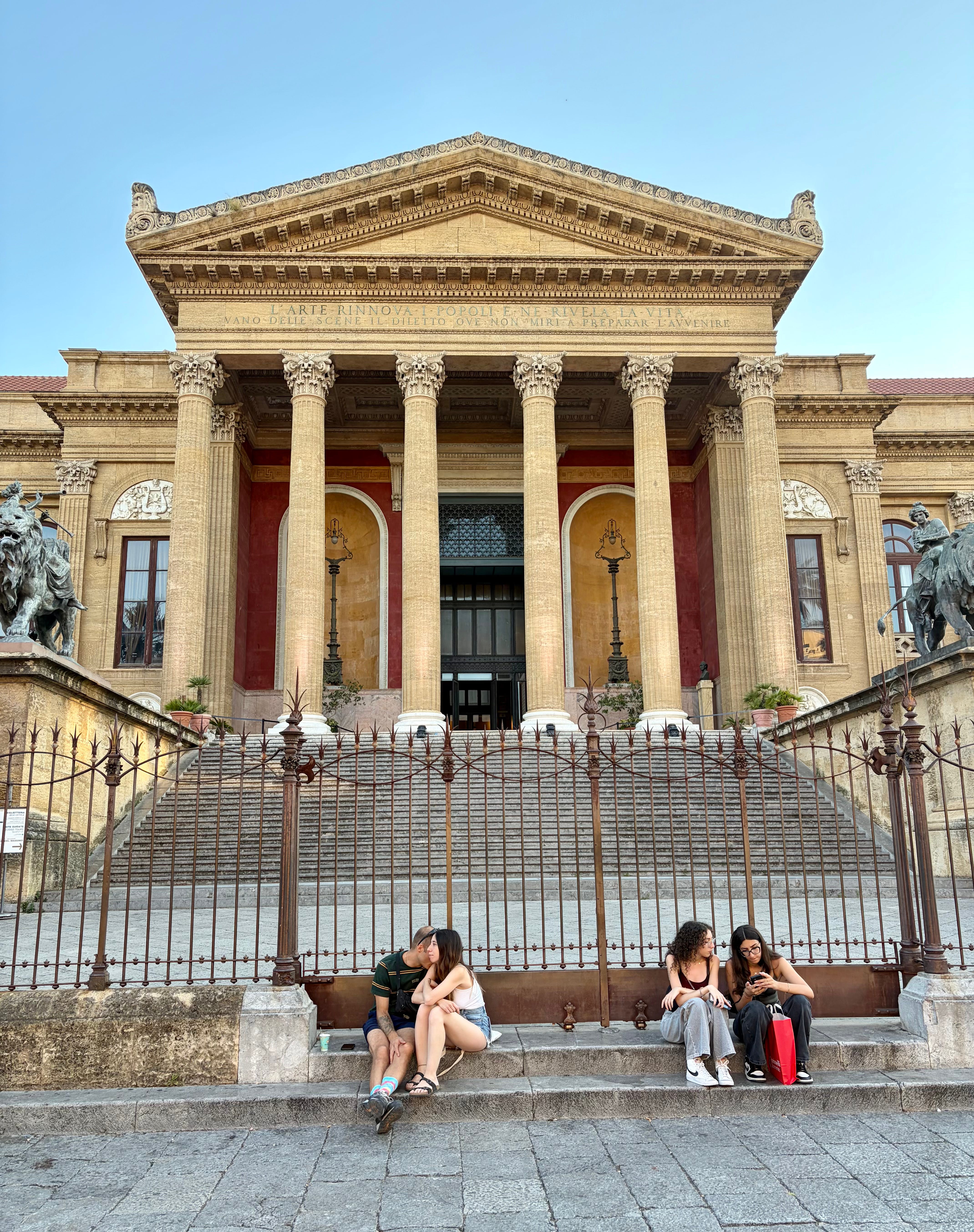
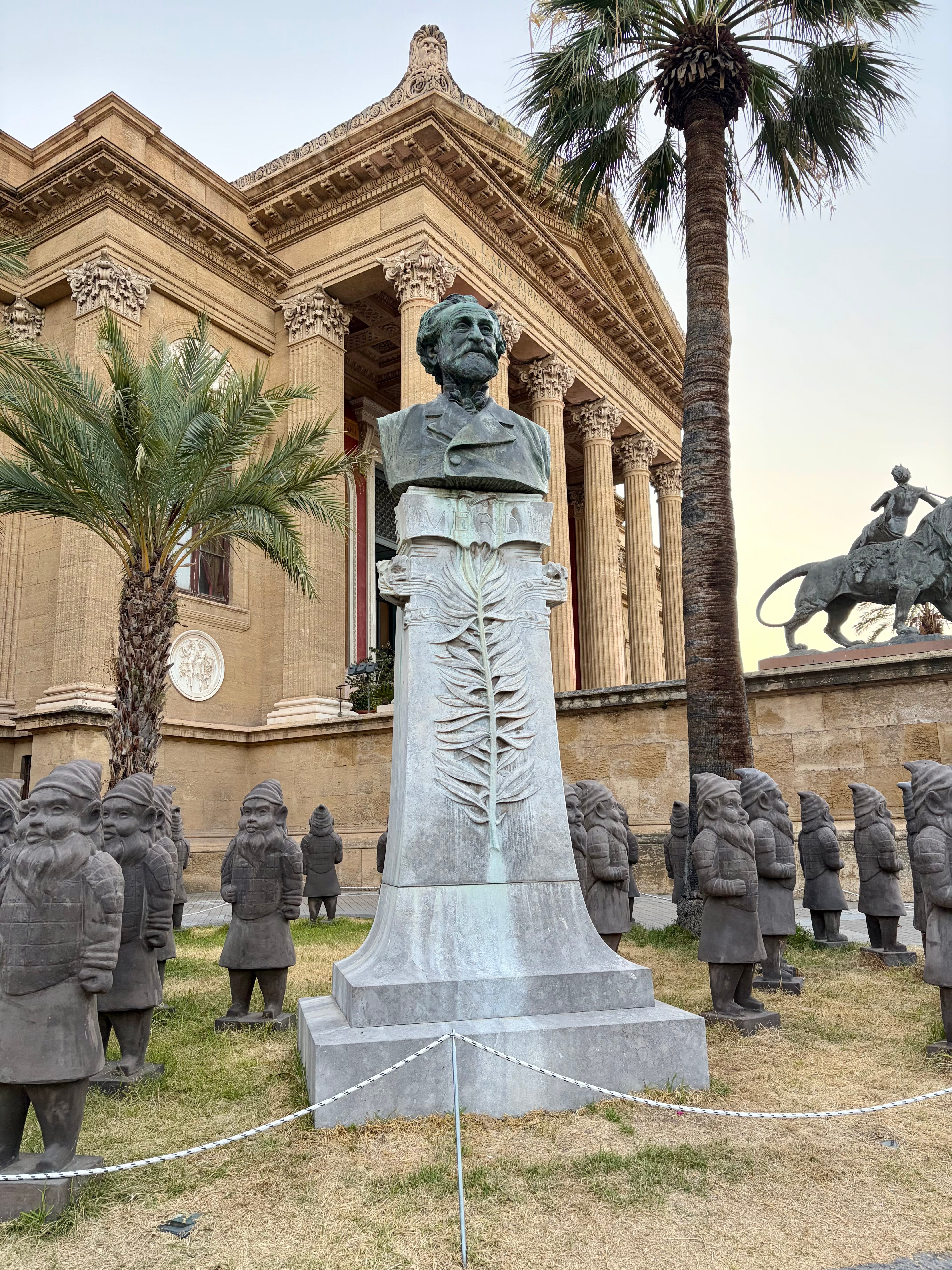
The house opened in 1897, with a performance of Verdi’s Falstaff. Later in that season, Enrico Caruso sang (in Ponchielli’s Gioconda). The house is located on Verdi Square, and a bust of the composer is on the grounds. Who those little fellows around him are, I’m afraid I can’t tell you:
The Teatro Massimo was closed for 24 years—1974 to 1997—because of the Mafia and its wicked influence. It reopened in time for the centennial. On that occasion, the Berlin Philharmonic played a concert, conducted by Claudio Abbado.
Said Abbado, “Reopening is important for music in Palermo, in Italy, in Europe, and in the world.” But there was a lot more, for him.
“What I wish to remember most is that my mother was a palermitana”—a native of Palermo—“and now I can be proud to say that. For the last 24 years I was ashamed to say that, because the Mafia had covered Palermo with shame.”
On this particular night, I’m attending a concert that features the Teatro Massimo’s chorus. (Review at The New Criterion to follow.) One member of that chorus is Enrico Caruso—I kid you not. That’s the man’s name. He is a bass, rather than a tenor.
***
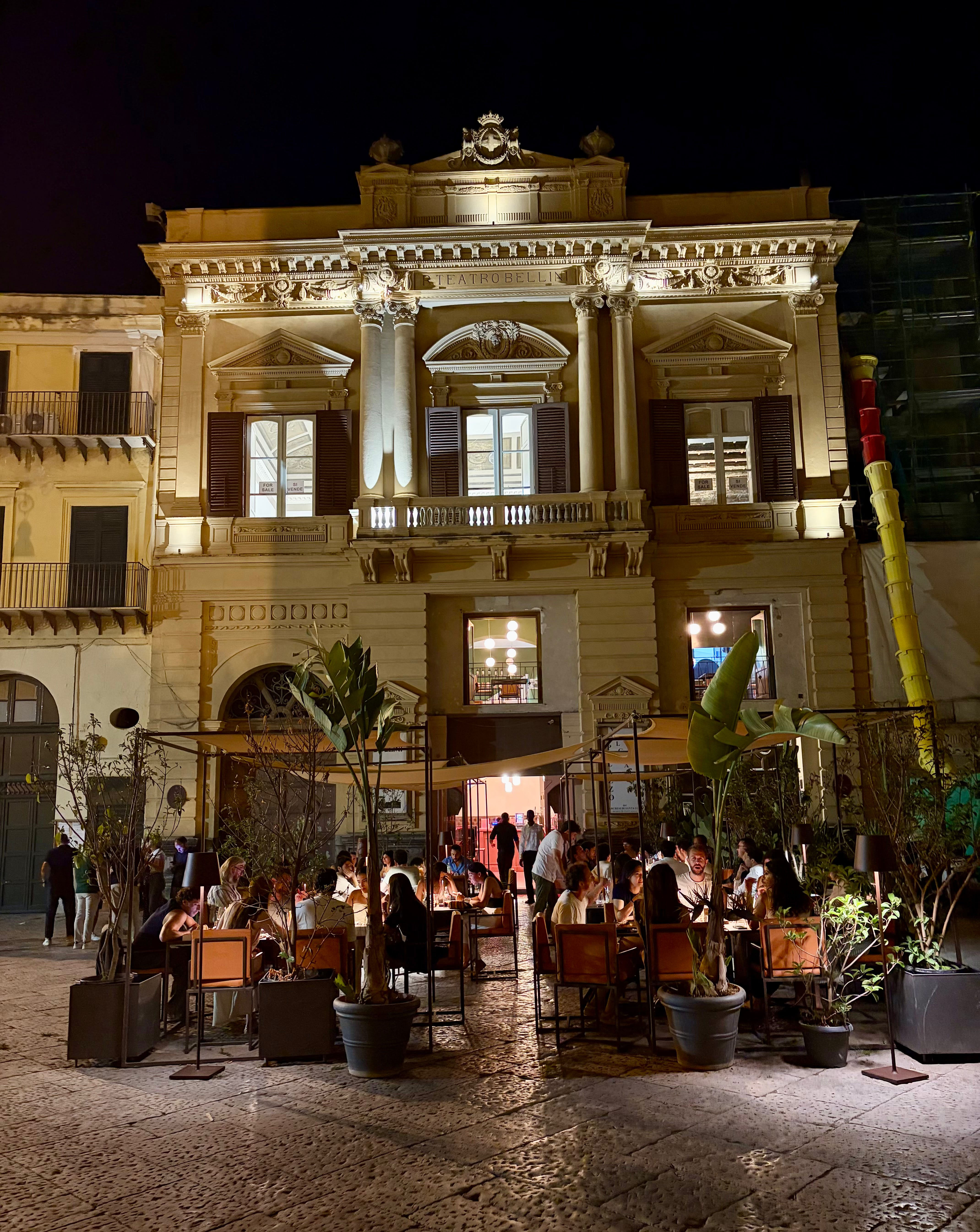
A night scene, with diners al fresco:
***
Early the next morning, women on balconies empty their cleaning buckets down onto the streets. Palermitane must have been doing this for … how many years? Centuries?
***
A couple of men, shirtless and paunchy, cast fishing lines into the marina. They have their rod in one hand and a cigarette in the other.
***
I head for the Palermo airport—which is called “Aeroporto Falcone Borsellino,” in honor of the martyred judges.
***
My friend Anthony Daniels, the British writer, says that he likes being a foreigner. He has traveled all over and has frequently lived abroad. For one thing, he says, the problems of other countries don’t bother you as much as the problems of your own. You can view them with a certain detachment.
I know just what he means.
***
In my month here, people have been very kind to me—Italians from Milan way down to Reggio Calabria, and then over and down into Sicily. They have been patient with my Italian, helpful with logistics, generous with information. I’m talking about men and women, old and young.
I am grateful. And to you, my friends and readers. Thank you.
What a pleasure to have read your journal. It reminds me that my wife and I need to make one more visit while the bodies will still tolerate it!
Jay - loved your Italy journal. I've enjoyed your travel diaries for years, and this journal is one of your best. I wish you were traveling around (and continuing to write about) Italy for the rest of the summer. The photos are great, and each Part has been educational, entertaining and very interesting. They have been the first email I look for each morning. Thank you!