


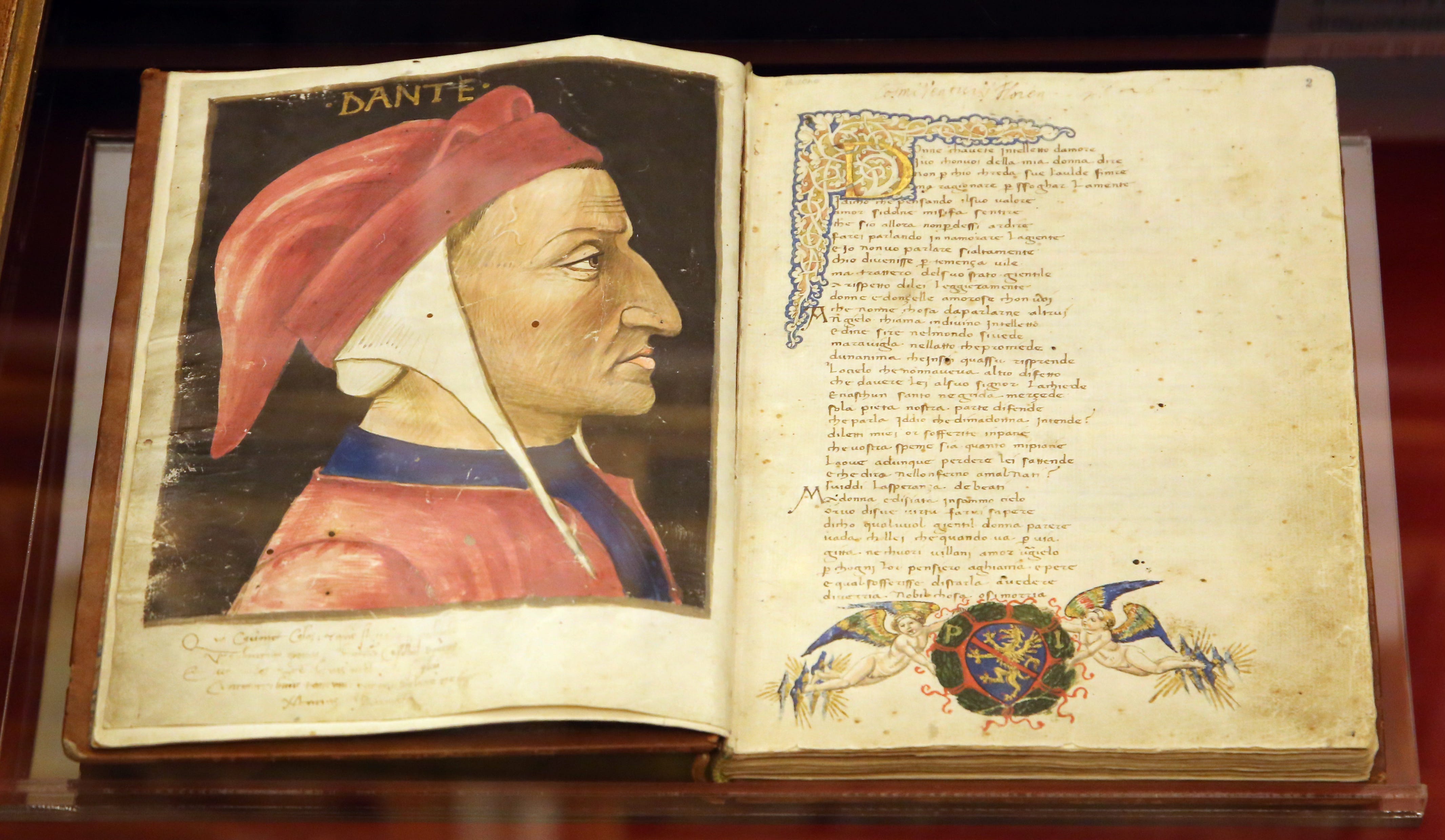
Dear readers: The previous parts of this journal can be found at the following links: I, II, III, IV.
One thing that draws a person to Ravenna is Dante. But wasn’t Dante from Florence? Wasn’t he a proud, archetypal Florentine? Yes, but he was forced into exile and spent his last years in Ravenna.
***
In the center of town, there is a restaurant called “Mr. Dante.” I am not translating. That’s its name: “Mr. Dante.”
***
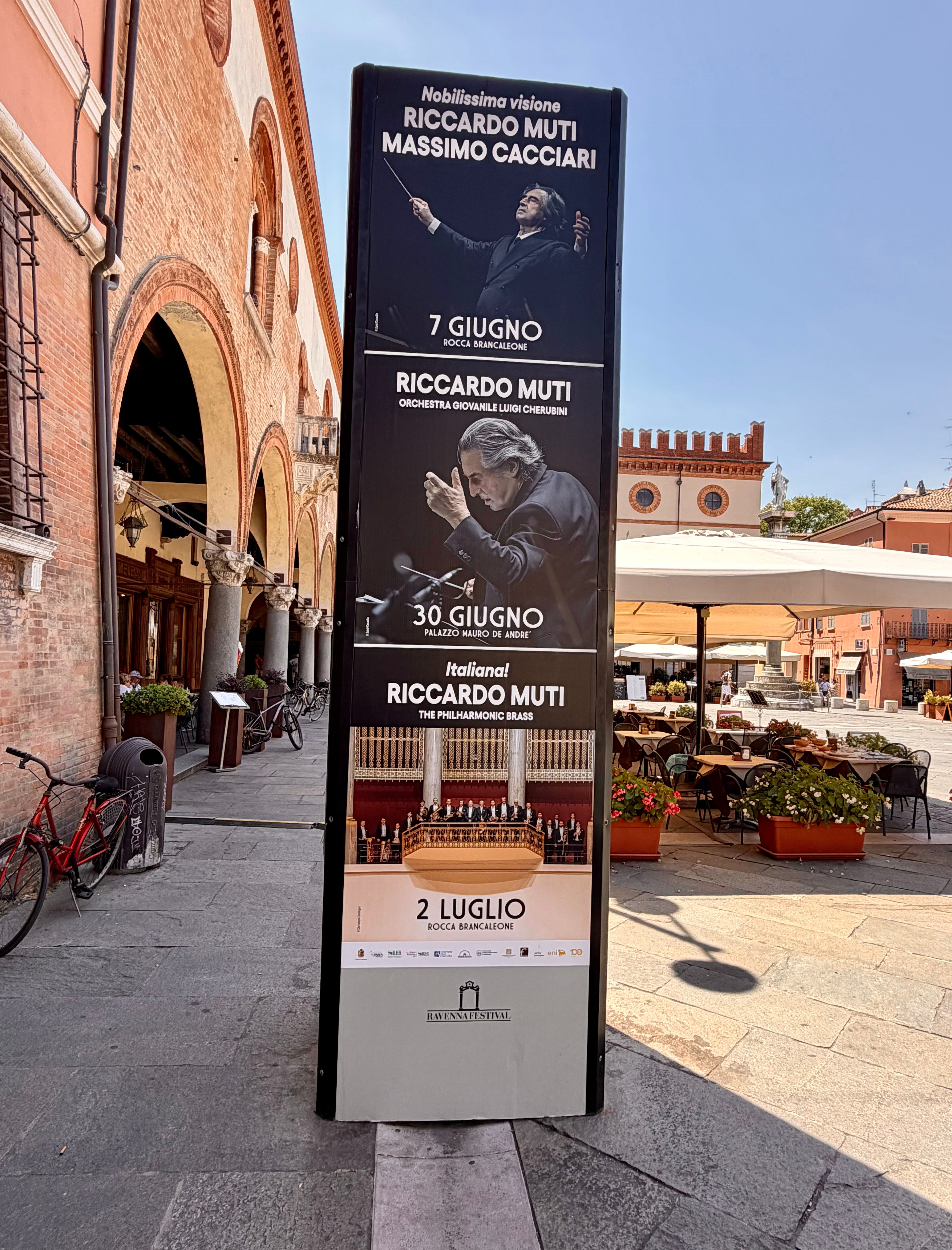
A leading citizen of Ravenna now is Riccardo Muti, the great conductor. He is from southern Italy, but has chosen to make Ravenna his home. That is, Ravenna is where he’s based between engagements.
Like Mr. Dante, this is in the center of town:
***
At the hotel where I’ll stay, the clerk is familiar with my hometown, Ann Arbor, Michigan. One of his friends played for the University of Michigan football team in the early 1980s: Jerry Diorio.
I’ll be darned. Small world.
Jerry died in March of this year. For an obit, go here.
***
In Part I of this journal, I gave a line-up of great Italians—including, of course, Galileo Galilei. “Incidentally,” I said,
Galileo was not merely one of the greatest scientists in history (“merely”!). He stands as a shining example of conscience: of the refusal to surrender right for wrong.
You know, I should have said the same of Dante Alighieri. Yes, he was one of the greatest literary artists in history. But also, he stands as a shining example of conscience.
I will not recap his life, but I will offer a few lines. In Florence, Dante was a politician and diplomat. He got on the wrong side of the Pope and others. They banished him from Florence, threatening death if he returned.
Later, they invited him back, but only if he would confess guilt, pay a fine—abase himself. He said, Hell, no, I’ll stay in Ravenna.
Dante was in his mid-thirties when he was banished from Florence. He wandered from one place to another, in his exile, before settling in Ravenna. He broadened—mentally, emotionally, geographically …
If he had been allowed to proceed with his life in Florence, he probably would have remained a political and diplomatic figure. Chances are, he would not have written the Comedy.
I’m glad he did—that he was led (however involuntarily) to his true calling.
Like you, maybe, I think of what Joseph, in Genesis, said to his brothers: “You meant it for evil, but God meant it for good.” (The way King James’s translators have it is, “… ye thought evil against me; but God meant it unto good …”)
Anyway, a few paltry lines, as promised. You might enjoy delving into fuller accounts.
***
Here in Ravenna, there is an entire “Dante zone”—a “zona dantesca.” And a sign bids that there will be silence—a respectful silence—in this zone.
***
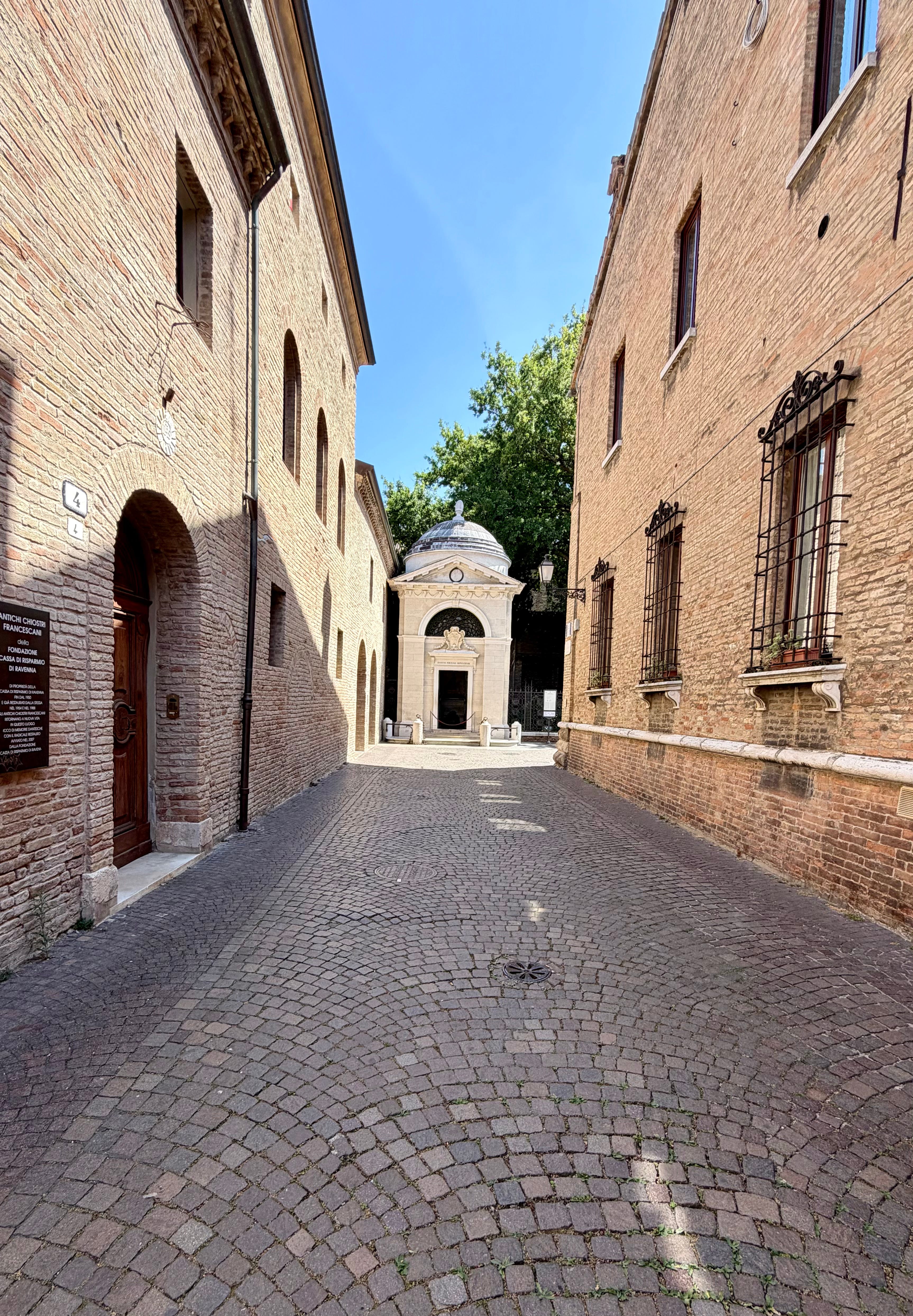
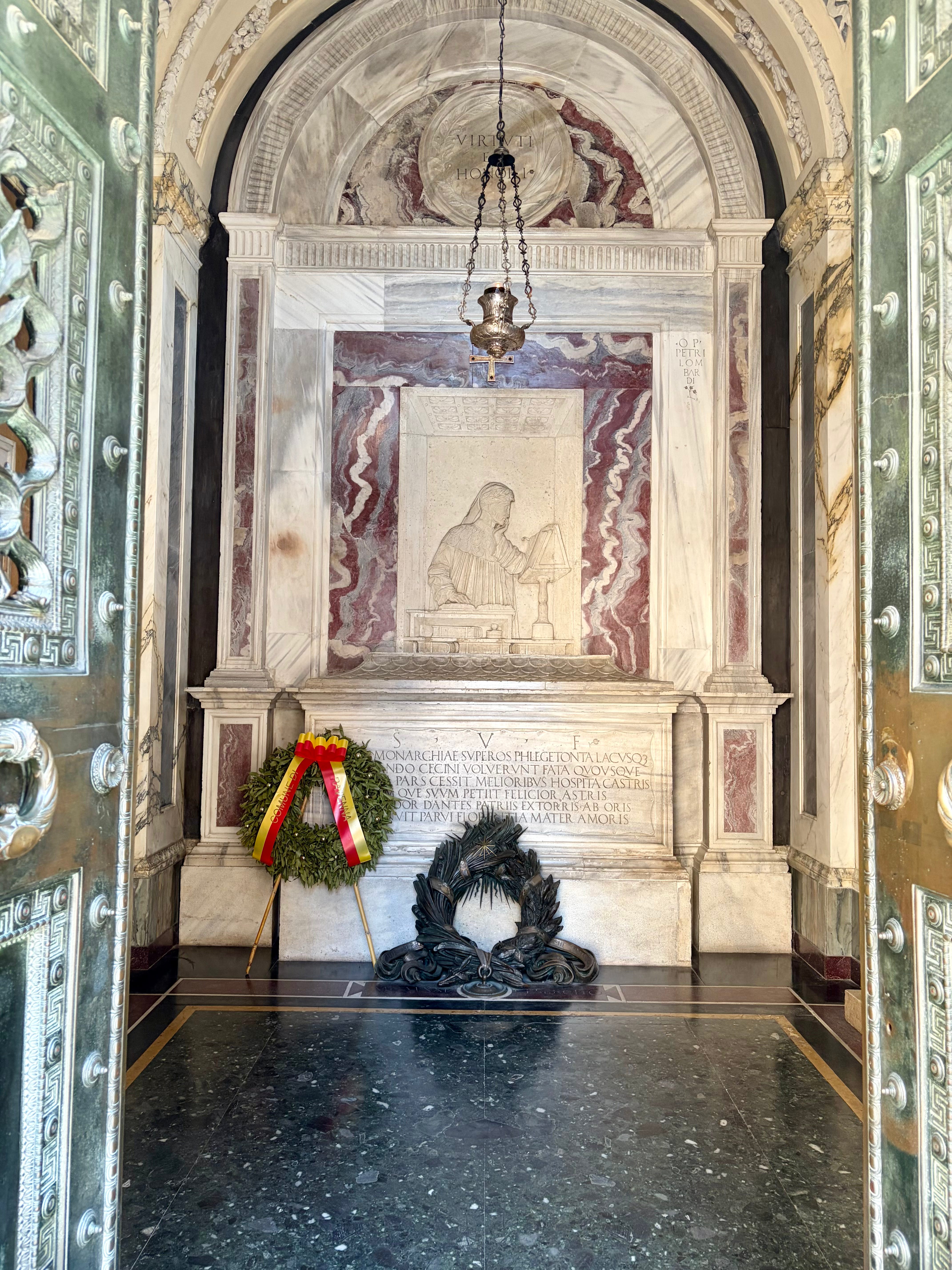
The poet’s tomb—or rather, the run-up to it:
Up close:
***
In a museum, there are many objects and artifacts, including a kind of plaque given by the Dante League of America in 1921—the 600th anniversary of the poet’s death.
A few blocks from me in New York is Dante Park, which has a towering statue of this towering poet. The park opened that same year, 1921.
The 700th anniversary was just a few years ago—2021. You know, I don’t remember much, Dante-wise. Maybe we were still caught up in the pandemic?
Maybe it relates to a diminished interest in high culture, including literature?
Dunno.
***
Ravenna, here in the Dante zone, holds a perpetual reading, a lettura perpetua. The cantos are cycled through, evening after evening. At 6 o’clock, a canto is read aloud. (Let me note that 6 is the starting time from April through October. In the other months, it’s 5.) The readers are various and sundry. Each reading is livestreamed, too. This is a ritual—an edifying rhythm in life, I would say.
On only one day of the year is there no reading: Christmas Day.
The evening I attend, two women, taking turns, read “Paradiso” XXXI.
***
I think back to Oscar Büdel, with whom I studied the Comedy (in my not very rigorous fashion, I’m sorry to say). He was a real scholar, with real training—a bona fide dantista.
Born in Germany, Professor Büdel was in the Luftwaffe and held as a POW in Italy. Remarkable story. I would like to ask him about it, today. (He died in 2001.)
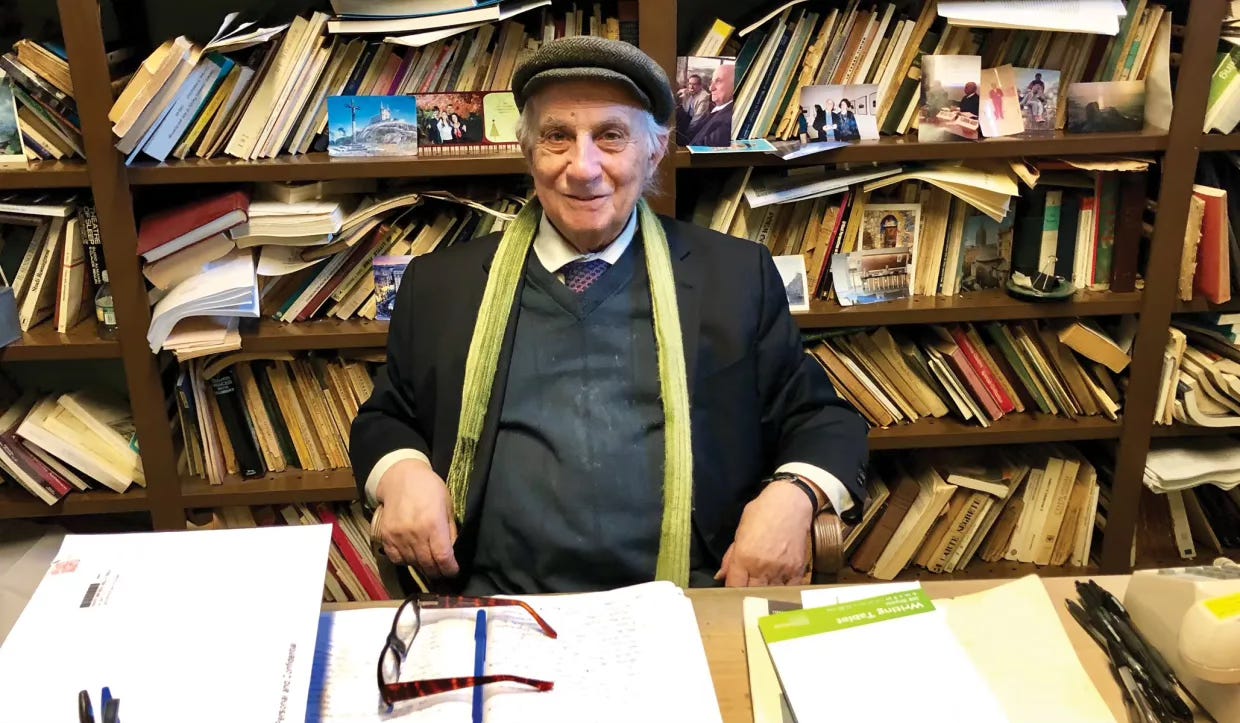
I also think back to Dante Della Terza, whom I went to see in 2018, when he was 94. He was a dantista of legend. I wrote a piece about him, titled “Dante and Dante: The tale of two lifelong companions.”
Maybe I could paste a quick portion:
Up in Widener Library, I ask Della Terza, “What would you ask Dante, if you could meet him? Any mysteries you would like cleared up?” Della Terza thinks for a moment and says, “I would ask for forgiveness. We do not have the knowledge of him that he deserves.”
Maybe just a little more, from my piece:
How many times has he read the Comedy? Hundreds? Many hundreds? Della Terza sort of shrugs and smiles. I then ask how much of the poem he ever memorized. (There are 14,233 lines.) Many cantos, he says. It was compulsory when he was a student. And then he starts, from the beginning, unbidden.
“Nel mezzo del cammin di nostra vita”—he goes on for eleven more lines, four stanzas. He recites the poem musically and dramatically. He is utterly focused and his eyes are lit up.
Maybe I can show you a photo I took of Professor Della Terza that day:
***
But, hang on, there’s another poet in town—in Ravenna, I mean. What do I see but the Hotel Centrale Byron?
(Lord Byron was a brilliant italianista, knowing the language and its literature intimately.)
***
I walk into John F. Kennedy Square. All through Italy, there are squares and streets named after JFK. His murder in 1963 had an impact.
***
In front of schools, I see a sign that says, “This school repudiates war.” Wonderful. A fine sentiment. But who can fail to think of Trotsky? “You may not be interested in war, but war is interested in you.” “You may repudiate war, but bear in mind: war may not repudiate you.”
***
Not changing the topic entirely—there is a memorial listing Holocaust victims, beginning with Hilde Fanny Abraham and ending with Massimo Zamorani.
***
I can tell you that Mr. Dante serves a delicious lemon cake—called in Italy “torta della nonna,” or “Grandma’s cake.” I note how small the slice is, comparatively. Compared with what?
Well, I come from America. And being abroad makes me realize how large our portions have become. When I see a muffin in a European café, I think, “Ah—I remember when our muffins were that size.”
Been a while.
***
I like a phrase, spotted in a pizzeria: “magra margherita.” “Skinny margherita”—that is, a narrow, narrow slice of that kind of pizza.
“Magra margherita” has the charm of alliteration.
***
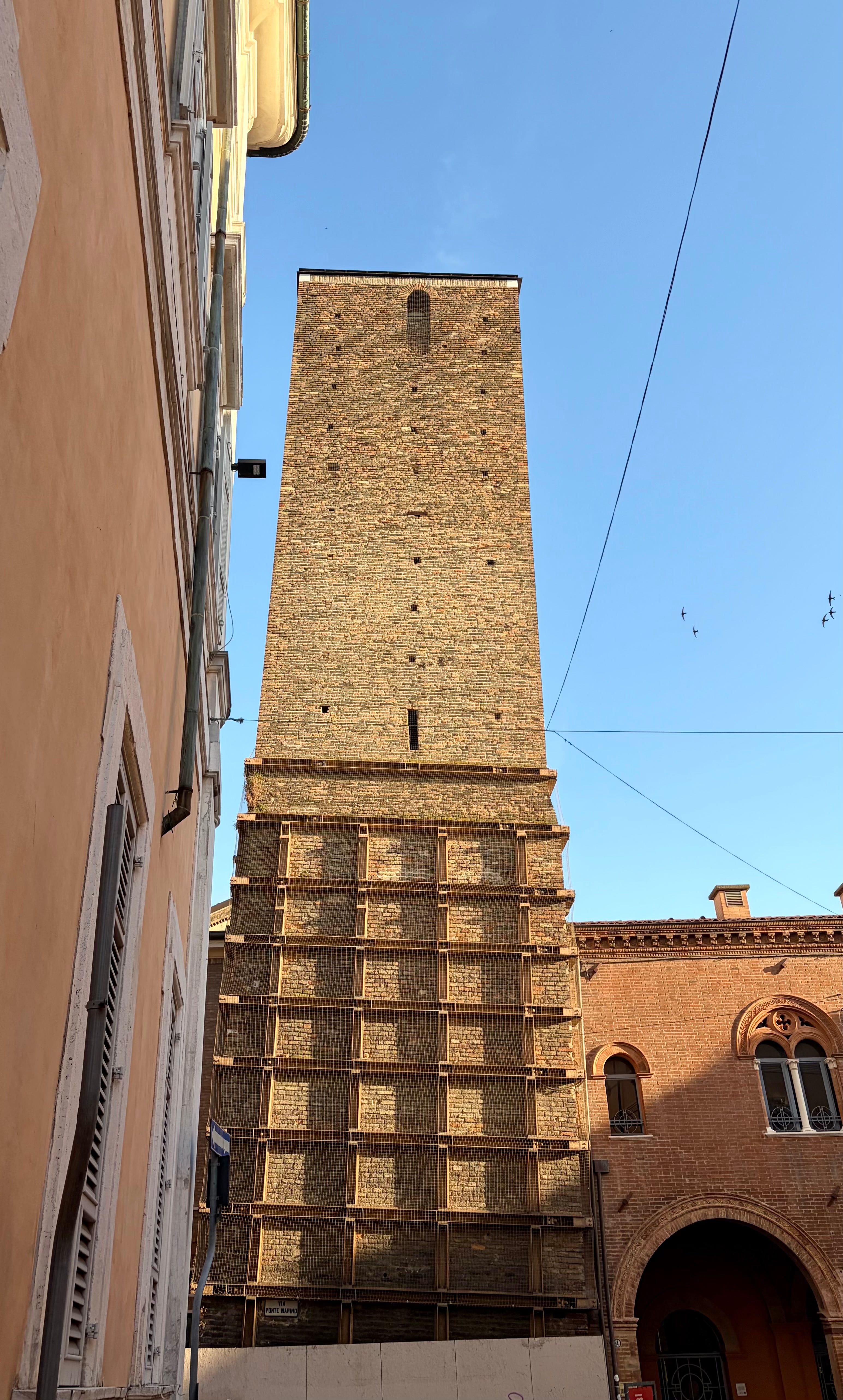
Wait a second now, isn’t the Leaning Tower in Pisa? What is this leaning in Ravenna?
It is the Torre Civica, or Civic Tower. Twelfth century. Hang in there, torre!
How I do love me some Jaywalking with a morning cup of Joe to know life is still beautiful in spite…of the political world flipped upside down. Who woulda thought that the same Papacy threatening a good man…would over a half a millennia later…not have anything threatening to say about the worlds most powerful man, psycho killer, residing on a plot of land Christopher Columbus actually thought was the India…and that the Pope would be born and raised on the other side of the globe. Can Pope Leo please grow like Meloni and and condemn this Idiocracy to Dante’s cold circle in hell. Salud…Gotta run on. Thanks for taking my morning jolt. Peace through superior mental firepower…in this school of thought we repudiate stupidity
Ah, the Immortal Dante. Thanks so much for working Ravenna and Dante into your travelogue.
Calvin Coolidge spent a lot of time and trouble translating (presumably portions of) The Divine Comedy.and gifted his translation to his lovely wife Grace.
Just one other good reason to choose Calvin Coolidge as your favorite President (which is not the same as choosing him as our greatest President).