


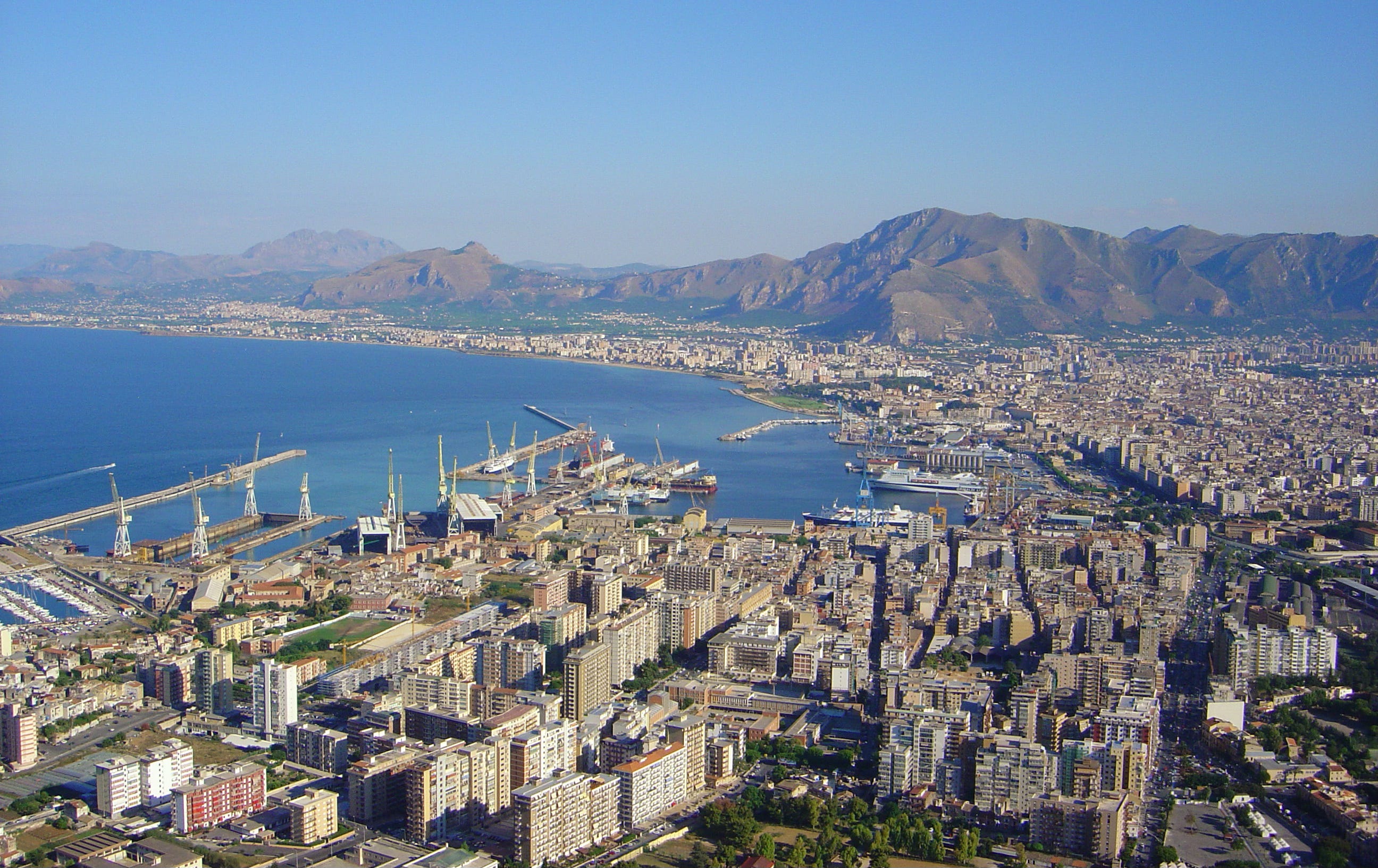
Dear readers: The previous parts of this journal can be found at the following links: I, II, III, IV, V, VI, VII, VIII, VIX, X, XI, XII, XIII, XIV, XV, XVI, XVII.
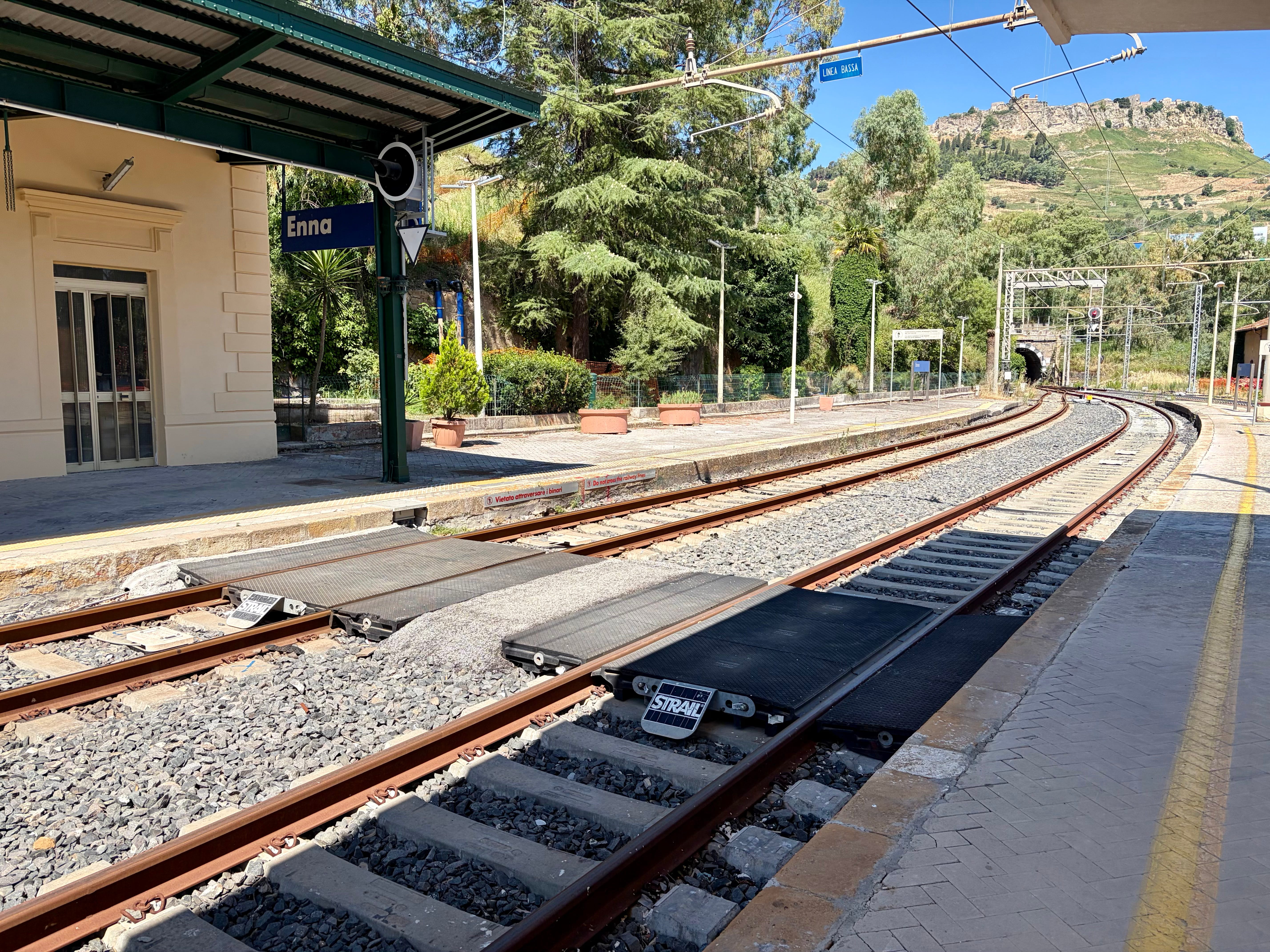
All over Italy, announcements in train stations say the same thing: Don’t cross the tracks. Whatever you do, don’t cross the tracks. The announcements are near constant. First they are in Italian, then in English: Don’t cross the tracks!
You are to take an underground passageway instead.
Except in Enna, here in the middle of Sicily. At Enna, you cross the tracks. There is no underground passageway. I can tell you that it feels very, very weird to cross train tracks after you have had almost a month of announcements—in two languages—telling you: You’d better not.
Care to see a picture of the track situation at Enna?
***
To get to Palermo from Enna, you switch trains at Caltanissetta Xirbi. That second word, that second name, is strange, right? There is no “x” in the Italian alphabet at all. This is pure dialect, or perhaps even a separate language (and delightsome to me).
Xirbi is a hamlet near Caltanissetta, population about 20. (You read that right.) I check with a conductor to be sure how to pronounce “Xirbi”—something like “Kseerbee.”
***
About Palermo, there is a mystique. The city is beguiling, dangerous, lawless, sensual, wild, wily, passionate, beautiful, ugly …
It’s all true. The one thing Palermo is not is dull—although it is capable of serenity, especially at night.
***
In Palermo, you will take in heavenly smells and foul smells. It is a place of extremes, I would say (though with a moderate middle).
***
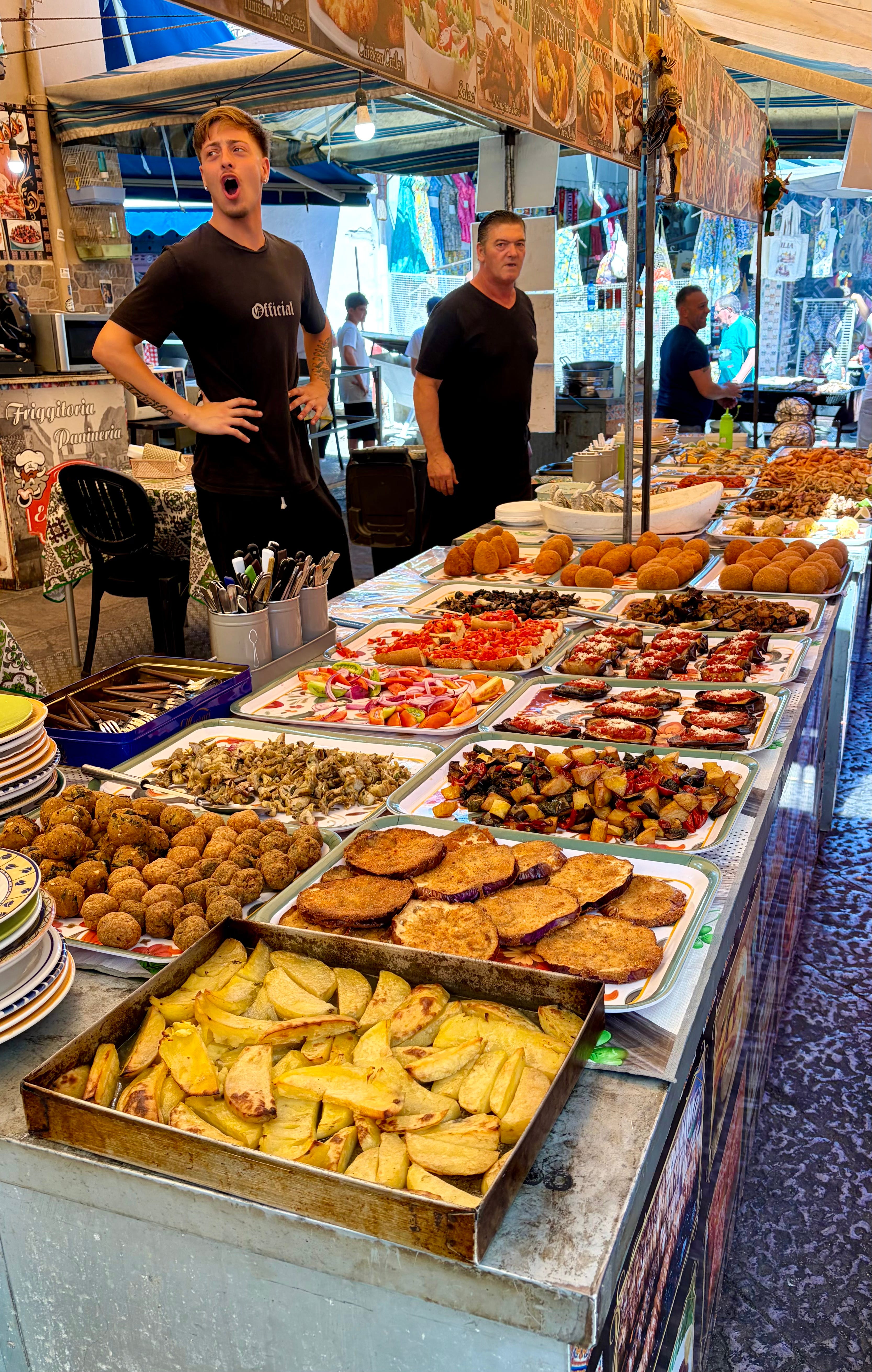
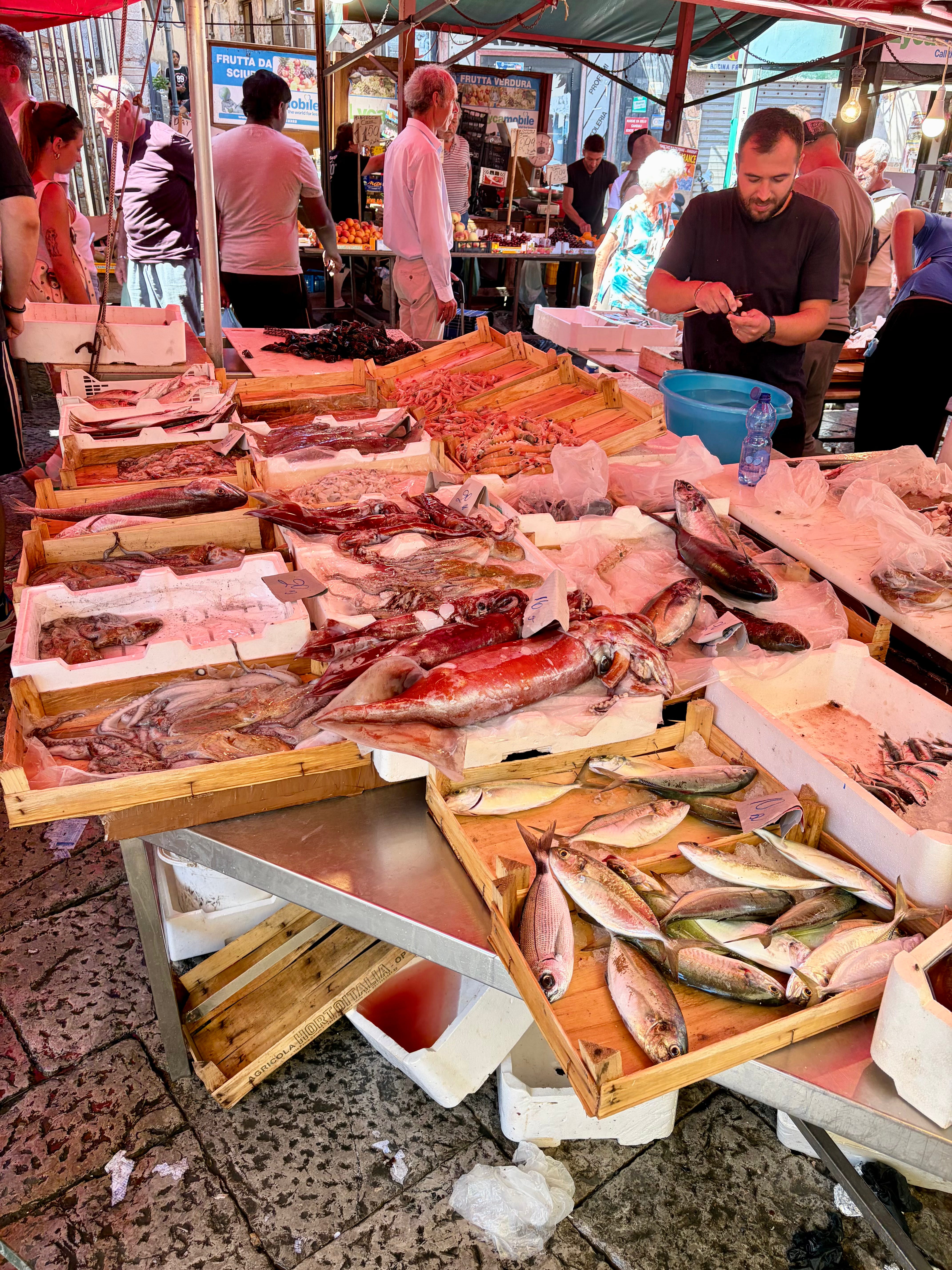
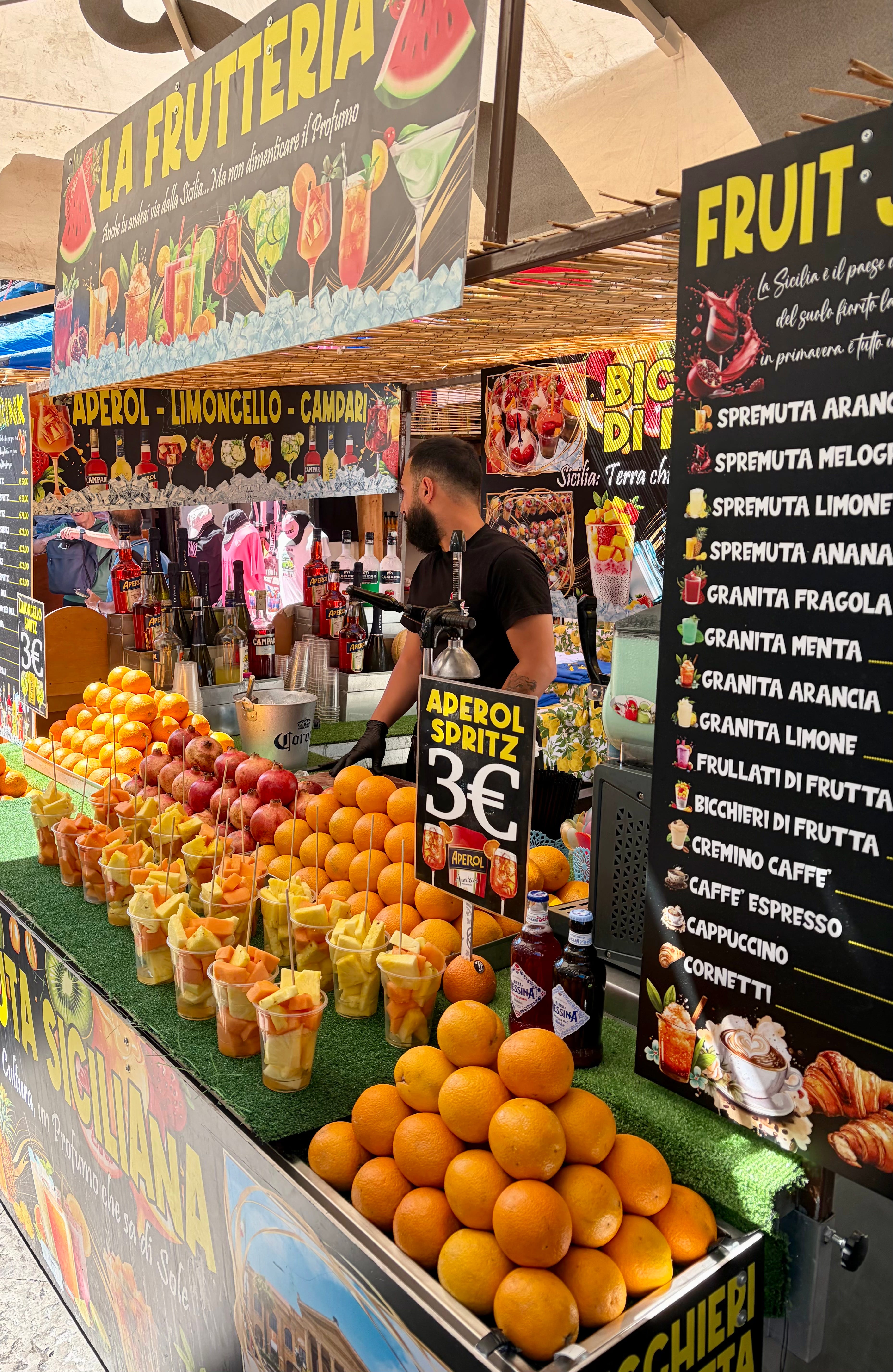
To get to my hotel, I trudge through Ballarò—the Ballarò market. It is a market, yes—an outdoor market, a street market, with endless stalls selling food. But it is also a scene, a party. Sometimes, it resembles a discotheque, with music pounding—with dancing, singing, performing.
It is loud, colorful, raucous. Video would do Ballarò more justice, but I don’t think you can post video on Substack. May I throw a few pictures at you?
***
In Palermo, there is a great variety of people—long has been (as in Sicily at large). The city is sort of an ethno-nationalist’s nightmare. There are Arabs, black Africans, South Asians, Orientals (as we said in the bad old days) …
Then there are people who are sort of American, sort of Sicilian. One vendor says something to me in pure American English. I say, “You’re an American.” He says, “Born here. But you got me: grew up in Pennsylvania.” “You sound red, white, and blue to me,” I tell him. He says, “Thanks, my man.”
***
Who’s this?
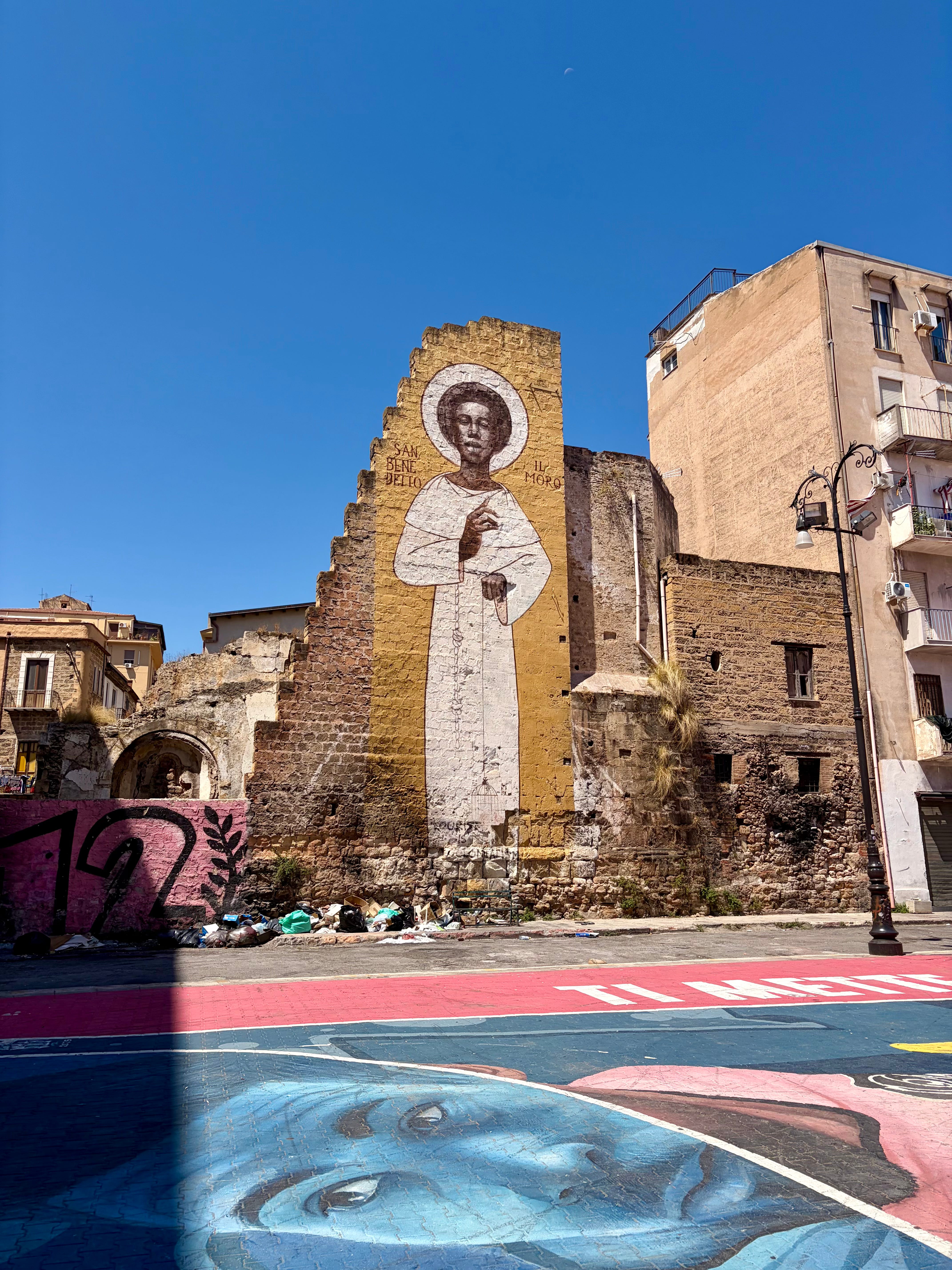
That’s Saint Benedict—a.k.a. Benedict the Moor, or Benedict the Black, or Benedict of Palermo. He lived from 1526 to 1589.
***
I see a lot of kids out playing—kicking a ball around, chiefly. I think, “These are not screen kids”—kids looking at screens. I also notice that they tend to be dark kids. I wonder whether they have phones or tablets to look at.
***
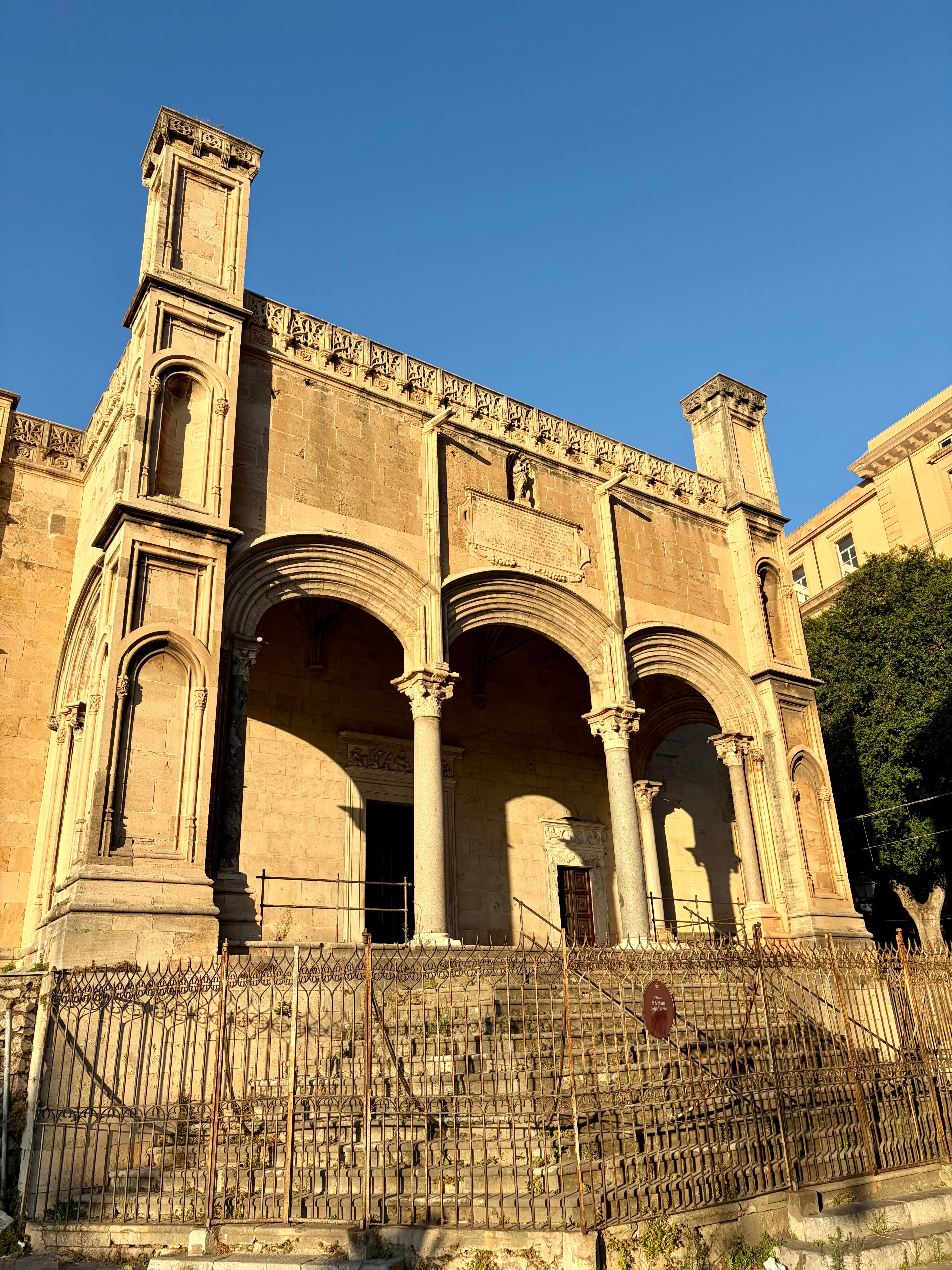
A church, bathed in light—this is Santa Maria della Catena, in the neighborhood known as “Castellammare”:
***
A typical street, with a stylish young woman walking down it—a woman with “attitude,” a woman with “swag”:
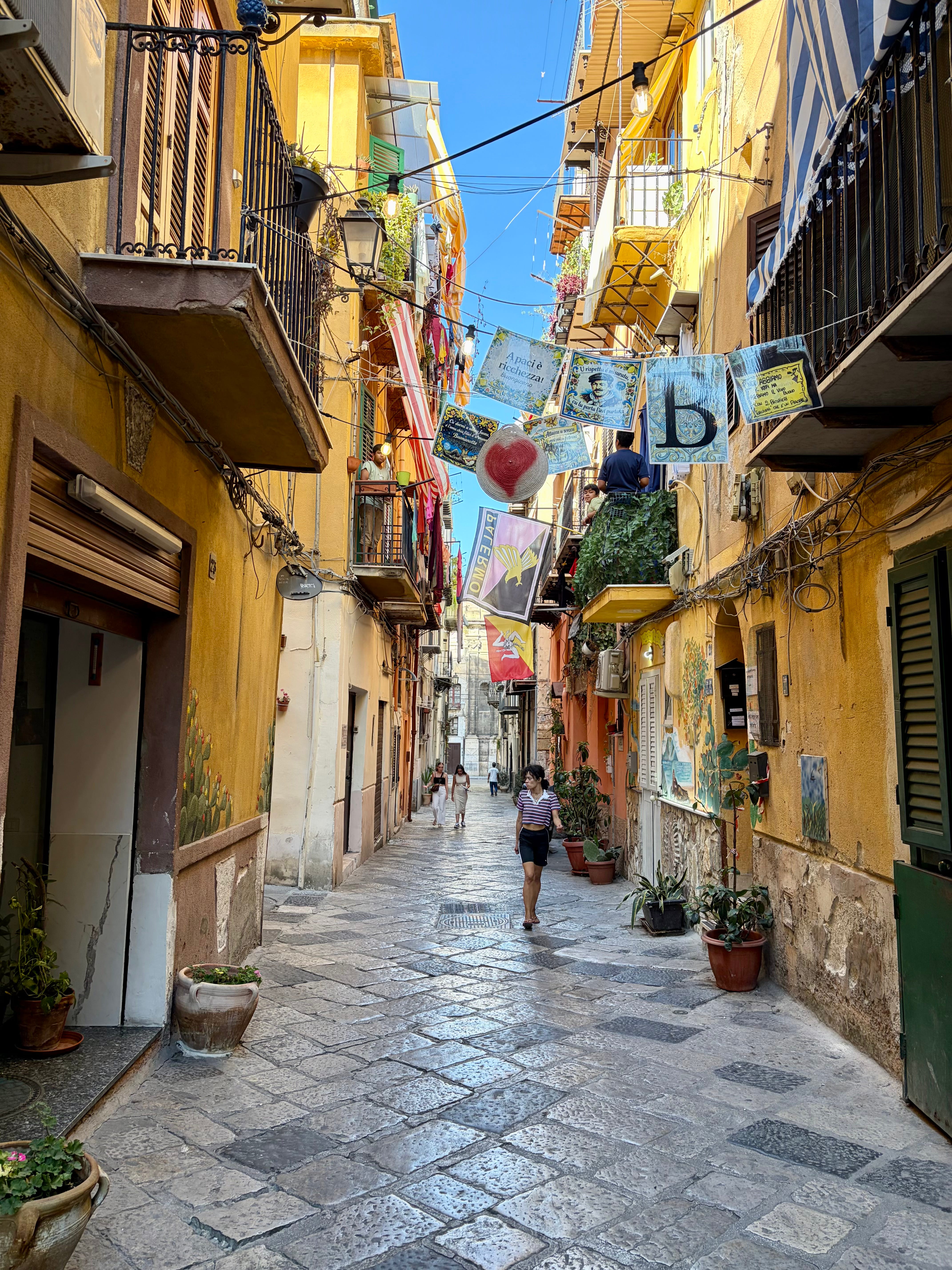
You know a song lyric: “There she was just a-walkin’ down the street.”
***
Care to see the marina? (This is toward evening.)
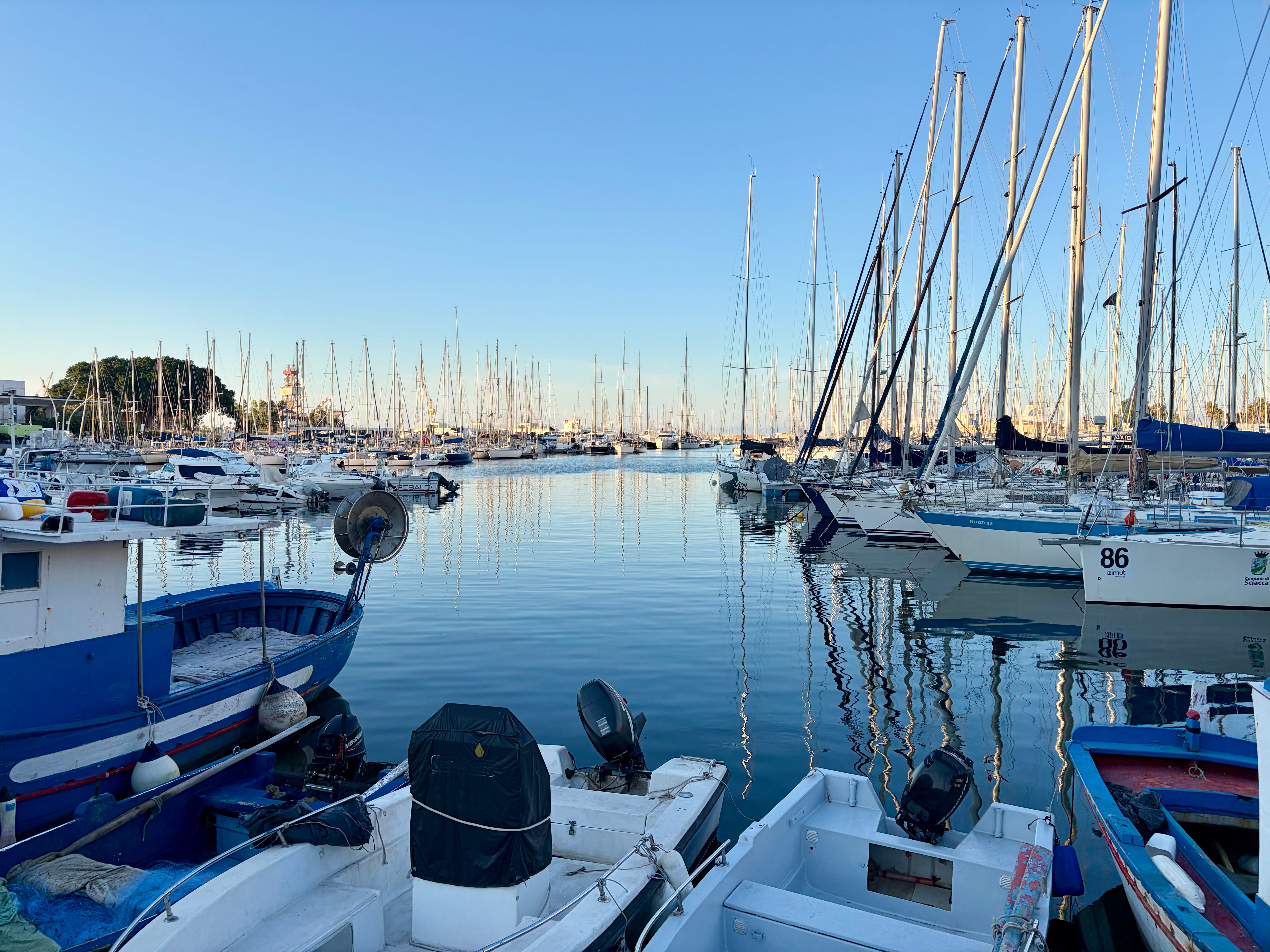
***
Some buildings are simply decayed—but you can imagine them as they were, and you can imagine them rejuvenated:
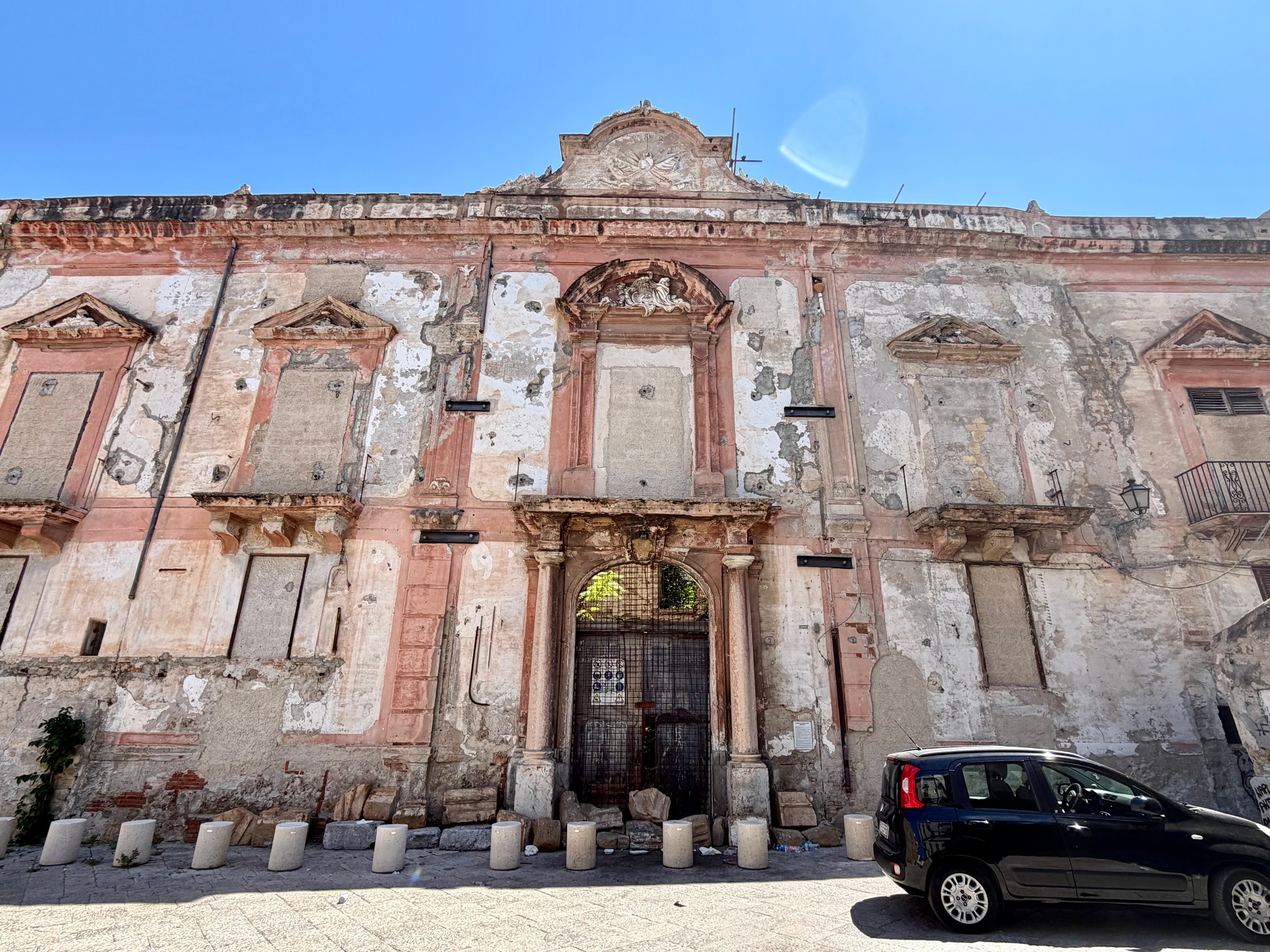
***
We are in the world—part of the world—of The Leopard, the novel by Lampedusa—Giuseppe Tomasi di Lampedusa—written in the mid 1950s. I have commented on this novel in several articles over the years—this one, for instance.
***
An old park is called “Piersanti Mattarella Park.” Well, I am thinking like an American when I say “old”—it was built in 1851. It was called the “Giardino Inglese,” the “English Garden.”
One man honored in the park, with a bust, is Pirandello—Luigi Pirandello, the versatile writer who in 1934 won the Nobel prize. Two of my professors, years back, devoted a fair amount of their careers to Pirandello. When people you esteem, esteem someone else—you sit up and pay attention to that someone else.
I want to show you a bust of Garibaldi, in the foreground, and then comment on the bust behind him and to the left:
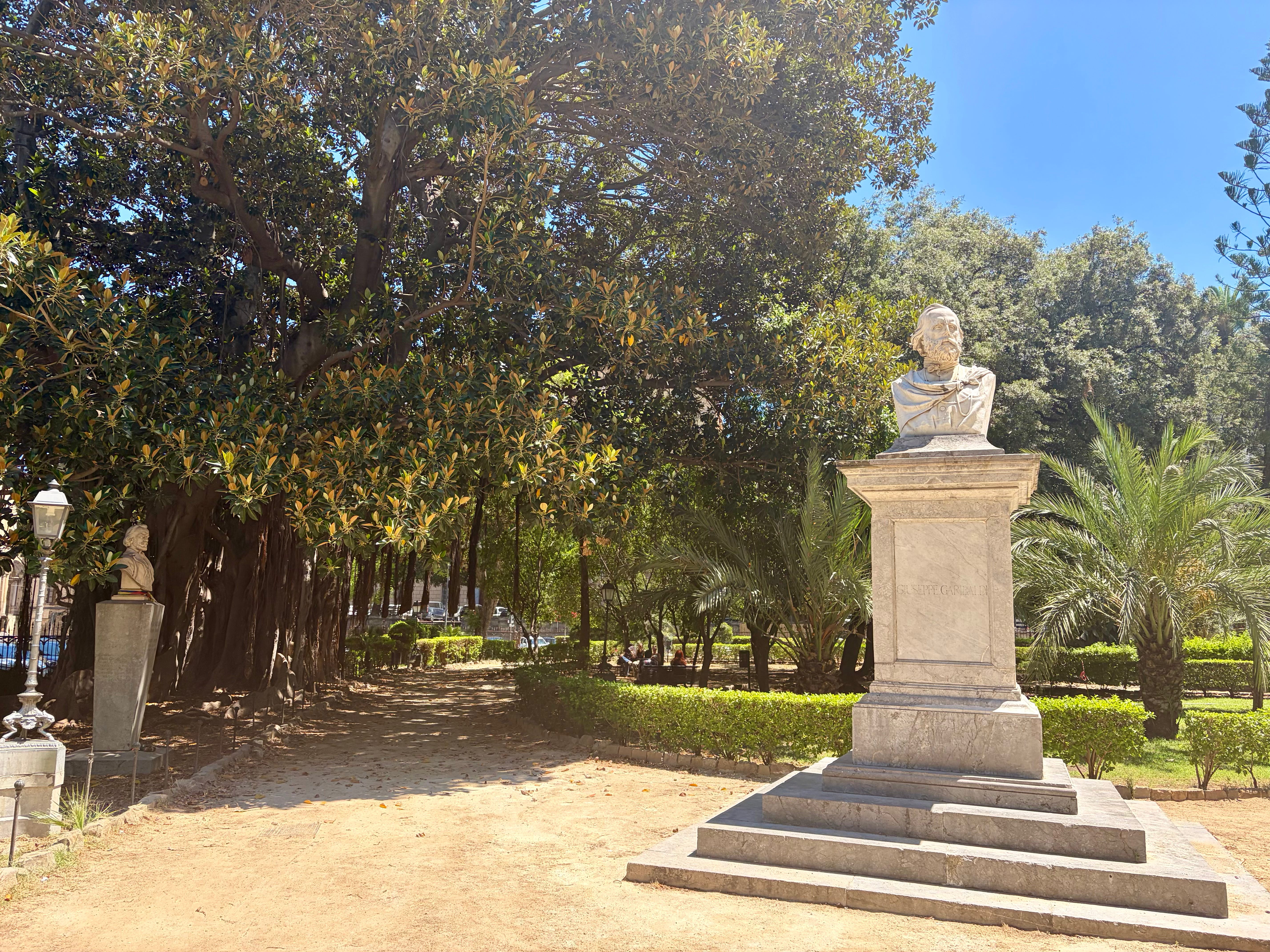
The latter bust is of Nicolae Balcescu, a Romanian who lived in the first half of the 19th century. What was he? Many things: solider, political leader, historian, journalist. He is associated with the Wallachian Revolution of 1848. On the run and in exile, he died here in Palermo at 33.
On the day I visit the park, someone has left a banner and a wreath in Romanian colors at the monument. I have noticed several Romanian visitors in town.
A fountain in the park doubles as a turtle pond. The all-knowing Internet tells me that these turtles are yellow-bellied sliders. (“Yellow-bellied” is commonly an epithet.) There are also huge, primitive-looking banyans—here’s one:
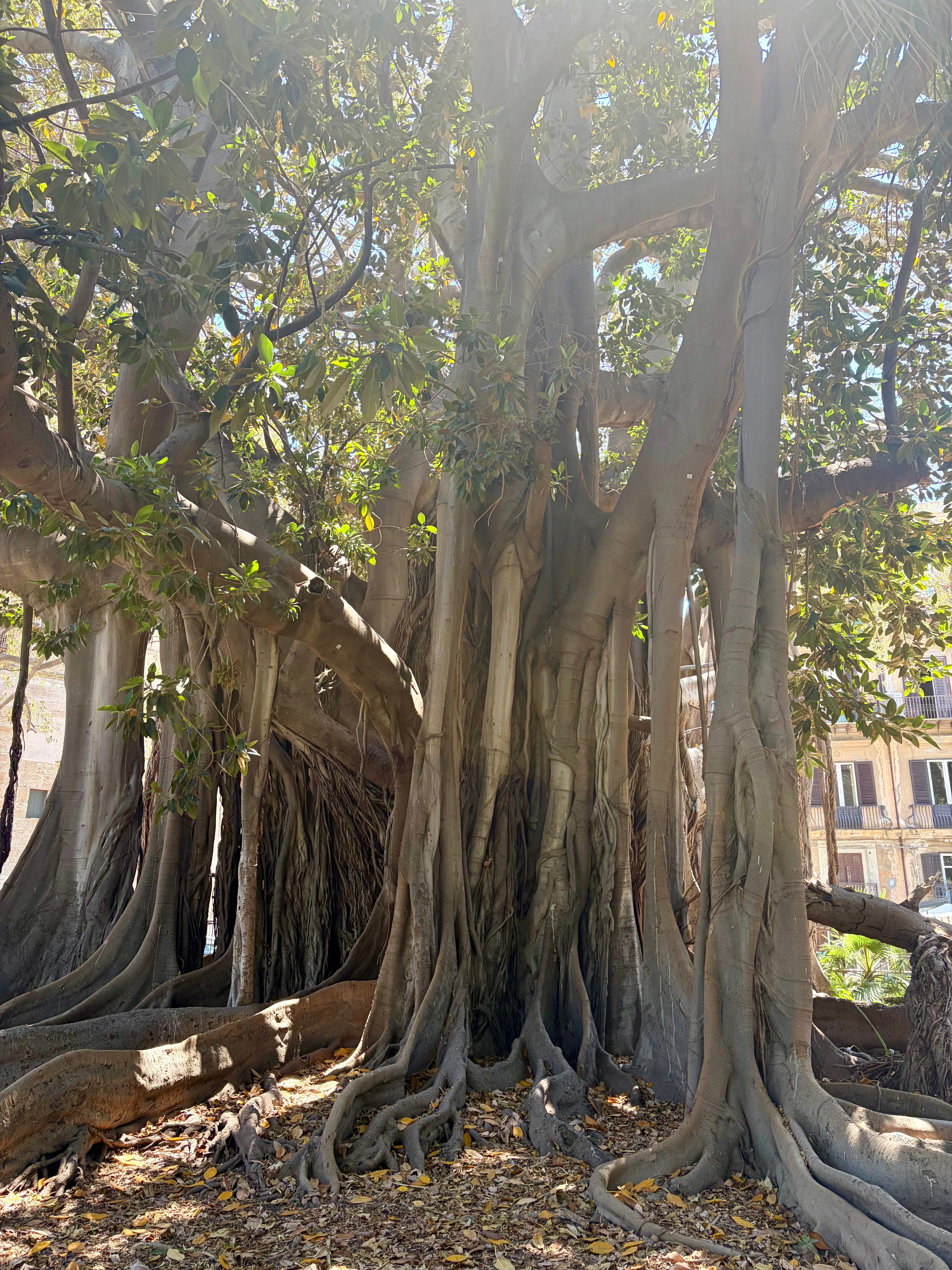
I have not explained how the English Garden came to be called “Piersanti Mattarella Park.” Piersanti Mattarella was an Italian politician—the president of Sicily’s regional government—who was murdered by the Mafia in 1980. His younger brother Sergio has been president of Italy since 2015.
Later in this journal, I will unload on the Mafia and all of its romanticizers and rationalizers. The Mafia are evil incarnate.
***
Above, I said something about thinking like an American. Well, here’s another instance: When I see a gas station, I think, “Drinks.” I think of a little store, where you can buy drinks and snacks. In Italy—certainly in Sicily—this is not necessarily so. These gas stations just sell … gas.
The audacity.
***
But I find—I stumble into—the best drink I’ve ever had. Certainly one of them. And perfect on a hot, hot day.
Sicily is the home of granitas. I have never much liked granitas. In America, granitas tend to be crushed ice with sickly syrup poured in.
Well, here in Palermo, I have a granita all right—but with fresh-squeezed orange juice. The freshly squeezed o.j. is in finely crushed ice.
Goodness gracious sakes alive, as we used to say in Michigan …
***
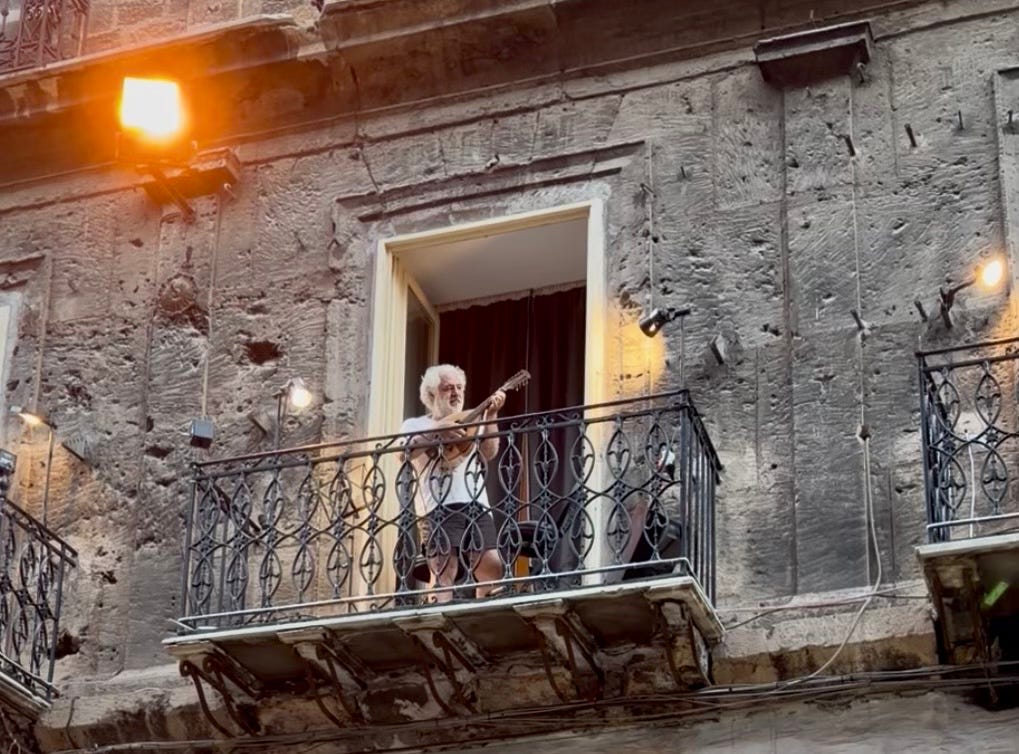
In the evening, in the heart of town, a man serenades passersby from his balcony. I have taken a video but can’t post it. But here is a photo from the video, to give you a sense:
You are really nice to join me. Thank you, everybody, and talk to you soon, when I’ll wrap up.
Buongiorno, I mean Good morning…or is it good mourning in Italy, as the Romans arch rival Francia (sounds like a cuss word in English) is in the Worlds Cup semifinals
Is it not ironic the simpler, more logical use of the number 13 is more iconic when ones piece is titled in ancient Roman text XVIII …wait, wait, did I say the number 13. Did someone say way back in the day “Math is hard” keeping up with all the letters. How many numbers are there in the alphabet again! Keep your eyes clean and stay off the tracks Buongiorno, I mean have a good day Jay. Thanks for your beautiful travel log Gotta run on.
Yellow-bellied sliders (Trachemys scripta scripta) are invasive in Sicily.
"In European countries where pond sliders are established and invasive, they can impose threats to native biodiversity through competitive advantage over native terrapins. They are often released into Europe from the pet trade, which makes them one of the top 100 invasive species outside of the United States."