


Dear readers: The previous parts of this journal can be found at the following links: I, II, III, IV, V, VI, VII, VIII, VIX, X, XI.
I’d like to show you a sign in an eatery and then make a quick comment:
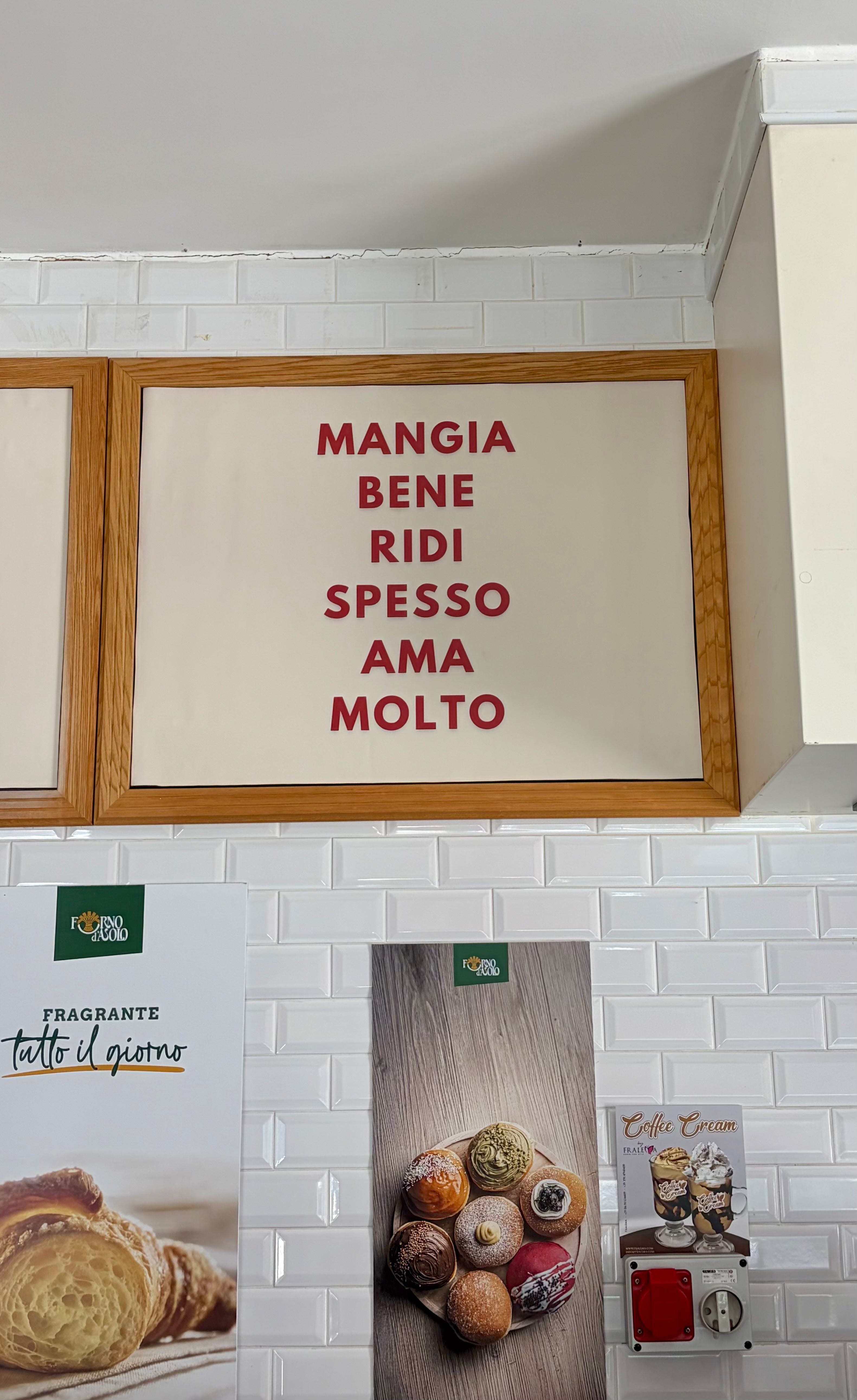
The sign says, “Eat Well. Laugh Often. Love a Lot.” The eatery in which it appears is in Cassino.
I think of Eubie Blake, the legendary jazzman, and his recipe for life: “Be grateful for luck. Pay the thunder no mind—listen to the birds. And don’t hate nobody.”
***
I am now in the city of Caserta, and I see a sign for the local Rotary club. As I think I mentioned earlier in this journal: Rotary International is a great and good thing in the world.
***
Talking with a local, I say, “People speak of ‘southern Italy.’ In your opinion, where does southern Italy begin?” She answers, decisively, “Campania.” That is a region of Italy, and, here in Caserta, we’re in it.
***
Downtown—or what I take to be downtown—there is a large war memorial, amid a kind of park. The park is a total dump, with graffiti everywhere—including on the memorial.
It’s a disgrace, I must say.
***
I notice a particular kind of graffiti here in Caserta: anti-vax.
***
A comment on mini-bars in Italian hotel rooms? As far as I can tell, their contents are sold at normal prices—not crazy ones. They are not that different from grocery-store prices.
How weird, and civilized.
***
In a restaurant one night, there are typical desserts, including tiramisù and torta della nonna. At the end of the list—almost as an afterthought—there are two flavors of ice cream: hazelnut and vanilla.
I ask the waitress—delightful, sparkling young woman—“Might there possibly be some chocolate sauce for the vanilla ice cream?” Shaking her head, she says, “No, I’m sorry.” But then she has a second thought: “Sure. I’ll melt you some.”
Does she ever. Glorious, and gratifying.
***
You know what’s civilized? Torta della nonna on your hotel breakfast bar. (Breakfast need not mean just wheat germ, you know.)
***
English words are weird—weird and wonderful—and it’s a wonder that foreigners ever learn to pronounce them. It’s a wonder that we native-speakers ever learn to pronounce them.
A hotel clerk says to me, in crisp, precise English, “receipt”—and pronounces the “p.”
Why wouldn’t she?
(No, I don’t mention it.)
***
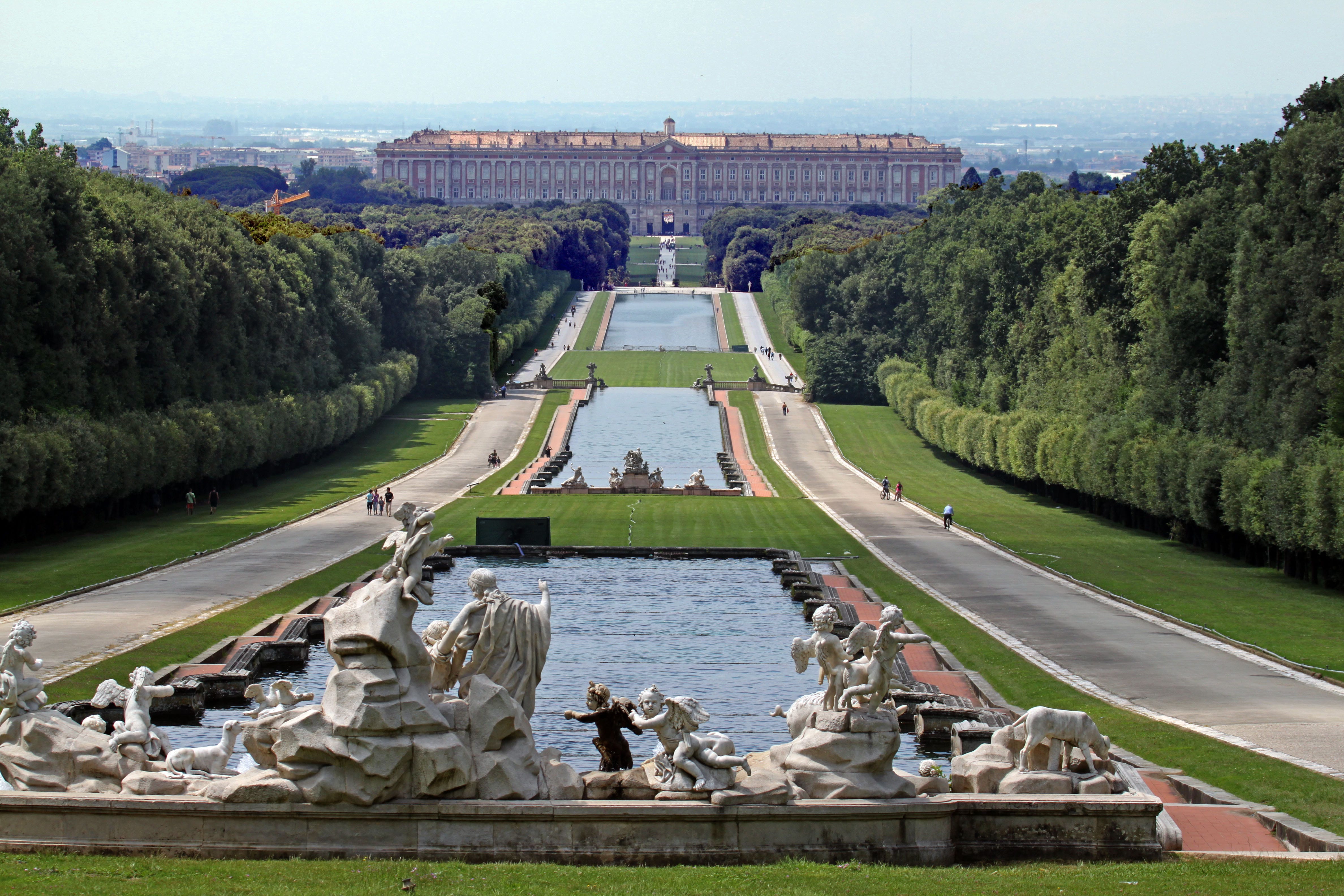
Caserta is known for a royal palace—an immense palace, built by the Bourbons in the 18th century. Behind the palace are gardens, covering about 300 acres. The gardens are as famous as the palace.
They were designed by some of the great gardening minds of the age. (“Gardening minds” is a funny phrase, but it applies, I think.) I’m talking about Luigi Vanvitelli and his son Carlo. And a botanist born in Germany, John Graefer.
These men were something like geniuses, scientific and artistic.
***
Walking through the gardens, I think, “One helluva playground.” About the palace and the gardens in general, I think, “Such glory, such glory. But for whom and why?”
I am a deep-dyed democrat.
Fingers itching, I jot a tweet:
A walk through the Bourbons’ palace and gardens in Caserta this morning put me in mind of something: In the old days, monarchs, aristocrats, and courtiers were the “elitists,” and people like me wanted to pick up pitchforks. Today, in my country, defenders of the liberal-democratic order are called “elitists,” by desirers after strongmen.
***
An adorable little girl cries out to her dad, “Papà! Papà!” I think of a lesson in Italian class, long ago.
Our professor, Frank Casa, demonstrated something. You can hold a candle to your lips, but he did not have a candle handy, so he used a piece of paper. Into the paper, he said “papà,” repeatedly. The paper never moved.
But when we native English-speakers said “papà”? The paper moved like crazy. We might as well have created a hurricane. We would have blown the candle out, if we’d had one.
Try putting your hand up to your lips and saying a few words beginning with “p”—“paper” will do. Feel that wind?
In proper Italian, you don’t create any. Very hard for us furriners.
***
In the morning, you say “Buon giorno,” meaning “Good day.” In some parts of Italy there’s a “Good afternoon”—“Buon pomeriggio.” But not in all. In most of Italy, I gather, you go from “Buon giorno” to “Buona sera,” meaning “Good evening.”
When do you start, when do you switch? Ah, good question. Tricky question. It depends on where you are.
In some places, you start in late afternoon, toward evening. But in others? Could be noon. Could certainly be after lunch.
It may feel strange to say “Good evening” at 1:30, but there you have it.
“Salve” works at any time. So does “Ciao” (the most informal greeting). (“Ciao” does double duty, serving as “Goodbye,” too.)
***
The sight of mortadella makes me think of my father-in-law: “Prosciutto, we know. We have a pretty good handle on it. And salami, pancetta, and so on. But what is mortadella, exactly? How is it put together? And the word ‘morta’ is very suspect …”
!
***
I see immigrant parents with their children. Often, not always, the family is speaking Italian. The parents have accents, of course. They always will. The children have none—and try to be patient with their parents.
I’ve seen this in America too, my whole life …
***
You know how to travel? Especially if you write? By foot. David Pryce-Jones impressed this on me long ago, and cited Patrick Leigh Fermor as the great example.
I will quote from the Wikipedia entry on Leigh Fermor:
Sir Patrick Michael Leigh Fermor (11 February 1915 – 10 June 2011) was an English writer, scholar, soldier and polyglot. He played a prominent role in the Cretan resistance during the Second World War, and was widely seen as Britain’s greatest living travel writer … A BBC journalist once termed him “a cross between Indiana Jones, James Bond and Graham Greene.”
A little more:
At the age of 18 Leigh Fermor decided to walk the length of Europe from the Hook of Holland to Constantinople (Istanbul). He set off on 8 December 1933 with a few clothes, several letters of introduction, the Oxford Book of English Verse and a Loeb volume of Horace’s Odes. He slept in barns and shepherds’ huts, but was also invited by gentry and aristocracy into the country houses of Central Europe.
Well, I have my smartphone. Anyway, thank you, my friends, and talk to you later. All the best.
My mother-in-law lived in the palace at Caserta when she was in the Red Cross during WWII. You can read about her experiences here: https://www.amazon.com/s?k=army%2Bguy%2Bred%2Bcross%2Bgal%2Bbook&crid=2HQL4KTZE8JBX&sprefix=army%2Bguy%2Bred%2Bcross%2Bgal%2Bbook%2Caps%2C243&ref=nb_sb_noss_1
Thanks, Jay, for another fine column on Italy: the people, places, history and customs (seasoned with your wry and gentle humor). Thanks also for the Eubie Blake quote, which I am going to commit to memory.