


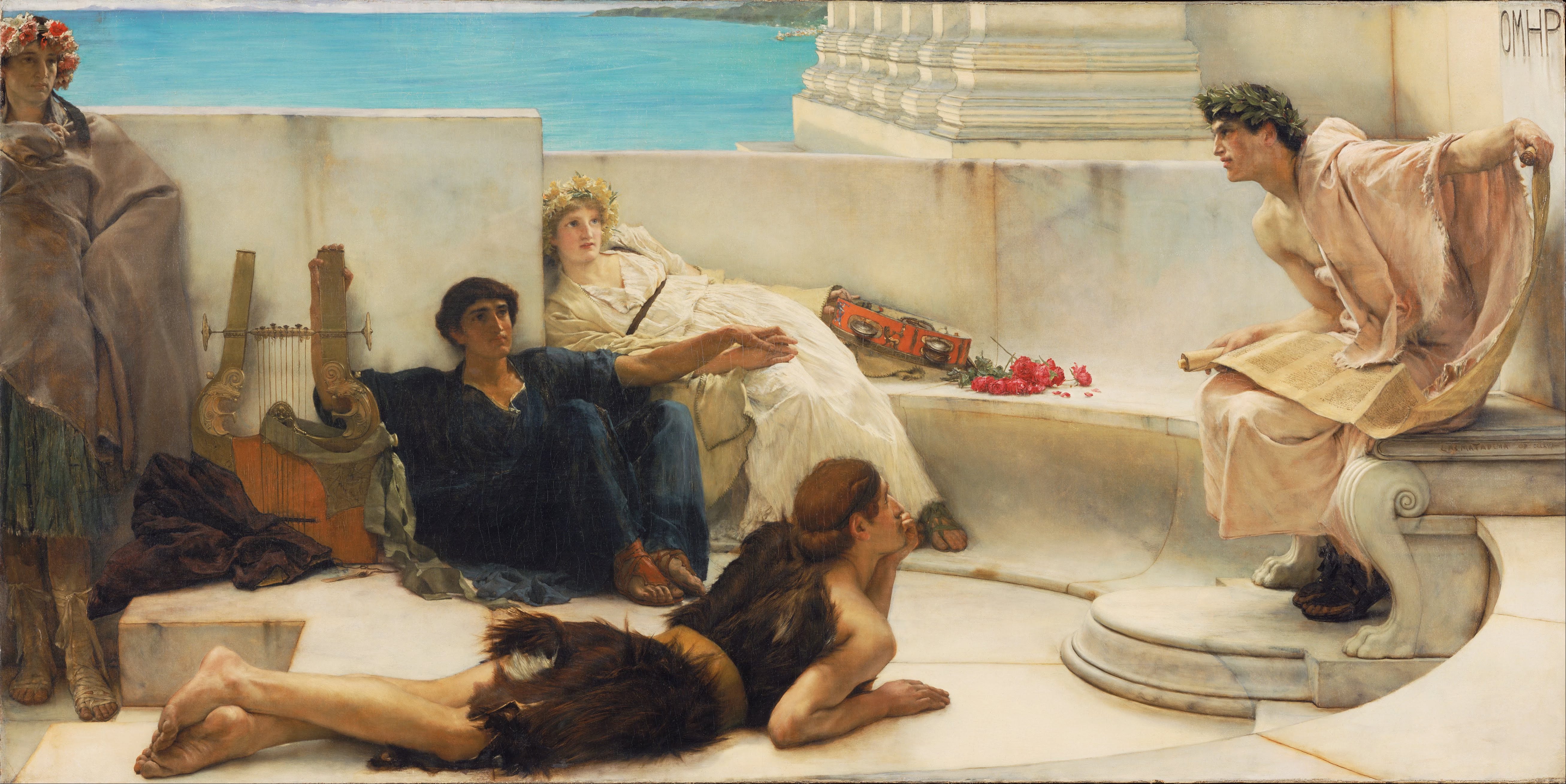
Every now and then, I write about an age-old issue: learning for learning’s sake; knowledge for the sake of knowledge.
Hang on, let me pause for a language item. I wrote “learning for learning’s sake.” Following the same formulation, I would have written “knowledge for knowledge’s sake.” Instead, I switched to “knowledge for the sake of knowledge.” Why?
‘Cause “knowledge’s sake” is a little clumsy, to my ear. Anyway …
In the New York Times, Dylan Loeb McClain published an excellent obit of Anthony J. Leggett, an English physicist who shared the Nobel prize in 2003. This eminent scientist first studied classics. But then, in 1957, came Sputnik—and the West got busy with science.
Here is what Leggett told an interviewer late in life: “The cry went up, ‘How come the Soviets have got ahead of us in this incredibly important technological field?’ And, of course, the answer was, ‘Well, we’ve encouraged all our best people to go into useless things like classics and not into useful things like physics.’”
I am reminded that Jean-François Revel wrote a book called “La Connaissance inutile,” or “Useless Knowledge.” We know it in English as “The Flight from Truth.” Its subtitle is “The Reign of Deceit in the Age of Information.” Revel was an influence on me, way back.
Well, is classics useless? It is certainly useful to the student of classics. It gives him a richer mind, a broader outlook, a greater understanding of human affairs. (Of arts such as poetry as well.)
I myself wish I knew more about antiquity. I expressed this in a column or two a few months back. (Here’s one.)
A friend of mine, Eric Simpson, “majored in Kagan,” as he says. Donald Kagan was the great historian of antiquity at Yale. (When he died in 2021, I wrote an appreciation of him called “A Scholar and a Gentleman.”) Eric was in the last group of students, I believe, who could study with Kagan all four years.
To “major in Kagan”—what a privilege.
But I’m grateful for the physicists, too, including Anthony J. Leggett, that switcher of majors.
***
In a column last month, I drew attention to an article about neighing—about how horses neigh. A fascinating sound, possibly unique in the animal kingdom.
A reader of ours, Warren S. Moore III, a professor of English, sent me a note. He discoursed, very interestingly, on Jonathan Swift, whose Gulliver’s Travels includes horse talk.
At the end of his note, Professor Moore said this: “As my father once told me, ‘Son, if it won’t make you any money, there’s a good chance you know it.’”
In a later exchange, the professor gave me another nugget from his father: “An IQ is like the number on the outside of a measuring cup. It shows capacity, but whether you fill the cup with sugar or [manure] is up to you.”
The original has the bonus of alliteration …
Another reader recalled a children’s book from 1964: The Pony Who Couldn’t Say Neigh, by Marjory Schwalje (illustrations by Stephen Thomas). What a beautiful book.
On a farm, in a barnyard,
Just over the way,
Lived a pony named Alfred—
Who couldn’t say neigh.
***
Kudos to my friend Harry Shukman, who has just been named Young Writer of the Year by the Sunday Times. He is a grandson of David Pryce-Jones.
Harry has been writing about the British Far Right. So did David—a biographer of Unity Mitford, that groupie for Hitler. Another such woman was her sister Diana Mosley, who married the leader of British fascism. The wedding took place at the home of Goebbels, with Hitler himself as guest of honor.
This stuff never goes away. Believe it or not, Oswald Mosley has been in the news lately.
Anyway, congratulations to Harry and the greater Pryce-Jonesian world.
***
Yesterday, I published a piece that begins,
This is Year 250, as most people know by now—the 250th anniversary of the Declaration of Independence. It is also Year 250 for The Wealth of Nations, by Adam Smith, that apostle of the Scottish Enlightenment. Smith published his book on March 9, 1776. The Declaration was issued—sometime in July, I think.
The Wealth of Nations and the American Founding go together like peanut butter and jelly, or whatever your favorite combo is.
An American composer, David Lang, has written an oratorio based on The Wealth of Nations. That’s what my piece is about, mainly. To read it, go here.
The piece is published at The Dispatch—whose founding was a bright contribution to our national life. Am grateful for it.
***
About a month ago, I had occasion to write about Clark Byse, who was an important professor at the Harvard Law School. He earned his bachelor’s degree at the Oshkosh State Teachers College in 1935. I commented,
You don’t have to start out in swanky places to wind up in one. At least that’s the way it was. And I believe it still is.
I heard from a number of readers—informed, experienced readers—who said, “No, it’s not that way anymore, sorry to say. Far from it.”
We might take up this topic another time. It is an important topic.
I would like to publish a letter from John Check—who says,
Good morning, Jay,
I sure wasn’t expecting to come across Oshkosh State Teachers College in your column this morning.
My father taught at what became the University of Wisconsin Oshkosh—UWO, called by some UW Zero, or, even more derisively, Zero—from the mid 1960s into the mid 1980s. (He taught adjunct thereafter until the 1990s.)
I was born in Oshkosh, fair Oshkosh.
In 1935, the school where I teach was called Central Missouri State Teachers College. I like that I work at the kind of school where my father worked.
I still follow his example, wearing a coat and tie every day to class, distributing handouts of new topics. And, like him, I strive to be a good influence on my students. When I fall short, I analyze what went wrong, try to learn from it, and strive anew.
Professor Check teaches music theory at the University of Central Missouri. When I was a kid, I knew a UCM man—Wesley True, a distinguished piano pedagogue. Wonderful guy.
***
Do a little sports, maybe? George F. Will has published his annual baseball quiz—the quiz he publishes in conjunction with Opening Day. Go here.
I was astounded at one question, one fact: “Three times he lost a no-hitter with two outs in the ninth inning.” The drama, the heartbreak. Three times!
***
A little language? For several years now, people have been saying “around” instead of “about.” A few days ago, I overheard two people at a restaurant. One said to the other, “My brother and I have to have a difficult conversation around my mother.” Now, he did not mean “in the presence of my mother.” He meant “about” her.
Isn’t that strange, this development in our language?
***
The kids at the golf range keep me current on youth slang (fairly current). I recently learned, “What’s the tea?” What’s the gossip, what’s the news? Got any tea to spill?
Also, do you know “washed”? It must come from “washed up.” “Yeah, that soccer player is washed.” Or, “We’re not friends anymore. That’s washed.”
The other day, a young friend of mine sent me some old slang—youth slang from 1942. You can hear it in the movie I Married a Witch.
Teen Boy: “What’s knittin’, kitten? You like to cut a rug?”
Teen Girl: “Let’s ditch these ickies. How ’bout goin’ to heaven in your jalopy?”
Teen Boy: “That’s solid, Jackson! Now you’re cookin’ on the front burner!”
Marvelous. (In the Midwest, we used to say, “You’re cookin’ with Crisco.”)
***
Let me throw a little music at you—not David Lang’s oratorio on The Wealth of Nations but a recital by Víkingur Ólafsson, the Icelandic pianist. My review is here.
***
A reader of ours told me about St. Patrick’s Day, and various gigs surrounding it:
My band and I just finished nearly a week of parades, parties, and pubs. (My Irish wife says, “Trust you Scots to make money off the Irish on their day!”)
Heh.
***
Above, I think I mentioned the animal kingdom. Let me close with this video—which affords a rare glimpse of the birth of a sperm whale, which is helped by its family to swim. To top it off, the scientist giving the commentary boasts a classic Canadian accent.
Thank you for joining me, my friends. Appreciate you.
In Indiana it was “cooking with gas” as I remember it.
But what of the talking horse.." A horse is a horse of course,of course but do you know of the talking horse "?
PS....did I get that question mark right.
Jay,u do make it interesting !