


In my column last Sunday, I had an item on classical studies: the study of all those thinkers, and doers, from Greece, Rome, and maybe other places. I introduced this item in a strange way:
I wish I knew about birds—the names of birds, the types of birds. Their calls. I wish I were a bird-watcher. I wish I knew about trees, and flowers. I wish I knew about the stars—the constellations and all that.
Have I ever roused myself to learn about these things? No. I am lazy (though my excuse is, “I know about other things, and you can’t know about everything”).
Another paragraph:
I sometimes fantasize about being a classicist—or at least having a decent acquaintance with antiquity: “Balzac and Shakespeare and all them other hifalutin Greeks” (as Mrs. Paroo says in The Music Man).
Eventually, I asked a question of readers: “What would you like to know about that you have not (yet) roused yourself to study?”
The answers were very interesting—and I thought, today, we’d have a sampling.
Let’s start with this:
Jay,
I know a few architectural terms, but would like to know more. I know a few types of roofs—I can recognize the American Foursquare style—but I don’t know much, considering.
Same here.
Another reader writes,
Man oh man, Jay, do I regret not taking calculus in high school (I was a humanities guy). As I matured, I began to see what a Beethoven symphony and a tractor engine have in common: a set of forces in play within boundaries.
How about calculus? The ability to map an isolated moment in a continuum, one little moment in a baseball’s path from the right fielder to the catcher ... Amazing.
I have a friend who designs howitzers for the military. She uses calculus like it’s child’s play.
That is amazing. (To me, I mean—probably not to a mathematician.)
There’s a lot to worry about, where artificial intelligence is concerned. But how about this?
Back in July, I decided I needed a bit of a challenge and asked various AI programs to teach me Italian. By Christmas, I was able to read Il gattopardo.
Holy moly. I read it with the help of my Italian prof, Maria Rosaria Vitti-Alexander, to whom I wrote a tribute in 2021. I wrote a joint tribute—to her and the historian Barbara J. Fields: here.
Our reader continues,
I have a degree in classics, so Italian wasn’t that much of a stretch, but the exercise showed me AI’s potential as a teacher, whatever stage in life one is at. It is (almost) all-knowing, patient, available 24/7—and, not unimportant, completely free.
A question: Are language teachers on the road to extinction? But we might address that question another day ...
Says a reader,
Netflix has a documentary on the Webb telescope. I’m now interested in astronomy.
Says another reader,
First, my Greek is perhaps on the same level as yours—fraternity life taught me to say the Greek alphabet (and I’m proud that I can still do it before a paper match goes out) and know what our secret motto is.
I also have a good idea what the “X” in “Xmas” is. That’s the extent of my Greek.But what I wish I had learned is—car repair. How to change oil and other fluids. How to replace spark plugs and brakes. Etc. For one thing, I’d have reason to buy a fixer-upper.
My friend Dave says,
#1 is photography. I tend to take a shotgun approach to pictures: snap seven or ten and hope that one of them is good. Modern digital cameras are very forgiving, but I’d love to take a class that deals with actual film. My dad has been a shutterbug his whole life, and my wife actually had a darkroom when she was a teenager.
#2 is flying. This is also paternal influence. My dad had a pilot’s license before he had a driver’s license. (Grandpa operated a rural airfield and charter service in Illinois.) Dad then became an aeronautical engineer.
Flying will likely wait until I retire from teaching.
Next:
What a fun question! My list includes:
1. Physics (at a lay person’s level). (I quit math at Algebra II and science at chemistry in favor of more languages in high school.)
2. Some Asian history (broadly speaking). The only thing I’ve read is the three-volume history of the Chinese revolution by Frank Dikötter.
3. Enough Russian to read a couple of the classics in the original language.
I have a tendency to go on “kicks,” so I reckon I’ll get there eventually with all three. And it’s always worth it.
Several years ago, I read 1177 B.C. by Eric H. Cline and followed it up with a year of reading about the Bronze Age in the Aegean. After that, I visited the Metropolitan Museum of Art and had a fantastic time wandering the relevant section of the museum, actually understanding it.
Isn’t that just a wonderful feeling, when you can appreciate the art you’re seeing or hearing?
Donald Mace Williams, you know. I have published his poetry here at Onward and Upward—most recently on New Year’s Day, here. Don writes,
Jay,
I have translated Beowulf and have been much influenced by the poem in writings of my own. I wrote my dissertation on the way the Old English lines were put together. And I have felt guilty for 50 years because I never really learned Old English. On the way to the dissertation, I somehow missed having a course in the bones and joints of the language. For my translation, I had to look up at least every second word to be sure I understood whether it was singular or plural, past or present, dative or genitive. If I had just got down to studying the rules on my own, things would have been much easier. Too late now. I’m 96 and haven’t become studious with the years.
I’ll have to disagree there—it’s never too late for Don Williams.
I found this rather amazing:
Hi, Jay,
From an early age (maybe when I was about ten), I developed a fascination with Iceland. I began by collecting Icelandic stamps. That was around 1951. I bought my first Icelandic language book in 1961 (a Teach Yourself book). Icelandic is difficult and as much as I loved words I never had the time, or maybe the ability, to study this ancient tongue.Fast forward to 2001. I applied for and received a Fulbright grant to teach organic chemistry at the University of Iceland in Reykjavik. Obviously, I taught in English, but the beautiful Icelandic language and grammar were there for me to hear and absorb.
Nothing stuck: I understand the grammar, but reading or speaking Icelandic is just “not gonna happen.”
The Icelandic phrase for “goodbye” is “bless bless.” So ... bless bless.
Wanna know a guy who “followed through,” unlike me? Listen to Mark Hurst:
I got “the bug” for some classical reading a couple of years ago. I ended up reading the complete works of Plato in a year, more or less. Conclusions here.
Last year, following up, I read the Odyssey, Iliad, and Aeneid, and several books about those epic poems. Essays on that reading to come, I hope, later this year.
(Everything I read was in English translation.)
Mad props (as I think people used to say).
Writes my friend David,
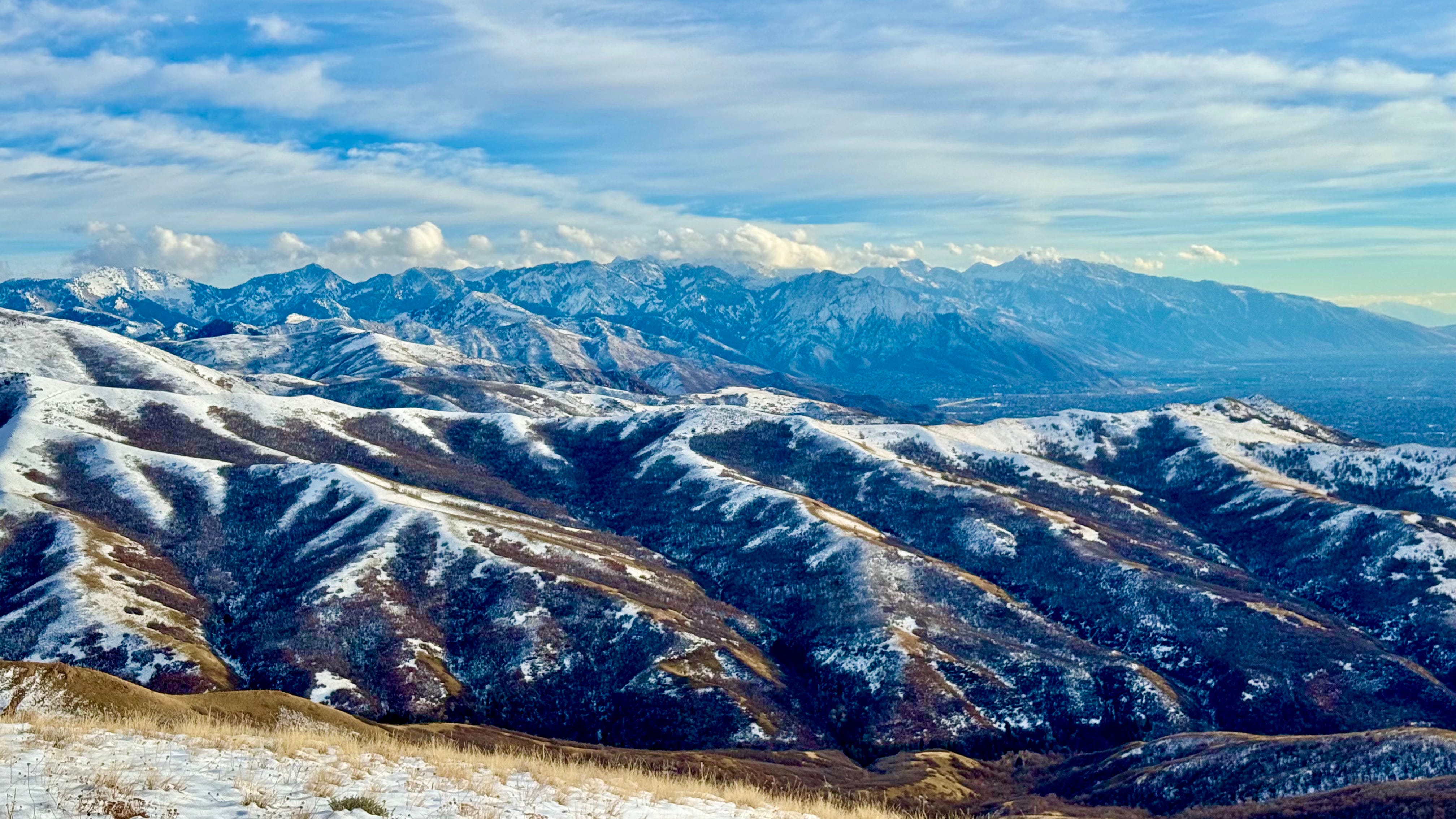
Geology! I love hiking the high ridges and peaks of Utah’s magnificent Wasatch Front, on the flanks of which I’m blessed to live. What stories the canyons and summits with their dramatically exposed strata could tell, if only I could understand them!
My friend Matt is a doctor—a physician—who gorges himself on history and related subjects. His answer surprised me, just a bit:
Far and away, the things I would like to learn—or actually shore up / relearn—are physics and chemistry, the basic physical sciences that I had as an undergrad, as well as physiology and the other basic sciences from the first year of medical school.
I had all of this stuff, and made an A in most of it (okay, mostly B’s in chemistry), but it is hard to express to a non-medical person how little we actually use the basic sciences in day-to-day clinical practice. It’s almost like some committee decided that med students just had to go through something hard before doing clinical medicine, and those sciences seemed as good as anything else.
That’s a funny line. (Why not hike through the Himalayas?)
So the pattern is for pre-med and med students to cram this stuff, regurgitate it for the best grade possible, and move on.
My idea is to start with basic physics and go from there ...
An English reader writes a (typically) eloquent and charming letter, and says toward the end,
... let’s console ourselves with the fact that most of us cannot know everything, and part of civilisation is that we pool our knowledge to cover one another’s lacunae.
Beautifully expressed.
Let’s conclude with my friend Fred:
Growing up Mennonite, I was discouraged (just short of prohibited) from dancing. I still aspire to develop 1 percent of the grace of my namesake, Astair.
You know the expression “thanks for sharing”? Well, thanks for sharing, my friends! Talk to you soon.
Calculus.
First week of senior year in high school. Monday I was pretty sure I needed to drop Calculus. Tuesday I was certain. By Friday I was in Study Hall passing notes to girls. I've never looked back.
I'd opine that the requirements for basic sciences prior to specialization in any science-related field (medicine, engineering, astronomy, etc...) is not to necessarily to learn things you are going to use every day, but to teach you how to think critically in an evidence-based way. The beauty of the scientific method is its almost universal applicability.