


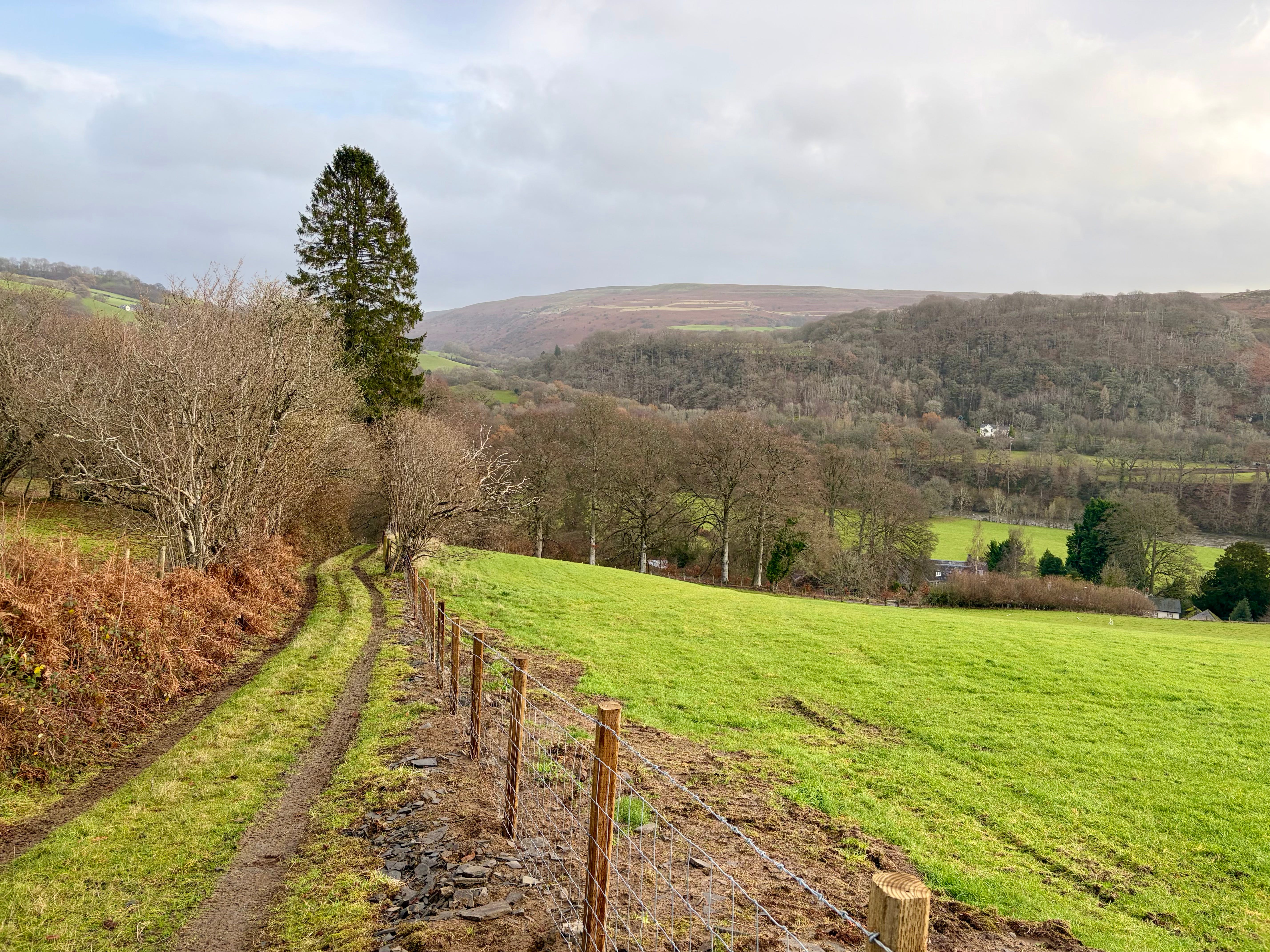
Dear readers: The funeral of David Pryce-Jones, the writer, took place in Wales on December 8. It was held at a church near the town of Builth Wells, in Powys County. Below is a version of my eulogy, with annotations in brackets.
It’s good to be with David’s family and friends, and in Wales. When I thought of Wales, earlier in my life, I thought of Dylan Thomas, Richard Burton, and a number of singers—including Bryn Terfel. Forgive me if I pronounce that name like an American, rather than a Welshman! But after I met the Pryce-Joneses, I could think only of them.
I can hear David utter the phrase “the traitors of Builth Wells.” He said it with a theatrical shudder in his voice.
[The phrase refers to people in the town who sided with the conquering English in the 13th century.]
When David was reporting in the Middle East, Palestinians would sometimes say, “You have no idea what it’s like to be occupied.” At least once, David replied, “I beg your pardon, my country has been occupied for 700 years!”
It was a privilege, many years ago, to meet Clarissa’s mother, Lady Caccia, down the hill from here, at Abernant.
[Clarissa is Mrs. Pryce-Jones, and her parents were Harold and Nancy Caccia. Abernant was the Caccias’ Welsh home. Lord Caccia was a diplomat, whose postings included Washington, where he was ambassador.]
It was also a privilege to be with David in bookshops in Hay-on-Wye. Was ever a man more in his element than David Pryce-Jones in a good bookshop?
[Hay-on-Wye is known for its bookshops—used books, in particular. It is also the site of the Hay Festival, an important event on the literary calendar.]
A great man, David Pryce-Jones: great mind, great spirit, great presence. And unique in all the world. Of course, each one of us is unique. But might we allow—pardon the expression—that some are uniquer than others?
The facts of his life are given in his memoirs, Fault Lines, but also in his novels, several of them, in a submerged way.
He was born at Meidling, in Vienna, in 1936. About 75 years later, we took a taxi to the place—to the Schloss—which was now a political conference center. We passed a young woman at the front desk. And went up a grand central staircase.
Then David did something unusual, for so polite a Brit. He walked into an office—there was no one around. And then into the office behind it. Whereupon he said, in a matter-of-fact tone, “This is the room in which I was born, as was my mother before me.”
When we left the Schloss, I mentioned to the woman at the desk that here was a man, Mr. Pryce-Jones, who had been born upstairs. It was his family’s home. She was disturbingly unimpressed. But it was made up for when we reached the taxi, which had been waiting for us. I told the driver about David’s connection to the place. And the driver, an immigrant, was touchingly wowed.
The Schloss, the compound, is on Tivoligasse. Last summer, The Afternoon Sun, a novel by David about his maternal family, was republished by an American firm: Tivoli Books. David thought that was poetic.
He was the beneficiary of privilege, you could say: Eton and Oxford and all that. But you can also say, as he did, that it was not easy being a member of that family.
Clarissa thought it would be well if I quoted a passage from Fault Lines: that the family was “not quite Jewish and not quite Christian, not quite Austrian and not quite French or English, not quite heterosexual and not quite homosexual, socially conventional but not quite secure.”
After Austria, France, Spain, and Morocco, David finally wound up in his essential homeland, Britain.
[David had a harrowing flight from the Nazis, in the company of his nanny, Jessie Wheeler. Their ultimate refuge was in Tangier.]
When he was six or seven, David went to Buckingham Palace. His grandfather, Harry Pryce-Jones, was receiving the Order of the Bath. King George patted David on the head and said, “Have a good look around. There are some interesting things to see in this palace.”
There were. But David also saw something grim—a grim scene, and indelible: soldiers and airmen, badly wounded in the war. (This was in the midst of World War II, recall.) Some of the men were on stretchers; some were missing limbs; some had been hideously burned. All were receiving awards from the King.
One man, a Pole, was weeping. It was explained to David, “He has lost his country.”
Maybe I could continue with something lighter—also concerning the royals. It’s 1954, and David is 18, doing his military service. He’s at the Grand National, in Aintree, where Queen Elizabeth asks him to place a fiver on a horse.
Does the Queen ask, or command?
In any case, David placed the bet—which did not pay off.
I loved to hear him talk about Oxford—Magdalen College, in particular. C. S. Lewis, A. J. P. Taylor, Raymond Carr. On an original piece of musical theater, he collaborated with Peter Levi, Dudley Moore, and John Cox. One of the guests at the after-party was Shostakovich.
“I ask you,” as David would say.
[The composer Dmitri Shostakovich happened to be at Oxford to receive an honorary degree.]
If it was good to meet Shostakovich, it was great—world-beating—to meet Clarissa, the ambassador’s daughter. What a catch, for each of them. What a match, what a collaboration, what an adventure.
I don’t know what the wedding vows were, in this church, all those years ago. I wasn’t invited. But they probably included the words “in sickness and in health.” Clarissa has set an all-time example in the keeping of that vow. David told me over and over what an angel, a godsend, she was. Is.
Their children, grandchildren, and great-grandchildren—another should be here any minute—are all unique. But there are resemblances, physical and otherwise.
Some years ago, I had lunch with Gemma in New York, and I later told Clarissa, “It was like having lunch with you! It was wonderful!” And I have heard Clarissa describe Candida as “David in a skirt.”
Not often did David speak of Sonia with me. But when he did, it was with great emotion, and great love.
[Gemma is a granddaughter and Candida a daughter. Another daughter, Sonia, passed away when she was two and a half.]
In talking about DPJ, we’re talking about a writer of rare versatility: a historian, a novelist, a biographer, a foreign correspondent, a critic, etc. And he wielded a beautiful pen—writing in a style that can only be called “Pryce-Jonesian.”
At lunch last summer, I said to him, “You’ve published pretty much everything except poetry, right?” Wrong. He had published several poems, he told me. What’s more, he was runner-up for the Newdigate Prize at Oxford. This is a significant, and historic, honor in poetry.
One of the jurors told David that he had voted for him. That was Auden. So haven’t you really won?
David survived the war and the Holocaust. And he lived life to the full. He was a great liver of life, a gulper-down of life. I think—as David might—of a line from Tennyson: “I cannot rest from travel: I will drink life to the lees.”
He never forgot the victims: of war, genocide, and persecution. He loved freedom—ordered liberty—and hated tyranny. He passed on to me what Elie Kedourie once told him: “Keep your eye on the corpses.”
I also heard—we also heard—about Jessie Wheeler, that invaluable nanny, that invaluable woman. David said, “Her morality was that of Britain in about 1860. And she put that morality in me.”
Always, always, he was concerned for the Jews and their survival and their well-being. I once asked him what had gotten him so interested in the Arab countries. There was his childhood experience in Tangier, of course, and his general curiosity about the world—particularly its volatile regions. But also, he said, “The fate of the Jews was involved.”
He dealt with the gravest of matters—political and geopolitical. But he also dwelt in the worlds of music, theater, and art. A man of culture, a man of letters.
And has anyone liked to laugh more? To cause others to laugh and to laugh himself? I can see him now, gripped with laughter, his eyes closed, with tears escaping sometimes.
You learned so much from him. I think of something that Marilyn Horne, the mezzo-soprano, once told me. We were talking about Leonard Bernstein. “You learned so much from him,” she said, “just by having a meal with him.” So it was with David. He was a natural teacher—an inadvertent teacher, if you will. What I mean is, he taught through his books, and articles, and conversation. And example.
I have known a few raconteurs in my life—none better than David. I have repeated his stories so often, the family ought to receive royalties. I am always passing on things from David—chiefly to the young: stories, observations, points about writing.
He has put his stamp on many of us. On trips with him, I really learned how to travel. To notice things. Why is that street called that? Who is that statue in the park of? What’s on at the ballet tonight?
Writing entails a certain solitude, but, man, was he engaged with life.
When I was in college, I had a professor of southern history—the history of the U.S. South. Here comes a Pryce-Jonesism: He rejoices in the name of J. Mills Thornton III. He himself was taught by C. Vann Woodward, a venerable professor at Yale (who, like JMT3, had an excellent name).
In a preface to a book, Professor Thornton said, “I am grateful to Professor Woodward for giving me what I can only call a cast of mind.” David Pryce-Jones has done much the same for me and others.
When I scan the news, when I attend a performance, when I puzzle over a problem, when I have an interesting encounter—I think of him. Words and phrases are always coming to my mind: “I ask you.” “Well, I never.” “Is that a name to you?” “Indonesia looks like blowing up.” “Courage, Pépé!”
That came from Jessie Wheeler. It was called out from the stands to a French tennis player when he was down. (The player was Jean Borotra.)
“Courage, Pépé!” David had occasion to say that to me, when I needed it. And vice versa.
To us, David Pryce-Jones will never die, can never die. It was, and still is, a privilege to know him, and to know his family and his circle. God bless him, and all of you.
Simply lovely - but a bit envy inducing. How one wishes one might have also had the privilege of sharing his acquaintance.
I stumbled on Mr. Pryce-Jones’s The Closed Circle-An Interpretation of the Arabs more than a decade ago. It was pellucid, bracing and convincing. The predispositions toward interpretation of Middle East problems the book instilled in me have never left. I don’t think Mr. Pryce-Jones led me astray.
I had no idea of Mr. Pryce-Jones marvelous back story. Thank you for the education provided by your touching eulogy Mr. Nordlinger (or should I say Forrest Gump since you seem to find yourself next to everybody who is anybody in the last three decades).