


“The very least important thing about 9/11 is how I, personally, spent that day. But you may find it interesting, and I can certainly vouch for it.”
That is the opening of a piece, published yesterday at The Dispatch. The magazine (for I think of The Dispatch that way, whether it is published in physical form or not) asked me to write a piece about 9/11 and New York. That piece is mainly personal, though it also has general applications.
Today, I would like to say a little bit more, mainly about the GWOT—the Global War on Terrorism, as we used to call it. (The term now sounds antique, doesn’t it? Almost like “Peloponnesian War” …)
I have no intention of rearguing it all—Afghanistan, Iraq, etc. That would take a series of pieces, or a series of books.
Speaking of books, I recommend Decision Points, by George W. Bush. He explains what he was facing, step by step. He tells you what it was like to “sit at the desk,” meaning the one in the Oval Office—the desk at which the buck stops (or is supposed to).
The highest praise for that book came from the author’s immediate predecessor as president. Bill Clinton said that Bush “gives readers a good sense of what it’s like to be president, to take the responsibilities of the office seriously, do what you think is right, and let history be the judge.”
***
In my Dispatch piece, I have a couple of paragraphs about Bush—in relation to New York, specifically.
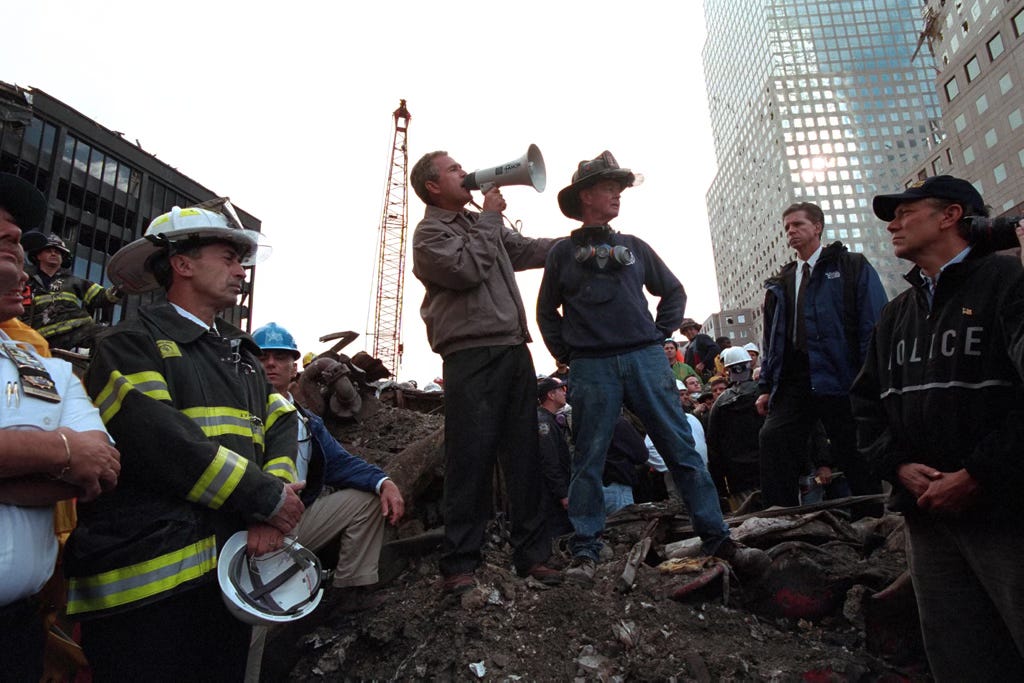
On September 14 (i.e., three days after the attacks),
Bush came to town to speak to the rescue workers at Ground Zero. He was speaking through a bullhorn. One of the men called out, “We can’t hear you!” Bush answered, “I can hear you. I can hear you! The rest of the world hears you. And the people who knocked these buildings down will hear all of us soon!”
A second paragraph:
In late October, Bush came back to New York to throw out the first pitch in a World Series game at Yankee Stadium. He appeared confident. Though encumbered by a bulletproof vest, he fired a strike. The effect on the crowd, and the city in general, was oddly inspiriting, close to electrifying.
Let me quote a commenter at The Dispatch: “The account of the conversation between GWB and the rescue workers brought some tears to my eyes.”
Well, I have a confession. When I was preparing my piece, I watched a video of Bush at Ground Zero—and the same happened to me. (What I mean is, my face might have been slightly wet.)
It was rather emotional to prepare that piece anyway—to relive 9/11 and its aftermath.
***
Bush spoke at Ground Zero on the 14th. On the 17th, he went to a mosque in D.C., to say that we were not at war with Muslims at large. No, we were at war with Islamist terrorists, or rather, they were at war with us, as they had long been, and we were now fighting back.
Some people thought that Bush was being “politically correct.” (That was the term we used before “woke.”) Others thought he was being prudent, practical: we would need the help of a helluva lot of Muslims in the days, months, and years ahead.
That was right.
***
My sense is, people have forgotten the atmosphere after 9/11, if they ever knew it. People were screaming at Bush to DO SOMETHING. They said that he and his administration had failed to “connect the dots.” That was the buzz-phrase: “connect the dots.” They should have known that these attacks were coming, in precisely the way they came!
No, wait a minute: they knew all along! And decided to let the attacks happen!
Here was the New York Post, in full tabloid mode:
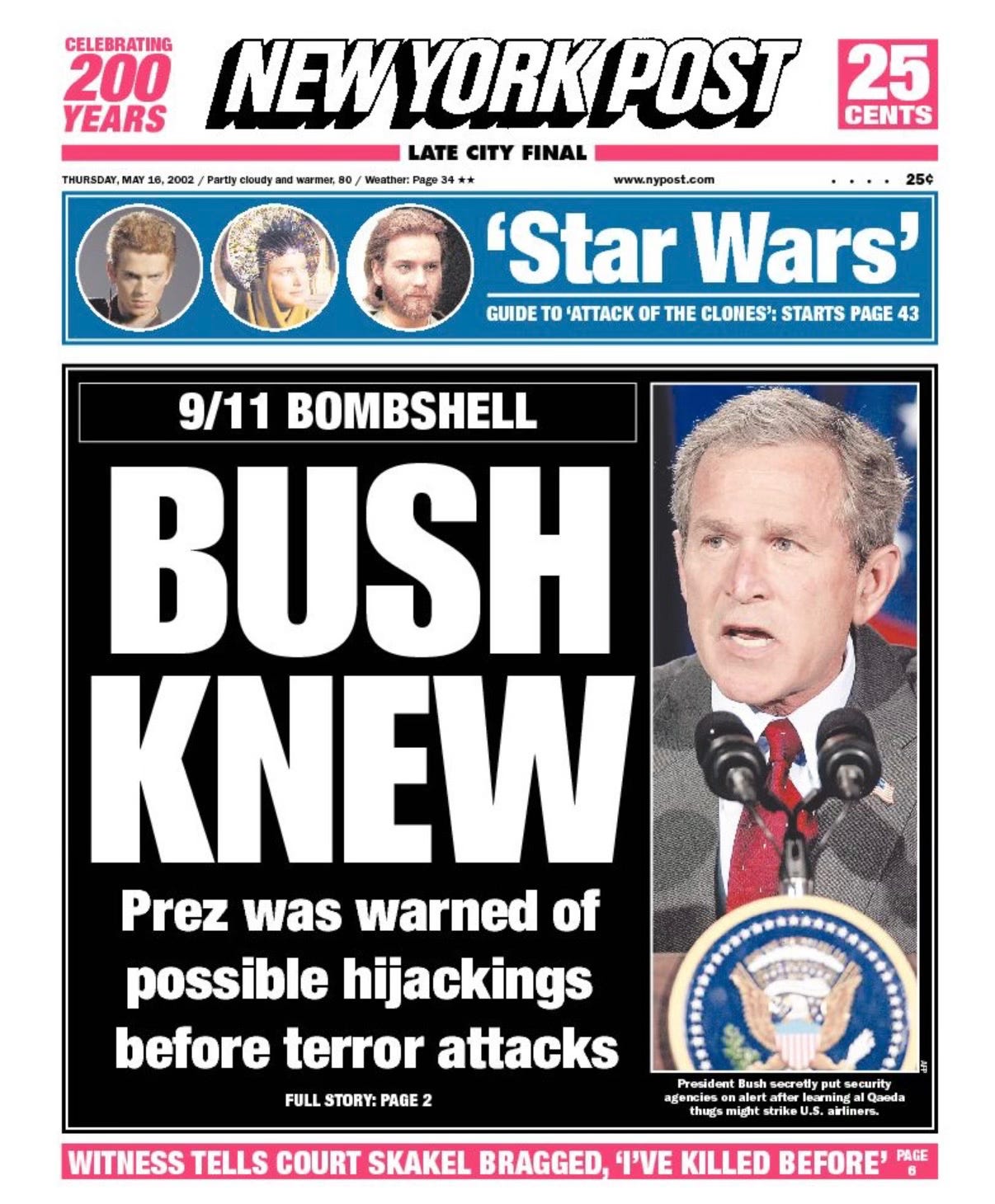
“9/11 Bombshell”! Yeah, right.
Hey, did you know that 9/11 was an “inside job”? Lots of people believed it, and believe it still. They include a dear friend of mine. Some things cannot be talked about.
***
In the run-up to the Iraq War, Bush said that he had to weigh “the risks of action and the risks of inaction.” People tended to know the risks of action. But did they consider the risks of inaction? Of doing nothing?
The president had to, even if the rest of us didn’t.
***
Some of us thought that the 9/11 attacks required a response more comprehensive than we had entertained, or carried out, before. Something beyond police work and counterterrorism. We spoke of a “9/10 mentality”—a mentality we could not afford, a mentality that was dangerous, actually.
More on this in a moment …
***
On the first anniversary of 9/11—now we’re up to the 25th—I gave a speech in Salonika, Greece. Under State Department auspices, I spoke at a conference called “September 11: Media and Terrorism.” That speech can be read here. And I would like to quote a single paragraph:
Above all, I think that covering and commenting on this war has meant an end to pretending—an end to pretending that everyone’s a friend, or potential friend, that every grievance is just, that a certain kind of hatred can be appeased, that America is to be blamed for humanity’s woes, that radical Islam is just another viewpoint, that there is never right and wrong, only personal subjectivity. When the prime minister of Italy said that a free, open, pluralistic society is better than a closed, stifled, lied-to one, everyone professed shock and indignation. This is the kind of pretending that gets harder to do.
Later that day, an American diplomat, a Foreign Service officer, shook my hand and said, “I think the primary message of your speech was: Time to cut the shit.”
I appreciated that, and still do.
***
As some of us saw it, 9/11 was the latest and worst—not the first. Let me explain what I mean.
In fact, I’d like to quote again from that speech in Greece:
In 1993, the World Trade Center itself was bombed, but only a few died. Everyone kind of shuddered, and then promptly forgot about it. Our men were murdered in the Khobar Towers, on Saudi soil. Many more people were murdered at the U.S. embassies in Africa. Then, the U.S.S. Cole, in Yemen, was attacked. And yet these incidents were far away, and, besides, weren’t most of the dead soldiers? They were in a dangerous business anyway.
At the World Trade Center, in 1993, six people were killed—seven if you count an unborn child.
In Khobar Towers, 19 were killed.
At our embassies in Dar es Salaam and Nairobi, 224 were killed.
On the USS Cole, 17 were killed.
I will continue to quote that speech of mine, starting with a couple of sentences already quoted:
And yet these incidents were far away, and, besides, weren’t most of the dead soldiers? They were in a dangerous business anyway.
But this thinking itself was dangerous. Some people said, at the time of the Cole, that this was not an act of terror—there’s a vague word, “terror”—but an act of war, and ought to be treated as such. And yet the U.S. did little; there was a collective shrug. And that undoubtedly emboldened America’s enemies for more. A colleague of mine pointed out the old French expression, “L’appétit vient en mangeant.” Appetite comes with eating. So it proved.
That colleague, by the way, was David Pryce-Jones.
How do you declare war, or wage war, against a terror group? Isn’t that kind of gauzy, like declaring and waging war against poverty? It’s easier—more logical—to deal with a state, right?
Yes. And what George W. Bush said was: If you arm, shelter, or otherwise abet terrorists, you are the equivalent.
***
It is important to remember: Most of us assumed that 9/11 would not be a “one-off.” We did not think our enemies would say, “That was nice. Murdered a few thousand of the bastards. We’re done now.” No, we figured they would do it again and again, as long as they could.
Here is a paragraph from my Dispatch piece:
Lots of people were on alert, nervous. I had a friend who was reluctant to travel to or from Grand Central Terminal, because the building made an inviting target for terrorists. Some people wondered, “Will anyone rent office space in the Empire State Building again?”
I liked what Donald Rumsfeld, the secretary of defense, said on different occasions. I will paraphrase him:
Look, we’re not going to bring the dead of 9/11 back. And we’re not going to war in order to avenge them. This is not about retaliation, retribution, or revenge. Those are three wrong R’s. It’s about self-defense. They have pledged to hit us again and again, and we can either defend ourselves or not. We vote: yes.
***
Shortly after 9/11, I happened to moderate a panel that included Vernon Walters, the distinguished Army general, CIA man, and diplomat. I asked, “What do we owe the dead? What do we owe the murdered of 9/11?” Walters answered, “That it never happen again.” In other words, we had to do the necessary to ensure, to the extent possible, that there would not be a repeat.
Amazingly, there has not been. There have been close calls, however. There was a string of close calls on the heels of 9/11.
An attack in Singapore was foiled. An attack on our embassy in Rome was foiled. Richard Reid, the “shoe bomber,” failed. José Padilla, the “dirty bomber,” failed.
Were we lucky? Or good? Some blend?
I can tell you this: On 9/11, 9/12, 9/13, etc., few of us could imagine that we would not be hit again, in something like a protracted, bloody struggle.
I am grateful to everyone—in the military, in the CIA, in the FBI, in elected offices—who has worked and sacrificed to keep our country safe, or as safe as possible. God bless them.
And God bless you all.
Prayers for peace of mind for the victims families ✌🏼❤️
I forgot what a porn mag The Post could be…just as I was just reminded our future and present President boasted on the Howard Stern Show while the remains of World Trafe Center where still piping hot that Trump Tower was now the tallest building in New York City. …GOD HELP U.S. Deliver U.S. from Evil and take him…I mean Calgon take me away