


Today, one must comment on the Iran war, or the joint U.S.-Israeli attacks on the Iranian government. Like everyone else, I will comment in the future. But for now, it seems wise to say only a few words.
The coming of the Islamist regime in 1979 was a disastrous thing. It has been a curse on mankind: on Iranians, first and foremost; on the Middle East; and on the world at large. Much evil flowed from the coming of that regime. Commensurate good should flow from its downfall.
I wish our forces, and Israeli forces, all success.
For many years—since I entered journalism in the mid-1990s—I have spoken with Iranian exiles and dissidents. Former political prisoners, future political prisoners. The Iranian regime is one of the most hellish on earth.
That’s at home. Abroad, it is one of the most dangerous.
I have no desire, here and now, to “relitigate” the War on Terror and its various components. But I recall something that Bernard Lewis said. (Professor Lewis was widely regarded as the dean of Middle East historians.) Rather, he quoted an Iranian analyst.
After our invasion of Iraq, this analyst told Lewis, “They should have gone in alphabetical order.”
***
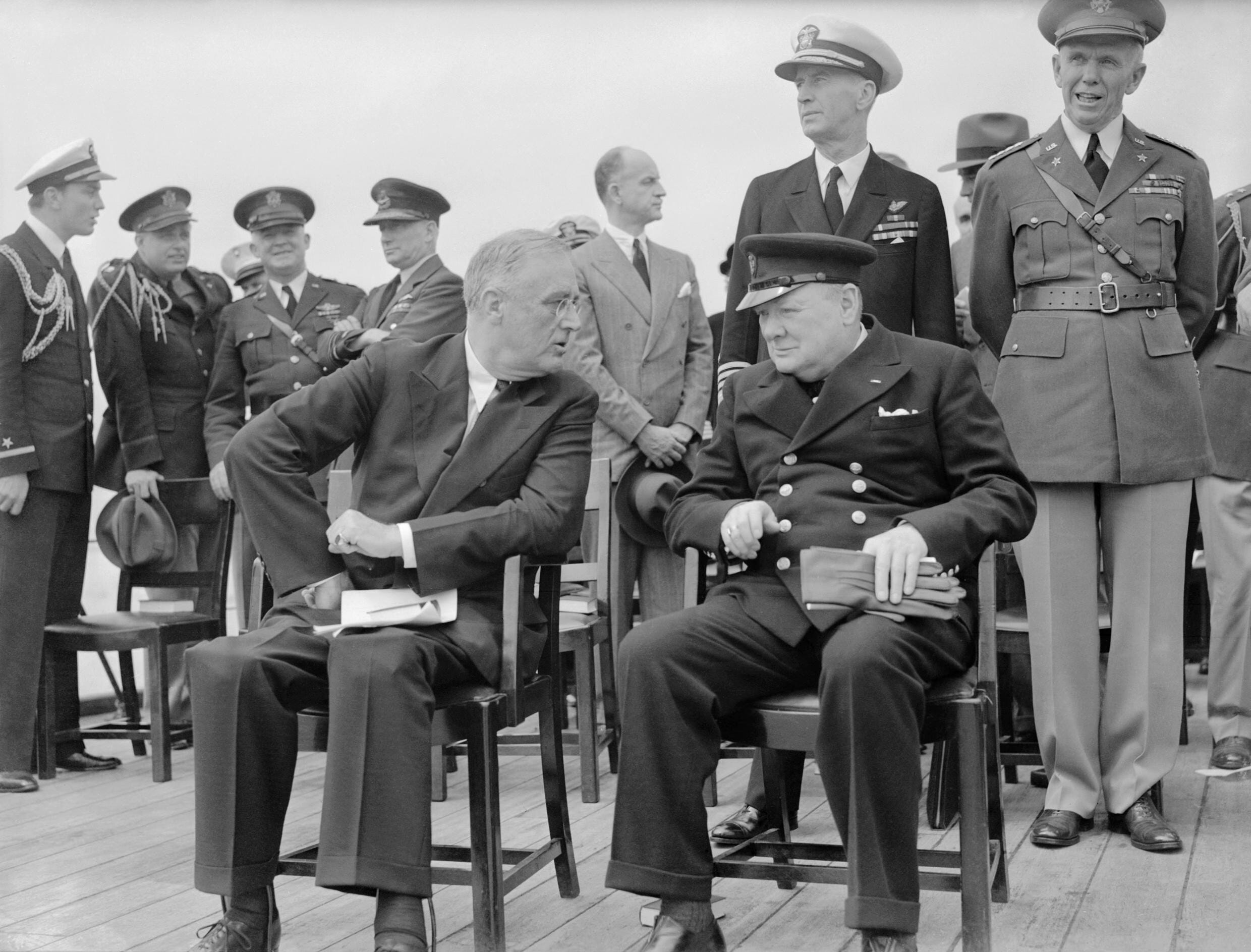
You may have seen, at Westminster in London, the defacement of the Churchill monument:

I rather liked it. Made me feel good. I’ll tell you why. One of the great things about Winston Churchill—and there were many—was his sympathy to the Jews, and his loathing of their enemies.
Yes, he was a strong backer of the Zionist project. He has earned the wrath of the anti-Zionists.
That vandalism was, in a sense, a badge of honor. Good goin’, Churchill. You matter. So far as I know, everyone who ever did any good was controversial.
***
Now would be a good time to recommend a book—a marvelous little volume by Gertrude Himmelfarb: The People of the Book: Philosemitism in England, from Cromwell to Churchill.
***
At The Next Move the other week, I published a piece called “The Dictator’s Daughter: On succession in North Korea.” It may be that Kim Ju-ae will be the fourth Kim to rule, and oppress, that traumatized nation. (She would also be the first female dictator, as I argue in that piece.)
In democracies, we have dynasties too. But “dynasties” is not quite the right word, unless used metaphorically. We’re talking about democratic choices. If Americans want to elect Adamses, Harrisons, Roosevelts, Tafts, Kennedys, Bushes, Clintons, and so on—why shouldn’t they? They can always vote against them (and have).
Back in 2015, when Jeb Bush was running for president, I wrote an essay called “The Dynasty Question.” In preparing the essay, I was astonished to find, or confirm, how common it is for people to follow parents into lines of work. I mean, in all fields: politics, sports, music, medicine, the law, business, writing, you name it.
Yesterday, I drafted my music chronicle for the forthcoming New Criterion. That draft begins,
The Budapest Festival Orchestra came to Carnegie Hall for a two-concert stand. On the podium was Iván Fischer, one of the Fabulous Fischer Brothers, the other being Ádám. They are both conductors. So was their father, Sándor.
Which brings me to Kaja Kallas. She is one of the most impressive European leaders, in my opinion. She was Estonia’s prime minister. Now she is an EU official. I learned, just recently, that her father, too, was prime minister of Estonia.
Did you see this video? I have circulated it on social media. It shows Kallas and Michael Waltz, the U.S. ambassador to the United Nations, at the Munich Security Conference a couple of weeks ago. Waltz is going on about how many wars President Trump has ended (allegedly). Kallas gives a look that says, “Whoo, boy. Stay cool.”
As I commented, “I think this is my favorite public reaction since King Juan Carlos told Hugo Chávez to shut up (‘¿Por qué no te callas?’).”
Do you remember that incident? It took place at the Ibero-American Summit in Santiago in 2007. Chávez was heckling the Spanish prime minister, José Luis Rodríguez Zapatero, as the prime minister was trying to give a speech. That’s when the King let him have it.
His remark was immediately made into, among other things, a ring tone.
(To see the Wikipedia entry on the matter, go here.)
***
Care for a little language? I mean, besides “¿Por qué no te callas?” As I was saying in a column last week, you can turn practically any noun into a verb. I mean, we can do this in English.
A day or two ago, I saw an article that used the word “foreground” as a verb. I had never seen that. “It’s critical we continue to foreground the victims.”
***
I was writing to a young colleague of mine, “Always good to communicate with you. You are such a gem. I hope your mother tells you that!” He replied, “She’s mentioned it once or twice!”
I loved that.
***
Something else I loved: I was trying to enter the vestibule of a bank with my debit card. I was a little slow with it. A woman came up behind me with her own card and said, “I got it, boo.”
Let me quote what the Internet—some brand of AI—gives me:
“Boo” is a popular US slang term for a romantic partner, boyfriend, girlfriend, or close friend, acting as a term of endearment similar to “baby” or “sweetheart.” Originating from Black American English and possibly derived from the French word beau (meaning “admirer”), it often implies a deep affection or special relationship.
***
I thought of something John Gross once said. (John was an English writer—an all-around man of letters—who lived from 1935 to 2011. He was a total gem.)
A few days ago, I received one of those spam texts—one of those political solicitations. This one began, “It’s JD Vance. I wish I could just call you.”
Many years ago, an acquaintance of John’s called him to enlist him in some cause. He (the acquaintance) had no idea that John would be unfriendly to the cause. The way John put it was: “You have the wrong number.”
Oh, he was great, in so many ways.
***
Throw a little music at you? Here’s a review of the Chicago Symphony Orchestra, under Klaus Mäkelä, at Carnegie Hall. Several interesting issues arise.
***
A little more music? In my column on Friday, I referred to the expression “my own private Idaho.” I said it came from the title of a 1991 movie. What I did not know, some readers informed me of: the filmmaker got the phrase from a B-52s song, which came out in 1980: “Private Idaho.”
“You’re living in your own private Idaho.”
***
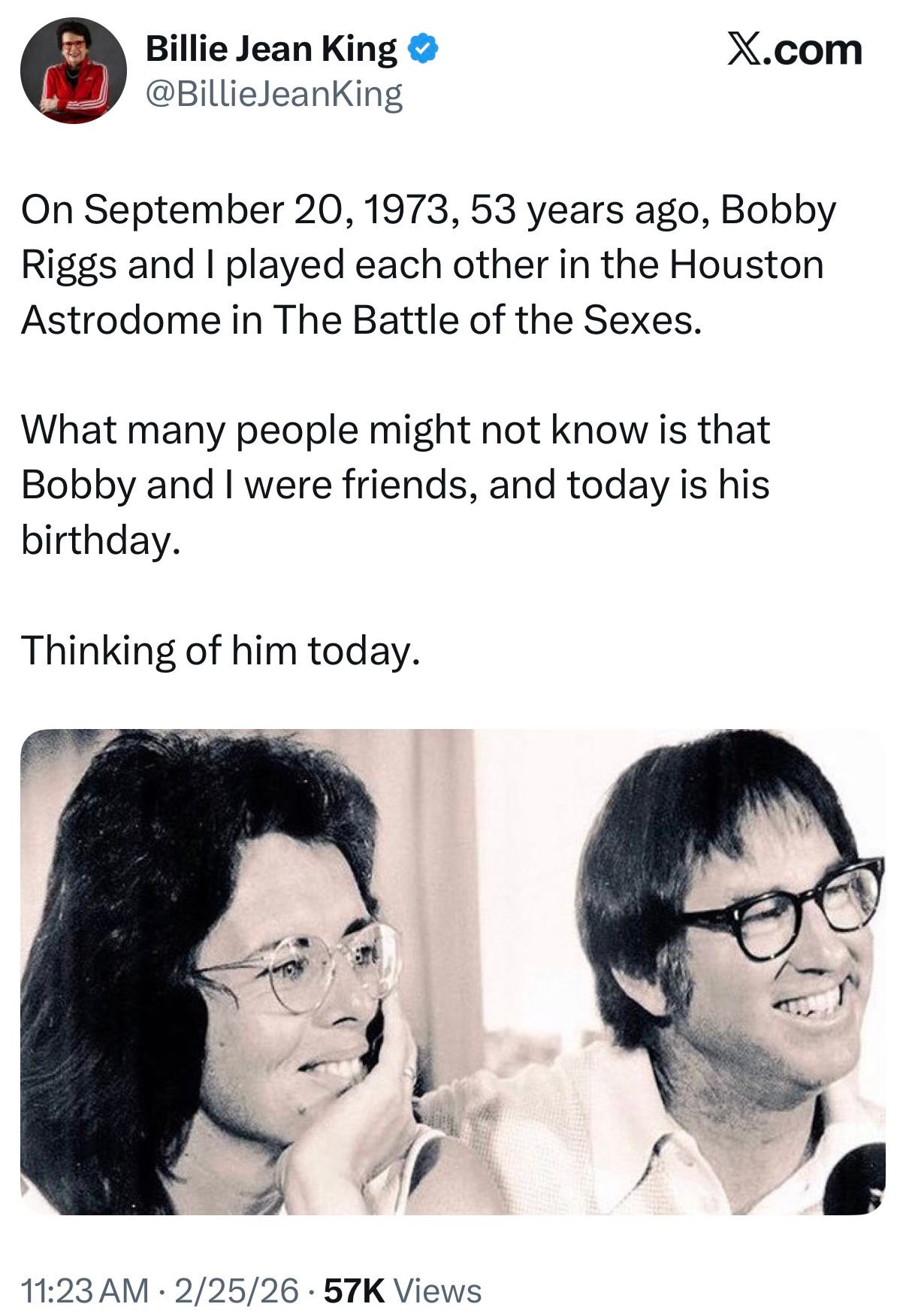
Where were you on the night of September 20, 1973? Like everyone else, I was in front of a television set. I was nine. Around the world, 90 million people watched the same thing. “The Battle of the Sexes,” an exhibition tennis match pitting Billie Jeane King against Bobby Riggs. King won in straight sets.
(Quick aside: In those days, we said “sexes,” instead of “genders”—correctly.)
Last Wednesday, Billie Jean posted the below. Classy lady, she is.
***
I don’t know what the weather will be today, but yesterday in New York was warm and sunny. Here’s a shot of a street in Lower Manhattan. Very New Yorky, I thought. A classic New York “vibe.”

Thank you for joining me, everyone. I appreciate your subscriptions. Happy Sunday. Catch you later.
The perfect Sunday morning read.
Thank you for sharing your thoughts.
It is not often you get Winston Churchill, the B-52s, and Billie Jean King in the same essay.
** This one began, “It’s JD Vance. I wish I could just call you.” **
I wish J.D. would call me. He can't be a happy man, with all his grievances and his party spirit. (Not the Lionel Richie and Jimmy Buffett kind of party: the "faction" kind.) I'd love to tell J.D. about the God of love and Oneness, the Lord who is "a meal for the poorest of the poor, a welcome door to the stranger." There will be cake!