


For about 25 years, I have traveled to a village in New York, where I have family. The village has a number of immigrants, both legal and illegal (I imagine). I have watched them, and interacted with them, for this quarter-century. They work their backsides off.
I like to talk with them about their roots, their present circumstances, their dreams. I am curious about people: where they come from, their mother tongues, etc. (This is one reason I became a journalist.)
Well, let me tell you about something that happened over Christmas.
I was in a barbershop, and the barber was a young man, maybe 18. I asked him where he was from. He named a town in Connecticut, I believe. Anyway, the young man couldn’t pronounce the name of the town very well.
He was clearly from Latin America, probably Central America.
I said, “Well, what country have you come from, where were you born?”
He said, indignantly and vehemently, “I born here!”
Then I understood. I had forgotten. I had behaved the way I always have. I had forgotten “what time it is,” as the Heritage Foundation would say. It’s ICE time.
I said no more. But I wanted to coach this young man a little. I wanted to say something like, “Look, if you’re going to answer the way you have, put a ‘was’ between ‘I’ and ‘born’: ‘I was born here.’ And try not to flip the ‘r’ in ‘born,’ okay?”
He had said, “I borrn here!”
I have nothing profound to leave with you. I am simply relating a tale of our time.
***
In column after column, I keep saying how much I admire the Ukrainians: their perseverance, their self-sacrifice, their patriotism. Here is another story: “Ukraine’s young skiers practice in a bombed-out Olympic training base.” I will quote the first few paragraphs:
Young athletes in northern Ukraine spend their days cross-country skiing through a scorched forest, focused on their form—until a siren inevitably shatters the silence.
They respond swiftly but without panic, ditching their skis and following coaches to an underground bomb shelter.
It’s an ordinary training session at the complex that produced Ukraine’s first Olympic medalist.
***
I feel for María Corina Machado, the leader of the Venezuelan democracy movement. She won the Nobel Peace Prize last year. But that was a prize that the president of the United States, Donald Trump, coveted. And campaigned for.
That left Machado in an awkward position.
As you have read, she made Trump a gift of her Nobel medal. I suppose this was a smart tactic—she and her movement need the support of the United States. But it was also debasing, in my opinion.
And what kind of man would accept another person’s Nobel medal? Particularly from a woman, I would say? Shouldn’t an American president say, “No, the medal is yours! We will help you anyway, to the extent we can”?
My critics on the right will say, as they always do, that I suffer from “TDS,” meaning “Trump Derangement Syndrome.” If so, then I have suffered from “TDS” my entire life. Because my principles and values have not changed (for better or worse).
***
Back to ICE. I would like to note some stories on the subject. This one is hard to take: “Federal immigration agents filmed dragging a woman from her car in Minneapolis.”
This is hard to take too. It relates to the story—the vignette—I began my column with.
A man says, “Why are you asking me for my paperwork?” The ICE agent says, “Because of your accent.” But, as the man points out, the agent has an accent too.
The agent then says, “Where were you born, sir?” The man replies, “Where were you born at?”
Another tale of our time.
I thought this comment was apt:

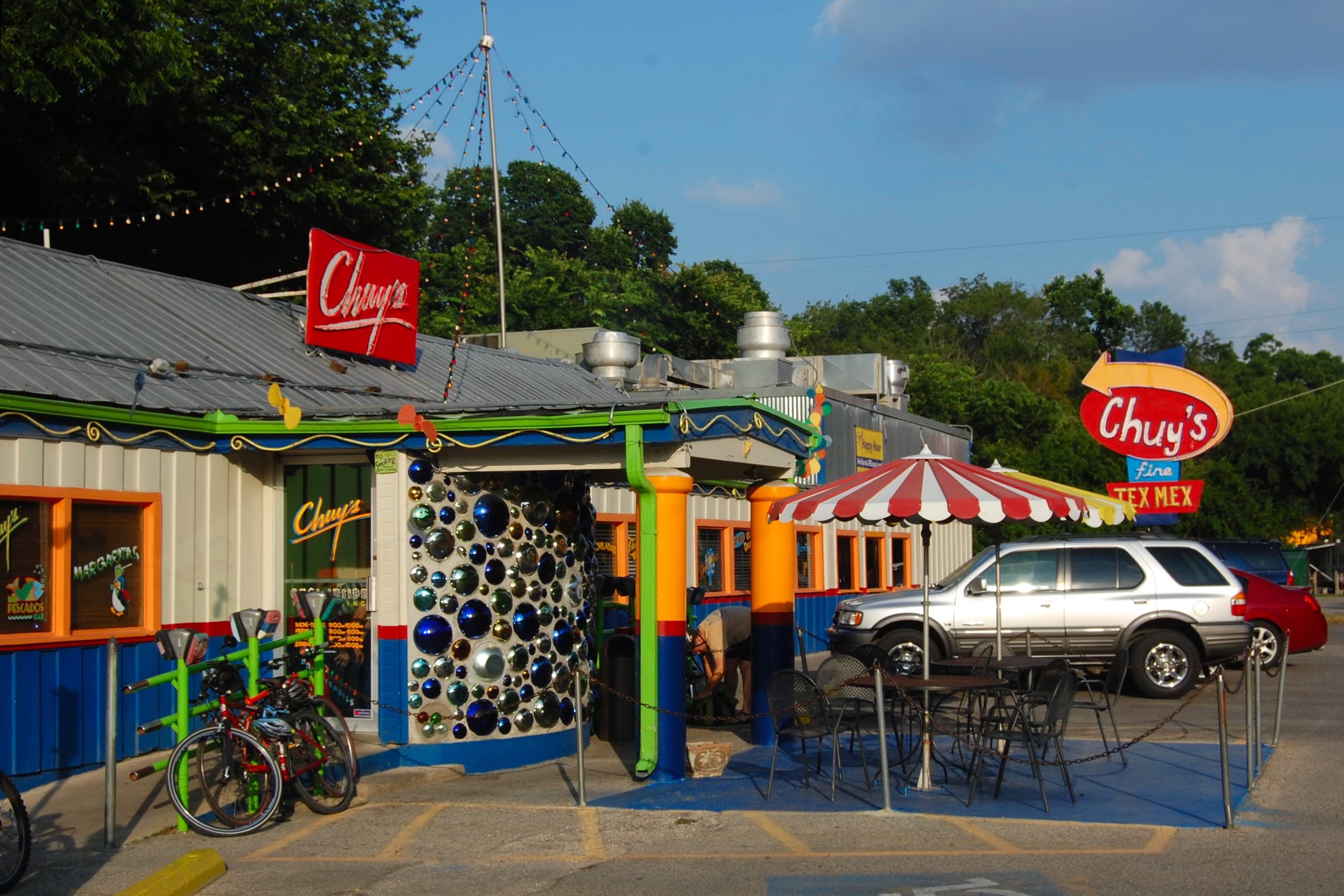
Then there is the story of the Mexican restaurant—where ICE agents had lunch and then came back in the evening to arrest the workers.
One more thing—this:
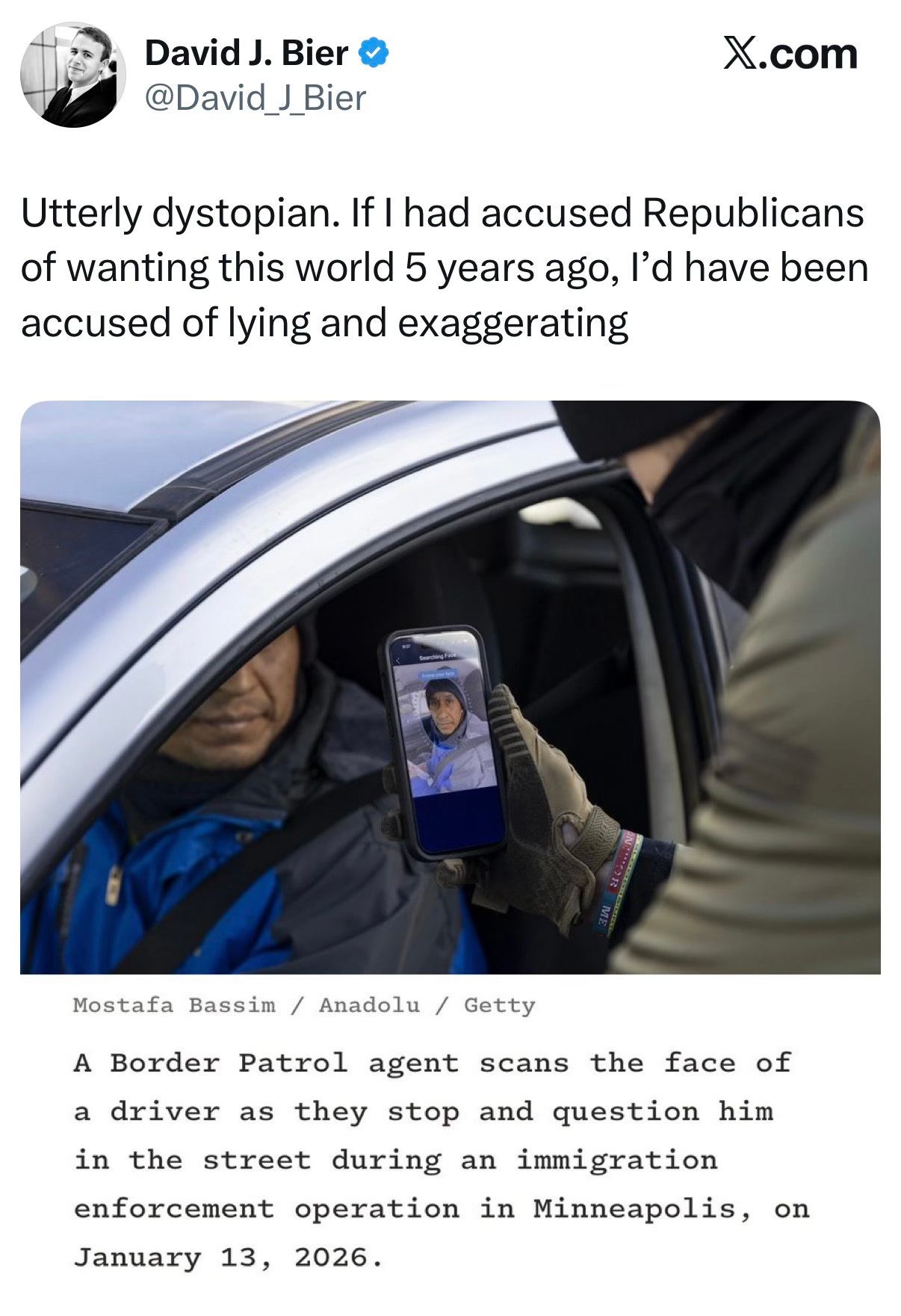
We are a long, long way from Tibet, or Xinjiang (home of the Uyghurs), or The Lives of Others (the film about the Stasi in East Germany). I also know that law enforcement must avail themselves of technological innovation. But I still say: beware the surveillance state. This is America.
I have always been pro-police—pro-police to a fault, some of my libertarian friends have said. I am instinctively, reflexively with the police. They are our friends and protectors, against a dark and lawless world.
(For a 2014 essay I wrote on the subject, go here.)
But police can be lawless themselves, of course. And we can do two things at once: enforce our laws, vigorously, and maintain our humane and democratic values.
To be continued (whether we like it or not) ...
***
I intend to write an article about the Kennedy Center—Trump’s renaming of it. In the meantime, I wanted to highlight this story: “Trump isn’t waiting for future generations to name things after him. It’s happening now.”
So we have the “Trump Kennedy Center,” the “Donald J. Trump Institute of Peace,” “Trump Accounts,” the “Trump Gold Card,” and on and on.
I would like to make just one point, here and now: George Marshall was about the only person to refer to the Marshall Plan by its formal name: the “European Recovery Program.”
I like Marshall. (He figures in my history of the Nobel Peace Prize, Peace, They Say. Marshall is the laureate for 1953.)
***
Stay on the subject of names for a moment. At the beginning of his second term, Trump decreed that the Gulf of Mexico would henceforth be known as the “Gulf of America.” I had never heard anyone use this term, except in the context of the renaming issue.
But a few weeks ago I was talking with a young man who lives in Florida and works in shipping—and he said “Gulf of America,” unironically.
I thought, “Huh. I wonder how widespread this is ...”
***
We’re nearing the end of this column. Time for a little language? Okay, this is from a sports story: “Mito Pereira, who would have won the PGA Championship in 2022 if he didn’t drive it into the creek on the 72nd hole ...”
“Who would have won” was just fine. But it needed to be followed by “if he hadn’t driven it into the creek ...”
(I can relate—about driving it into the creek.)
***
End on a little music? Sure. Isabel Leonard, the mezzo-soprano, gave a concert in Carnegie Hall with some friends of hers. For a write-up of mine, go here.
And I wish you a pleasant—a blessed!—Sunday. Later, y’all.
One of the really depressing things about the raid on the Mexican restaurant is the number of people who find it hilarious. It’s almost as depressing as the number of people who think Rene Good had it coming, Zelenskyy is a welfare queen, etc. So far, the worst thing for me about living in the Trump era is learning that I don’t live in the country I thought I did.
The polite inquiry is, "I can't place your accent, friend. What part of Texas are you from?"