



A few days ago, I was talking with a friend who is a veteran conservative writer. She was saying that she felt homeless, tribeless, politically. “But I have my friends,” she said.
Yes.
I thought of a story that Bill Buckley used to tell. He told it in various ways, but here is one version, from a column in the New York Times, published in 1983:
There are two strangers taking wine at a café in the French provinces. After a while, one addresses the other, who is reading a newspaper, and asks, “Do you like Americans?” “No,” is the curt answer. ‘‘Well, then, do you like Frenchmen?” Again, “No.” “Well, do you like Jews?” “No.” “Catholics?” “No.” Finally, with some exasperation, ‘‘Well, whom do you like?” Without looking up from his newspaper: ‘‘I like my friends.”
***
You have seen this, I trust, circulated by the president of the United States:
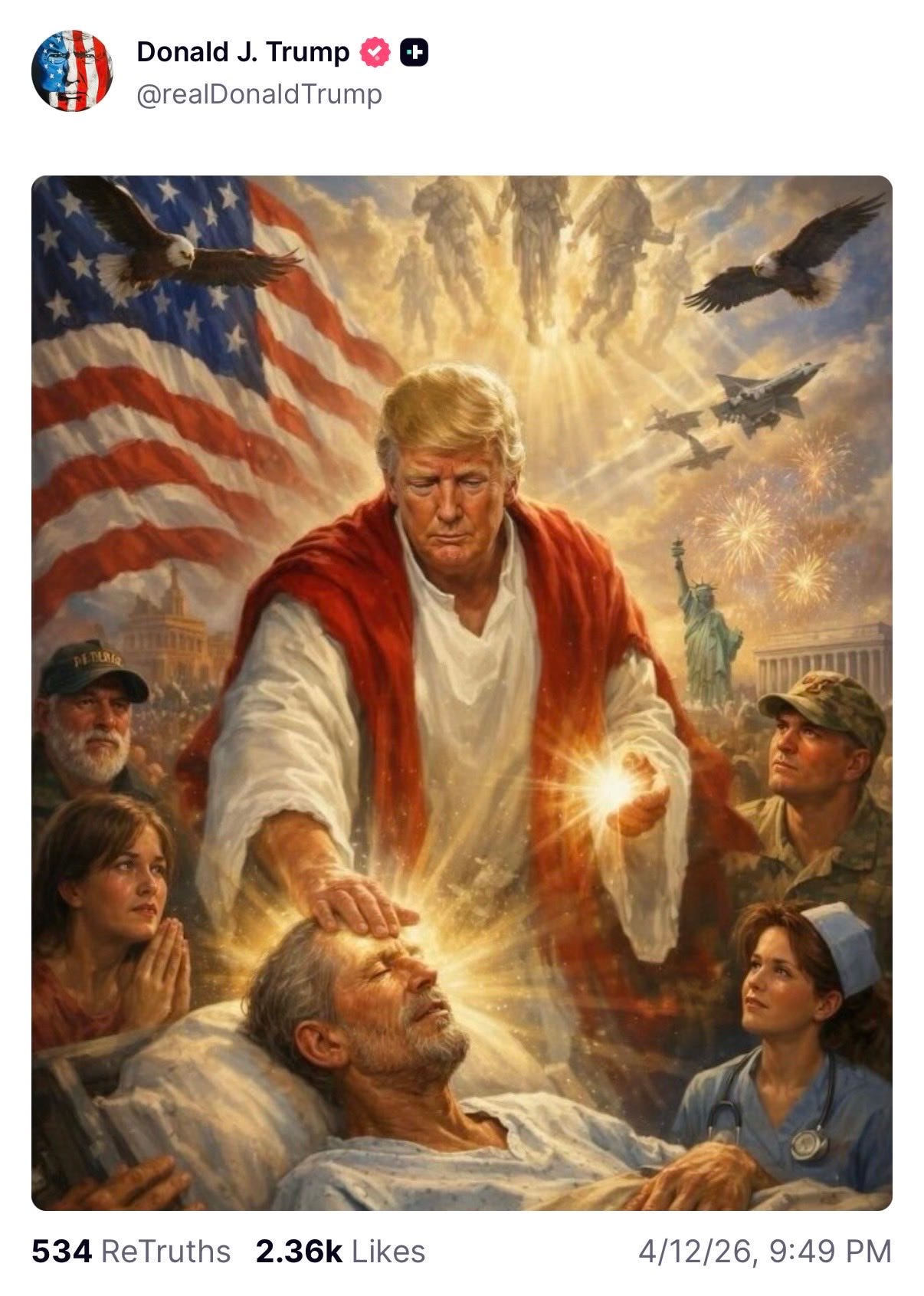
I have long had an idea, which I think would make some publisher some money: a book of Trump iconography. It might sell to everyone: to anti-Trumpers, to marvel at the outlandishness; and to Trumpers, to enjoy the imagery.
Plus, such a book would leave a record, of a time in American history.
Can you imagine, by the way, if a Democratic president—Barack Obama, let’s say—routinely circulated such imagery of himself? Man alive.
Still, a lot of people objected to the Trump-as-Jesus thing, including some Republicans. I will quote from a news report:
Trump on Monday deleted an image of him as Jesus from his Truth Social account amid intense backlash, telling reporters that he thought it was meant to portray him as a doctor.
“I thought it was me as a doctor and had to do with the Red Cross,” he said outside the West Wing. “It’s supposed to be me as a doctor making people better. And I do make people better.”
According to some of my critics, I have “TDS”—“Trump Derangement Syndrome”—but, you know? I’m not sure I believe the president.
In any case, it’s interesting that Trump deleted the image. He is not much of a deleter, which is probably to his credit. He “owns” what he publishes.
He did some serious deleting after the election of 2016, however. Four years earlier, he had jotted a series of tweets about the Electoral College. For a time, on Election Day 2012, it looked like Mitt Romney might win the “popular vote” while losing to President Obama in the Electoral College.
Here is a sample of Trump’s tweeting:
“This election is a total sham and a travesty. We are not a democracy!”
“He lost the popular vote by a lot and won the election. We should have a revolution in this country!”
“More votes equals a loss … revolution!”
“The phoney electoral college made a laughing stock out of our nation. The loser one!”
“The electoral college is a disaster for a democracy.”
Four years later, Trump became president via that very mechanism. He deleted his 2012 tweet storm—but it had been captured by the media at the time.
Kind of interesting, right? It speaks to the tribalism, or partisanship, of everything. Everything is “situational,” ungrounded in principle.
***
The Iran war began on February 28. I have written relatively little about it, which is surprising, given that I have spent a lifetime, virtually, writing about foreign affairs. A great deal about war and peace. And here, my own country is in a war.
I believe it is a war, by the way. I will quote from a column I published on March 24:
“The beginning of wisdom is to call things by their right names.” Who said that? Plato or Confucius? In any case, more than one sage has said it, over the millennia.
President Trump says that only Democrats call the Iran war a “war.” “They call it a ‘war’; we call it a ‘military operation.’”
Vladimir Putin calls his war on Ukraine a “special military operation.” It’s “special,” all right.
Here is a curiosity: The administration that insists on calling the Department of Defense the “Department of War” won’t call the Iran war a “war.”
In any event, I sure as hell hope we win. What would winning look like? That is a challenging question.
We will return to that in a minute.
More quoting of President Trump—who said, “I won’t use the word ‘war’ because they say, if you use the word ‘war,’ that’s maybe not a good thing to do. They don’t like the word ‘war,’ because you’re supposed to get approval, so I’ll use the word ‘military operation,’ which is really what it is.”
This reminds me of Rwanda in 1994. The Clinton administration was reluctant to use the word “genocide”—which applied—because that would have obligated the administration to act.
Trump has also used the phrase “little excursion” to describe our war in Iran. He has done that many times. Some people think that he heard the word “incursion” from someone and interpreted it as “excursion.”
As I mentioned above, I have written about the war relatively little. Five days into it, I published an essay called “Facing Iran.” Two days after that, I published another one, focused on Iranian dissidents and their views of the war.
Concluding that first essay, I wrote,
The ayatollahs’ regime has been in power for 47 years. It has been a curse on mankind: on Iranians, first and foremost; on the Middle East; and on the world at large. There is much to say about the current operation—“Operation Epic Fury,” the Americans call it, while the Israelis call it “Operation Roaring Lion.” There will be plenty of time to say it, as events unfold.
I will say, here and now: I wish our forces, and those of our ally, Israel, every success.
Why have I written relatively little about the war? (I’m asking myself this question, not you, the reader.) Frankly, because I have not been quite sure what to say. I have been waiting for clarity. And if I have nothing to say—nothing interesting, nothing useful, nothing worthwhile—I shouldn’t type.
If you had told me, short years ago, that I would be ambivalent about a U.S.-Israeli attack on the Iranian regime—I would have wondered why.
Our president, Trump, and our secretary of defense, Hegseth, have not filled me with confidence. Their statements on the war have often been cartoonish, sometimes alarmingly so.
And the prime minister of Israel, Benjamin Netanyahu? Two weeks ago, I published an essay on that subject: “Bibi and Me.” That one concludes,
The truth is, I’m ambivalent about Netanyahu. … My only comfort is that others of my acquaintance are in the same boat.
Today, the key question to ask, I think, is: Was the Iran war worth it? I’m not even sure what tense to use: “was”? Is the war over? And how do you decide whether the war was worth it?
We have killed a lot of people—a lot of innocent Iranians. I understand that this is inevitable, or nearly so, in war. Forgive the repetition, but: was it worth it?
What have our objectives been, by the way? (That is a big “by the way.”) Trump, Hegseth, and others have been all over the place.
“Unconditional surrender.” The end of the regime. Freedom for the Iranian people.
The reopening of the Strait of Hormuz?
I think of an old, old saying, dating from antiquity: “If you strike a king, kill him.” Is the regime still standing? What about the state of its nuclear program? Can the regime still inflict harm on its neighbors? What about its internal standing? Is the regime in a position to carry out reprisals against its critics and dissenters, making Iran more oppressive than ever?
As you can see, I have many questions and not many answers. I don’t know whether the war was worth it. “Was”? “Has been”? “Will be”?
Perhaps you are in the same boat as I. To be continued …
***
I have a lot more items for you, but I see I have gone long. I’ll talk to you again soon. (That’s a warning, not a promise.) Maybe I could leave you with a couple of shots of Central Park, springing.


Thank you, my friends. Didn’t we begin this column with friendship? You know this Cole Porter song? “Friendship, friendship, just a perfect blendship.” I think my favorite line is: “If you ever lose your teeth when you’re out to dine, borrow mine.”
Later.
Better than K. Harris is a very low bar. But it's about the only one Trump can clear.
Mr. Nordlinger, your erudition and writing skills are formidable, and I always like and appreciate your viewpoints. But this grated on me a bit, grammatically: "Perhaps you are in the same boat as I." Maybe "...same boat as me."? Or "...the same boat as I am."?