



Last week, I wrote about Joshua Wong, a political prisoner in Hong Kong—heroic. Here and now, I would like to mention another political prisoner in Hong Kong—also heroic. She is Chow Hang-tung, who has been imprisoned for five years. She has just been sentenced to another seven, plus three months.
Her crime? They are two. She has commemorated the Tiananmen Square Massacre (carried out by the Chinese government on June 4, 1989). And she has called for an end to one-party dictatorship.
These are indeed crimes in China—very much including Hong Kong.
In court this month, she had an exchange with the judge, Alex Lee. Perry Link has translated this exchange. He is the eminent American scholar of China, who has also been a friend to dissidents. I wrote about Professor Link in 2023, here.
Let me give you a taste of the exchange in that Hong Kong court. And, by the way, when Judge Lee refers to “sentences,” in the plural, he is referring to the sentences of Chow Hang-tung and her fellow prisoners from the Hong Kong democracy movement.
Chow: “If my actions violate the law—if the law truly cannot accommodate my beliefs—then I would rather be a criminal in a prison than a hypocrite groping my way through a sea of lies for the rest of my life.”
Judge Lee: “You’re going to persist in these beliefs?”
Chow: “Yes.”
Judge Lee: “And you believe that what you are pursuing is justice?”
Chow: “More than justice.”
Judge Lee: “You seem to feel no remorse whatsoever … How does this help with the sentencing? Will it make the sentences lighter? Heavier?”
Chow: “Each time you put another of us in prison, or add time to our sentences, you turn up the volume on our microphones. …”
Judge Lee (smiling): “Well, then, you ought to thank us, no?”
Chow: “Yes, exactly. Our thanks to the court!”
Judge Lee: “But this is no joke. We are going to handle this case rigorously.”
Chow: “I, too, am rigorous when I say I should not have been in prison a single day.”
Let me repeat something that this brave woman said: “If my actions violate the law—if the law truly cannot accommodate my beliefs—then I would rather be a criminal in a prison than a hypocrite groping my way through a sea of lies for the rest of my life.”
We are lucky to have people such as Chow Hang-tung among us—in the human race.
***
Now to the United States. Much has been written about the below message, from a Republican nominee to a statewide office in Texas:
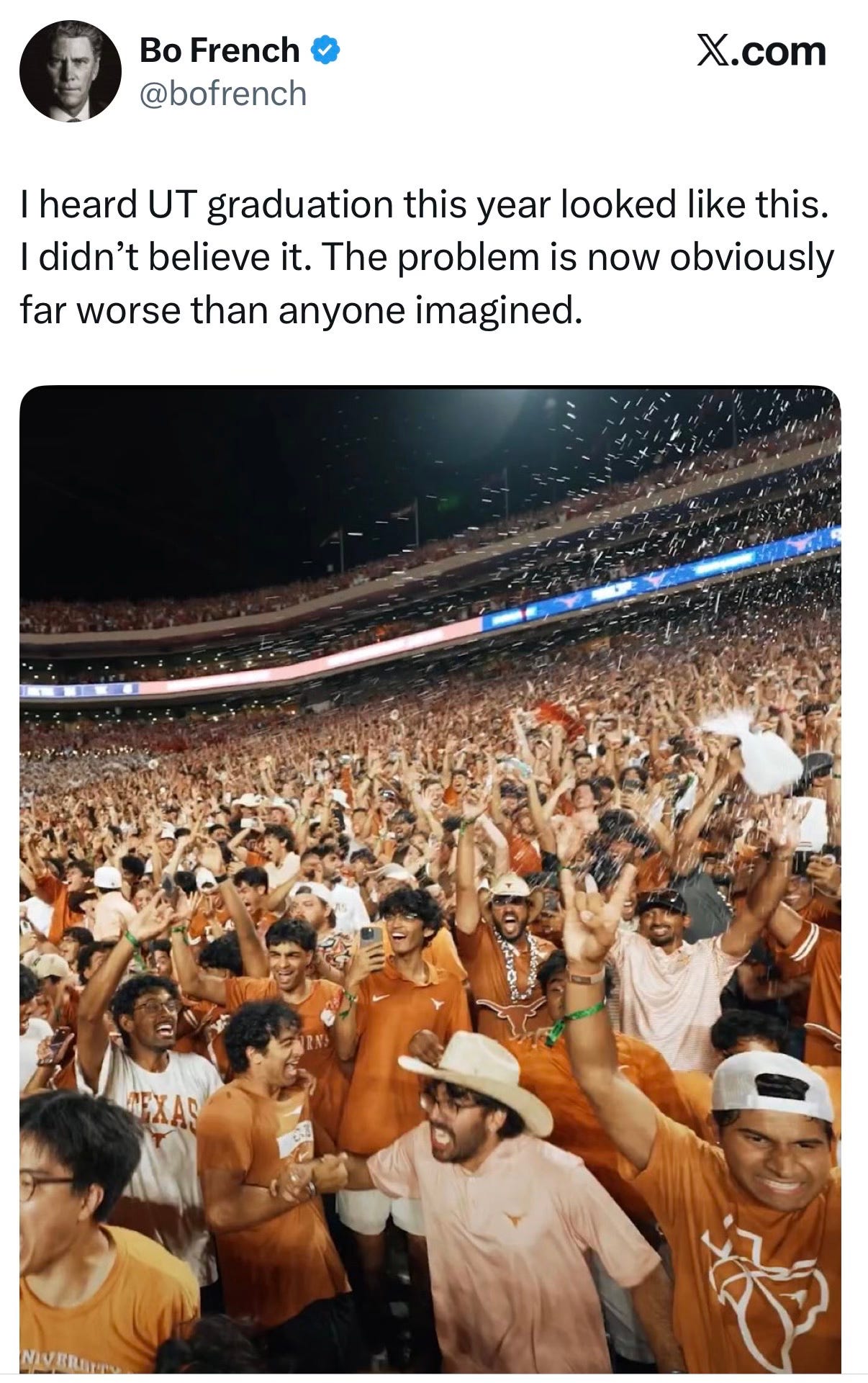
Let me recommend a piece by Nick Catoggio, in The Dispatch: here. I would like to say just a few things about the topic.
1. In my experience, Indian immigrants and their offspring are much better and truer Americans than our nativists. (I have had ample experience with each.)
2. Will that candidate’s message—his tweet—help him or hurt him on Election Day? He must have calculated that. This is sobering, to me, certainly.
3. A friend of mine—an American of South Asian origin—said to me, “Gee. I thought they wanted us to assimilate.” I have noticed a progression, in recent years. Goes like this:
I’m not against immigrants, mind you. Just illegal ones.
What I insist on is assimilation. Being legal isn’t good enough.
Oh, hell, just kidding: I’m against immigration.
4. A critic of mine on social media—one of these people who style themselves “based”—told me I had no idea what it means to be an American.
I think I do. And I will call on President Ford, in a speech he gave on the occasion of our Bicentennial:
To be an American is to subscribe to those principles which the Declaration of Independence proclaims and the Constitution protects—the political values of self-government, liberty and justice, equal rights, and equal opportunity. These beliefs are the secrets of America’s unity from diversity—in my judgment the most magnificent achievement of our 200 years as a nation.
Today, there are people who boast of being “Heritage Americans.” I suppose they are “based,” too. I wonder whether these people are acquainted with our heritage—in particular the Declaration and the Constitution.
I think of Akhil Reed Amar, that son of Indian immigrants, and the Sterling Professor of Law and Political Science at Yale. He may know more about our Founding and its purposes than all the “Heritage Americans” put together.
(For a podcast I did with Professor Amar in 2022, go here.)
5. Texas Republicans were forced to respond to the noxious tweet. The governor, Greg Abbott, did not criticize the tweet directly, nor did he criticize the tweeter. He opened with “That is not my message.” And he closed by pointing out that he had frozen H-1B visas at Texas universities—a freeze that affects Indians in particular.
Governor Abbott’s response seems to me a perfect snapshot of the GOP in our times.
***
In recent days, our vice president, JD Vance, has had favorable things to say about Huey Long and unfavorable things to say about Milton Friedman. In 1968, William F. Buckley Jr. had a famous debate with George Wallace. Which way would the Right go? Which would be “conservatism” in the United States?
Today, Long and Wallace have the upper hand. But Friedman and Buckley are waiting—to be rediscovered and returned to.
***
Yesterday, I was thinking about Israel, and … Hang on, let me tell you a story, before I continue.
Once, President Johnson called up Abba Eban and said, “I was a-scratchin’ of my ass and thinkin’ about Is-ra-el.”
How do I know this? Because Eban told David Pryce-Jones—complete with LBJ accent—and David told me.
Anyway, I was thinking about Israel—and wishing for the appearance of a new party. Then I thought, “If I were an Israeli, founding a party, what would that party look like? What would the party stand for?” Then I thought, “Hell, what if I were founding a party right here at home?”
Back-of-the-envelope kind of thing, these would be the party’s leading principles—its planks, its tenets, its raison d’être:
the rule of law
constitutionalism
the separation of powers
federalism
individual rights
a free economy
international trade
fiscal responsibility
personal responsibility
honesty
good character
intolerance of corruption
a strong national defense
the national interest
democratic alliances
championship of human rights
equality of opportunity
equality under the law
colorblindness (not to be confused with naivety)
civil society (its flourishing); endless little platoons
genuine patriotism (free of jingoism)
pluralism—and yet E pluribus unum
ordered liberty (the lodestar)
I will close by quoting Lesley Gore, singing in 1963: “It’s my party, and I’ll cry if I want to.”
Bless you all, dear readers. Thank you for reading and subscribing—and being.
Jay, I have to tell you I am a full on sucker for your brand of breezy, yet straight to the heart and head, brand of journalism.
I have mentioned this before, but no other journalist of whom I can recall does as fine a job as you with respect to political prisoners of conscience. The only one that compares is Canadian journalist Terry Glavin, in my opinion.
I was appalled and astonished at the tweet from Mr. French.
One of “Donald Ashman’s Ten Tenets of Principled Conservatism is the notion of “support for a mutually advantageous system of immigration that benefits both the immigrant, and the host Country.”
These kookaroos aren’t conservatives; heck, they are nothing but civil, and social, and international disruptors.
Your bit about Heritage Americans made me smile. It reminds me of an exchange about which I have read, between Margaret Thatcher and the press. Margaret Thatcher was talking about British heritage, values, civility and the social customs that unite the Brits. She was asked “what are those values?”
She replied, “Exactly those values the IRA are trying to bomb out of existence.”
Great piece, Jay; a certified pleasure to read.
That single dialogue between Chow Hang-tung and the judge is enough to mark one's entire life as a success.
Here is a smile creating thought ... for those old enough to remember her ... Just imagine what Florence King would have written about Trump. (former NR columnist)