


More than a few analysts have said, “President Trump is not focused on this war”—meaning, the Iran war. “He needs to get focused. This is important.”
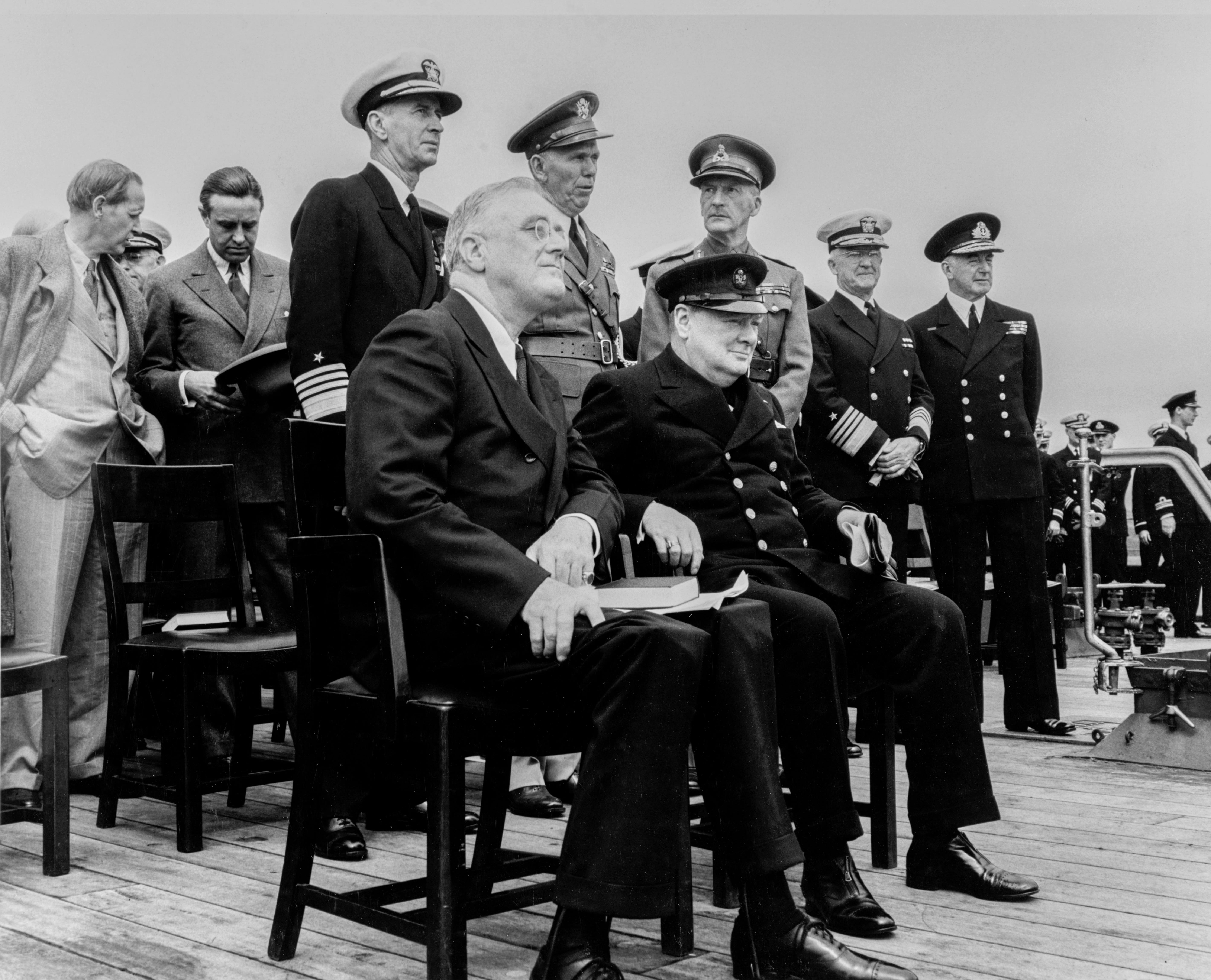
I thought of a phrase from our past: “Dr. Win-the-War.” In a press conference—December 28, 1943—FDR said that America had once needed “Dr. New Deal.” (We might debate that.) After December 7, 1941, however, our country needed “Dr. Win-the-War.”
To read a transcript of that press conference, go here. You might be amazed, as I was, at how a president could talk: in complete and rich sentences and paragraphs.
***
In a column last week, I quoted President Reagan in a speech given to a conference during Captive Nations Week. (This was in July 1987.) He highlighted the case of a Soviet political prisoner, Petro Ruban.
Ruban, said Reagan,
is a prisoner in Special Regimen Labor Camp No. 36-1, one of the most notorious of the Soviet camps. In 1976, he fashioned a wooden replica of the Statue of Liberty and for that was taken away. Later, he was arrested again for criticizing the invasion of Afghanistan.
I thought you might like to see what Ruban said when Reagan died in 2004:
For a long time, the U.S. Congress was struggling to force the Soviet Union to release me from jail as a prisoner of conscience. But only Ronald Reagan achieved this. I was released in May 1988 …
I remember Reagan for his magnificent internal beauty. For me, he is the president who gave me freedom.
And second, I think that in the history of America there was no other political figure, with a bright mind and strong actions, who could ruin the Evil Empire, the Soviet Union.
Several weeks ago, Senator Lindsey Graham (R., S.C.) appeared on Fox News and said, “To Donald J. Trump: You just surpassed Ronald Reagan as the most consequential Republican president since Lincoln.” He went on to say, “You’re Reagan plus, plus, plus.”
Some of us don’t think so.
***
At The Dispatch, Ivana Greco had an article about Nathan Hale—specifically, about the statue of Hale at Yale. (I did not mean to make a rhyme.) To refresh your memory on this illustrious American, I will quote Wikipedia:
Nathan Hale (June 6, 1755–September 22, 1776) was an American Patriot, soldier, and spy for the Continental Army during the American Revolutionary War. He volunteered for an intelligence-gathering mission in New York City but was captured by the British and executed.
He was 21.
Talk of a Hale statue made me think of William J. Casey—our CIA director under Reagan. There is a statue of Hale outside CIA headquarters at Langley. Casey never liked this statue—because Hale had been caught.
Here is Casey, giving an after-dinner speech to the Friendly Sons of St. Patrick on March 17, 1981:
… it was not Nathan Hale but the Irish tailor, Mulligan, who was the intelligence hero of the American Revolution.
That was Hercules Mulligan (a memorable name).
We Irish are too frequently deprived of the credit due us.
When the CIA headquarters were built in Langley, Virginia, Allen Dulles—I believe he was of Welsh descent—had a statue of Nathan Hale erected to inspire American intelligence officers. I think we can do better than Nathan Hale.
It is not so much that Nathan Hale is of British descent. What is important is that Nathan Hale got caught. In contrast, Hercules Mulligan kept delivering secrets until the British went home. He never broke his cover to the end. …
Hercules Mulligan, not Nathan Hale, is the example we want to emulate. I intend to speak to the grounds committee about it when I return to Langley tomorrow.
I hope and trust that Casey was (mainly) kidding. (Otherwise, he sounds like Donald Trump putting down another American hero, John McCain.)
***
Dip a toe into literature? Let’s dip. Kevin D. Williamson writes,
There is a new television series out set in the world of The Handmaid’s Tale, which means a new round of not very interesting discussions of the sexual politics at play, the relationship between sex-policing and broader authoritarian tendencies, all that stuff. One thing that is too often left unsaid in these conversations: Margaret Atwood is a hell of a writer, and The Handmaid’s Tale is a novel that is very much worth your time.
Huh. I have read about that novel but have not read it. (I could say the same about many novels. Many, many.)
I have had one encounter with Margaret Atwood. She wrote poems for a song-cycle by Jake Heggie: Songs for Murdered Children. I wrote about that cycle last year, here. Those poems are—damn good. I remember thinking, as I sat in Carnegie Hall, “The Handmaid’s Tale may be deplorable, but one thing seems clear: this woman can write.”
***
The heading over an obit reads, “Andrew Hacker, Author Who Challenged Conventional Thinking, Dies at 96.” I’m not sure this fellow would have been my cup of tea, or that I would have been his. But I was taken by something in his life story.
A political science major, he graduated from Amherst in 1951, from Oxford with a master’s degree in 1953, and from Princeton with a doctorate in 1955. He then joined Cornell as a lecturer, rose to full professor in 1966, and joined Queens College in 1971.
That would be Queens College in New York City, not Queens’ College, Cambridge, in England, or The Queen’s College, Oxford (also in England).
The obit continues,
“I looked at myself in the mirror one day and decided that I didn’t want to spend the rest of my life in an Ivy League school,” Professor Hacker recalled. After 16 years, the transition to the urban melting pot of Queens College was, in his words, “the ultimate.”
“The Cornell students were smarter, but the Queens students were hungrier,” he went on. “The administration at Queens said to me, ‘You want to come here?’ They couldn’t quite believe somebody would want to leave Cornell.”
I was struck by that: “… the Queens students were hungrier.”
***
Feel like a little language? I have pretty much given up on “reticence”—I mean, the retention of its meaning. People have seized it as a synonym for “reluctance.” Therefore, we will have to have a new word meaning “reticence.”
Will “taciturnity” suffice? But it’s a pity to lose “reticence.”
Here’s The Atlantic—The frickin’ Atlantic: “… even as he reiterated his reticence to back a progressive politician such as Gavin Newsom over JD Vance.”
I give up (although I may have some fight in me yet).
(The article from The Atlantic, by the way, is about Hasan Piker and is found here.)
(I had not heard of Hasan Piker until a few weeks ago. Since then, I have heard about practically nothing else.)
***
An old, old word came to thought the other day: “Yugoslavian.” I was writing about Ivo Pogorelich. When we first knew him, he was a “Yugoslavian pianist.” That phrase is burned into my mind, apparently: “Yugoslavian pianist.”
Pogorelich, properly, is Croatian.
Here’s another one: “Günther Herbig, the East German conductor.”
***
I texted a young friend the other day, “Everything copacetic?” I then worried that he might not know this word from long ago. But he did …
***
On social media, I spotted a wonderful video, which came out in 1992. It explains, and illustrates, the “Minnesota goodbye,” which is a long one. See the video here.
Reminded me of something I learned from my grandmother: “What’s the difference between the British and the Yiddish? The British leave without saying goodbye, and the Yiddish say goodbye without leaving.”
***
I was going to see some friends in a few days, and I found myself texting them a line from my dad: “As the butcher said when he bumped into the grinder, it won’t be long now.”
(This same butcher backed into the grinder and “got a little behind in his work.”)
***
Care for a little music? Here’s a review of Alexandre Kantorow, the phenomenal young pianist from France. (He played a recital in Carnegie Hall.)
***
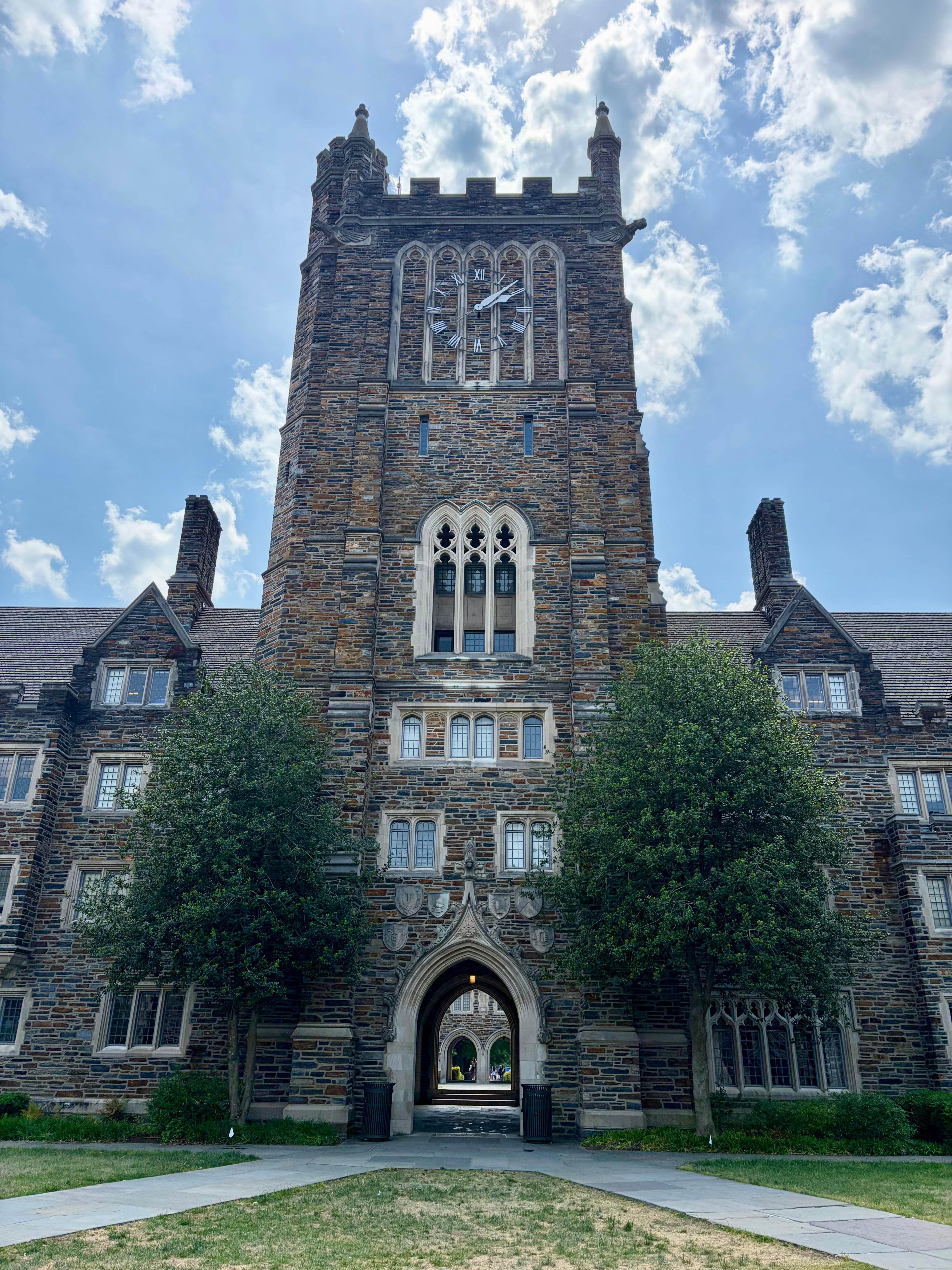
Yesterday, I found myself tramping around Duke University. Here’s a shot:
And here’s James Buchanan Duke, the founder, or funder:
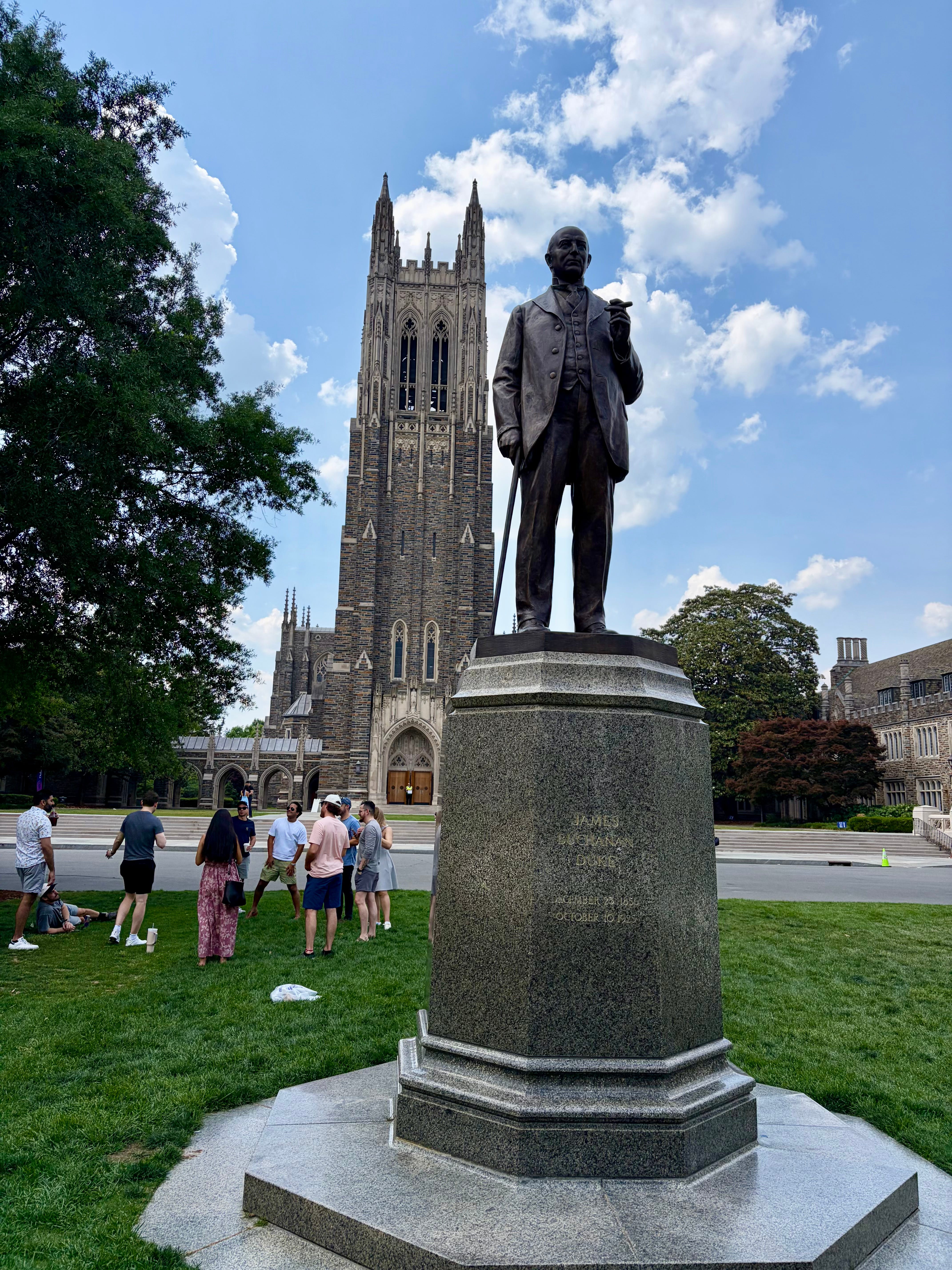
James Buchanan Duke was born on December 23, 1856, several weeks after James Buchanan was elected president of the United States. Did this have an influence on the name?
Dunno. Would like to ask the man’s parents …
***
Before I left for North Carolina, I was at the golf range in New York, talking with a man about the weather. He said, “Any weather I wake up to, is good weather.”
Well, happy weather to you all, and thanks so much for joining me. Talk to you soon.
Please don't give up on "reticent," Mr. Nordlinger.
As a great man with fantastic sentences once said, "Never give in, never give in, never, never, never, never—in nothing, great or small, large or petty—never give in except to convictions of honour and good sense."
I don’t have one particular memory of President Reagan’s leadership, because there are just too many.
But my favourite way to remember him is as a giant among other large leaders.
It is hard to believe that at one time, Margaret Thatcher, Brian Mulroney, and Ronald Reagan were the leaders of Great Britain, Canada, and the USA respectively, at the same time.
Brian Mulroney convinced Margaret Thatcher to harden her edge on South Africa, Brian Mulroney convinced President Reagan to pursue free trade.
My Dad would tell me when I was young, that we were fortunate in the Western World to have stood on the shoulders of giants. When I think of that phrase, I think of the leadership of the 80s, and softly weep for our future.