



Earlier this month, I wrote a piece remembering President Reagan—in particular, how he always took care to separate people under dictatorship from the dictatorship itself. In other words, he never equated the victimized with the victimizers. And, at every opportunity, he spoke over the heads of dictatorships to the people under their thumb, or boot.
My piece is here. (It was prompted by the Iran war.)
In my piece, I quoted a speech that Reagan gave at the Ukrainian National Catholic Shrine in Washington, D.C. That was in July 1987. He began by saying,
Let us look forward to the day when Ukrainian Catholics and members of the Ukrainian Orthodox Church will again be free to gather and worship in churches like this in their own homeland.
Later on, he said,
Our global commitment to freedom does not mandate the sending of arms or troops, but at the very least it means that any people whose liberty is denied or whose independence is violated—that these people know we Americans are on their side.
Yes. That was the point, or one important point. Even if we could do nothing for a people, materially, we would let them know that we were on their side. It was moral (to use an antique word).
Anyway, I quoted the above comments in my piece earlier this month. I would like to quote some more.
Reagan was speaking to a conference during Captive Nations Week. The shrine was a natural venue for the conference. He said,
This commemoration is in keeping with the vision of our Founding Fathers, who saw our new land as an inspiration to all mankind, a bastion of freedom, and a shining beacon of hope for all the world’s oppressed. And that’s what America is all about, and together, we intend to keep her that way.
Doesn’t that seem like a long, long time ago?
Reagan spoke of Abraham Lincoln and his admiration of Lajos Kossuth, that champion of Hungarian independence. Kossuth toured America in 1852, stopping by Springfield, Illinois.
By the way, I have often quoted Kossuth in my writings about peace (this one, for example): “I am a man of peace—God knows how I love peace. But I hope I shall never be such a coward as to mistake oppression for peace.”
Andrei Sakharov, the great Russian dissident, did not like to talk about human rights in general. He did not like to talk about human rights in the abstract. He wanted to talk about particular cases—about political prisoners, especially ones he knew personally.
(His widow, Yelena Bonner, told me this.)
Reagan, too, was mindful to talk about particular cases. Here he is at the Ukrainian shrine:
Petro Ruban, for example, is a prisoner in Special Regimen Labor Camp No. 36-1, one of the most notorious of the Soviet camps. In 1976, he fashioned a wooden replica of the Statue of Liberty and for that was taken away. Later, he was arrested again for criticizing the invasion of Afghanistan.
Well, free Petro and the others in the Gulag and respect people’s fundamental human rights.
That’s the way an American president talked.
He liked jokes—or humorous stories that made a point. Listen:
People who live in the Soviet Union tell many funny stories, often as a form of underground protest. One is about the question: What is a Communist? The answer: A person who has read the works of Marx and Lenin. And the question: What is an anti-Communist? The answer: Someone who understands the works of Marx and Lenin.
About his country, America, Reagan said,
We are the keepers of the flame. It’s up to us to foster the legacy of those who came before us and to ensure America remains a champion of liberty and a force for good in the world.
One more statement from this fella, this kid from Dixon, Illinois:
I think America is heading into one of the greatest periods in its history. Yes, we have our differences, and at times politics can get pretty rough. Democracy is not for weak spirits. Whatever problems we have, whatever differences we have, however, are minor compared with those of our adversaries.
Freedom is now on the offensive. We turned a corner in 1981, and if we have courage and are realistic in our approach to world affairs, freedom will not only survive, it will triumph.
Huh.
***
Speaking of freedom: As I have mentioned in this space before, I am a journalist-in-residence at the Center for the Philosophy of Freedom, which is a component of the University of Arizona, in Tucson. I’m sitting in New York. But I am a journalist-in-residence in spirit, let’s say!
My fellow journalist-in-residence is Johanna Maska, and, on Thursday, we recorded a “Substack Live.” I believe this is a podcast, only one done “live,” rather than on “tape.”
I’m afraid my words are outdated.
In any case, that “live” is here. (And “live” rhymes with “dive,” not “give.”) (English is a mess, isn’t it? A glorious, perfect mess.)
***
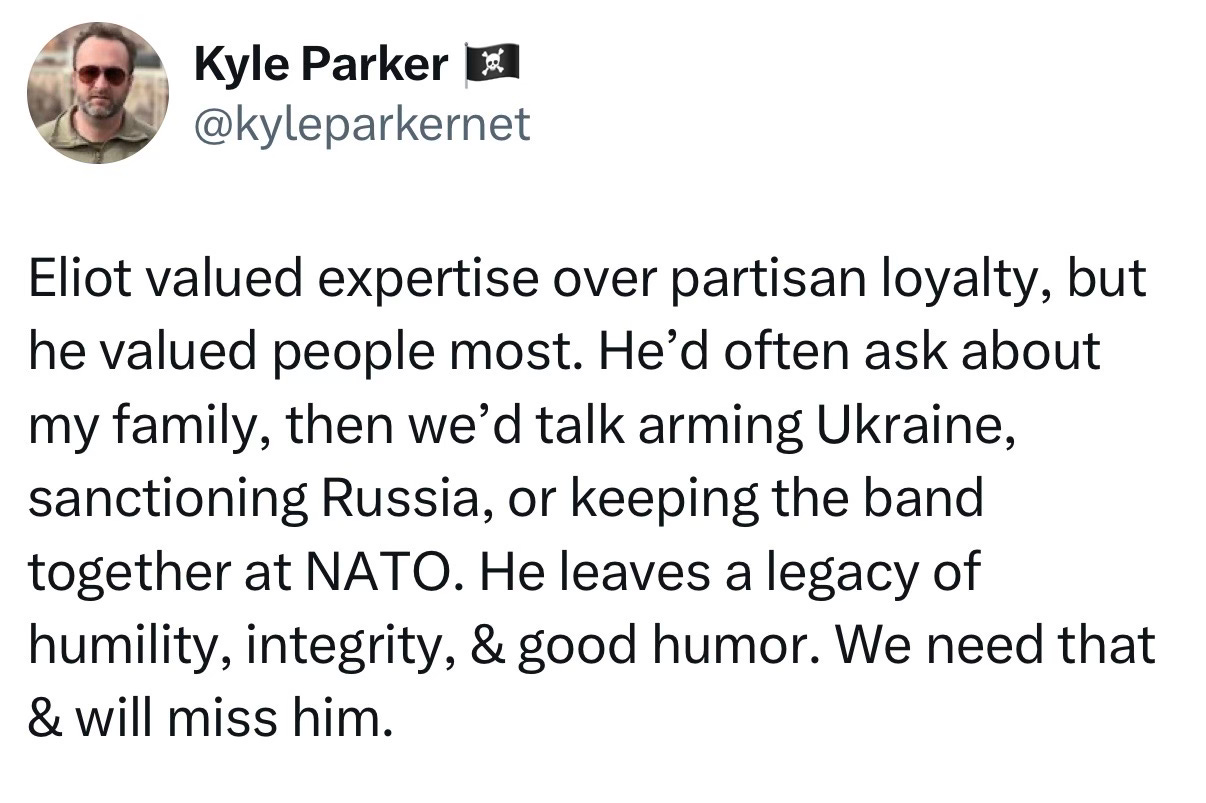
Last week, I had a piece on Eliot Engel—a remembrance, an appreciation. For many years, he was a congressman from New York, and he called himself a “JFK Democrat,” and just about the last of them.
My piece is here. And I thought you’d like to see a comment by Kyle Parker. Kyle is an invaluable guy, the chief of staff at the U.S. Helsinki Commission. I have done a couple of podcasts with him: this one in 2023, for example (and an accompanying article about it is here).
Anyway, Kyle:
***
Feel like a little music? For a review of Khatia Buniatishvili, the Georgian pianist, who gave a recital in Carnegie Hall, go here.
***
A little sports? On Twitter, “Ballesteros” was trending. For me, that can only be Seve, the golf champion. But it was Moisés Ballesteros, a catcher and designated hitter for the Chicago Cubs.
Okay, then!
***
A little language—sort of? On social media, people often express an opinion and add, “and it’s not even close.” For example, “Smith is the best ever, and it’s not even close.”
This is a sign of insecurity, I think. It says, “Don’t argue with me, case closed, shut up.”
Bluster, to be avoided.
***
I spotted a passage from Robert A. Heinlein, which comes from his novel Friday:
A dying culture invariably exhibits personal rudeness. Bad manners. Lack of consideration for others in minor matters. A loss of politeness, of gentle manners, is more significant than is a riot.
That is something to think about, at length.
***
On the subject of manners, or of general behavior: I met some fellow Midwesterners of mine at a restaurant here in New York last week. We were going to have a quick bite. Basically, we had about 45 minutes to talk.
For his family and me, Adam ordered just a little—an appetizer or two, and some sparkling water. He said to the waitress, “We’re pressed for time, a car is picking us up at 1 to go to the airport, so …”
I thought, and said: “That’s so like us. So Midwestern. We have to explain to the waitress why we’re not ordering more. We have to apologize, practically. That is so us, isn’t it? A New Yorker would just order what he wanted—period.”
In all my years here, I have never quite adapted …
Maybe I could paste a little note I wrote in 2021. (It’s “on-topic.”)
I loved Wally Moses—I think everyone did. He was the father of Howard Moses, the president and founder of the Cruise & Vacation Authority, which has handled dozens of National Review cruises. Wally was a businessman and bon vivant from Albany, G-A. He was a great raconteur—one of the best and funniest storytellers in world history. Oh, to hear that splendid southern baritone, in those tales!
A day or two before Howard wrote to inform me that his dad had passed on, I was thinking about him—thinking about Wally. One night, I observed him in the casino—the casino aboard the cruise ship. He played a few hands or rounds of whatever he was playing. Then he said, “I quit.” The pretty young woman behind the table—doing her job and trying to keep him on—said, “Awww, why?” Wally answered—you’ve got to hear the accent, and the sheer breeziness and confidence with which he said it—“Because I want to.”
What is so remarkable about that? Well, in brief: Where I come from, you really didn’t say that. You had to invent some excuse. “I’m tired” or “I told my sister I’d meet her” or whatever. Are you allowed simply to say, “Because I want to”?
I want to be more like Wally when I grow up, and I’m trying.
Have you had enough for one day? Enough out of me? Well, I’ve had enough out of me. Thank you for joining me, my friends, and for your—you know: your support and all that. Later on.
Regarding the passage from Robert A. Heinlein. Yes,very,very true. I'd like to specifically add shame. People seem to have lost the ability to be ashamed. And the ability to apologize. Accidently bump into the wrong person these days,you can very quickly wind up at the OK Corral. If it's truly an accident,smile,apologize,defuse,move on. "I'm sorry,it's on me" goes a long way. Who's got time for a duel?!
As a thick midwesterner, I will never forget my first trip to NYC when standing 12 feet back from the McDonald's counter while pondering breakfast options, to hear the cashier shout, "Hey, are you just going to stand there all day or are you going to order something?" ... "Oh sorry", I replied and quickly read off whatever my eyes were looking at, (which was not what I wanted).