


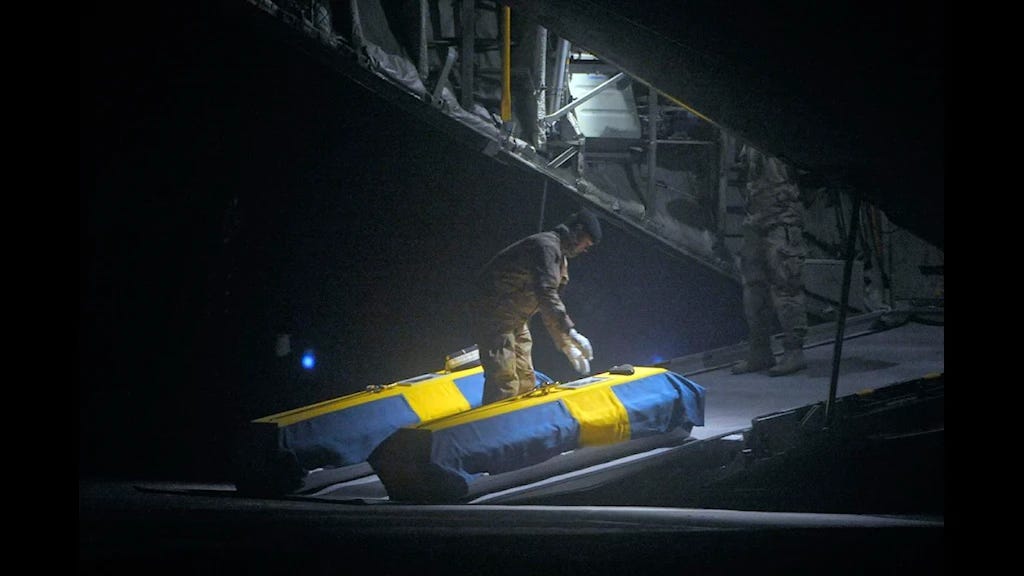
By now, you’ve no doubt heard what President Trump said about our NATO allies: “I’ve always said, ‘Will they be there if we ever needed them?’ That’s really the ultimate test. I’m not sure of that.”
Trump went on to say, “We’ve never needed them. We have never really asked anything of them.”
Recently, we had Nick Burns as a guest on Q&A: here. At the time of 9/11, he was the U.S. ambassador to NATO. And he recounted, during the podcast, how our allies invoked Article 5, in our behalf.
(Article 5, as you know, states that an attack on one is an attack on all.)
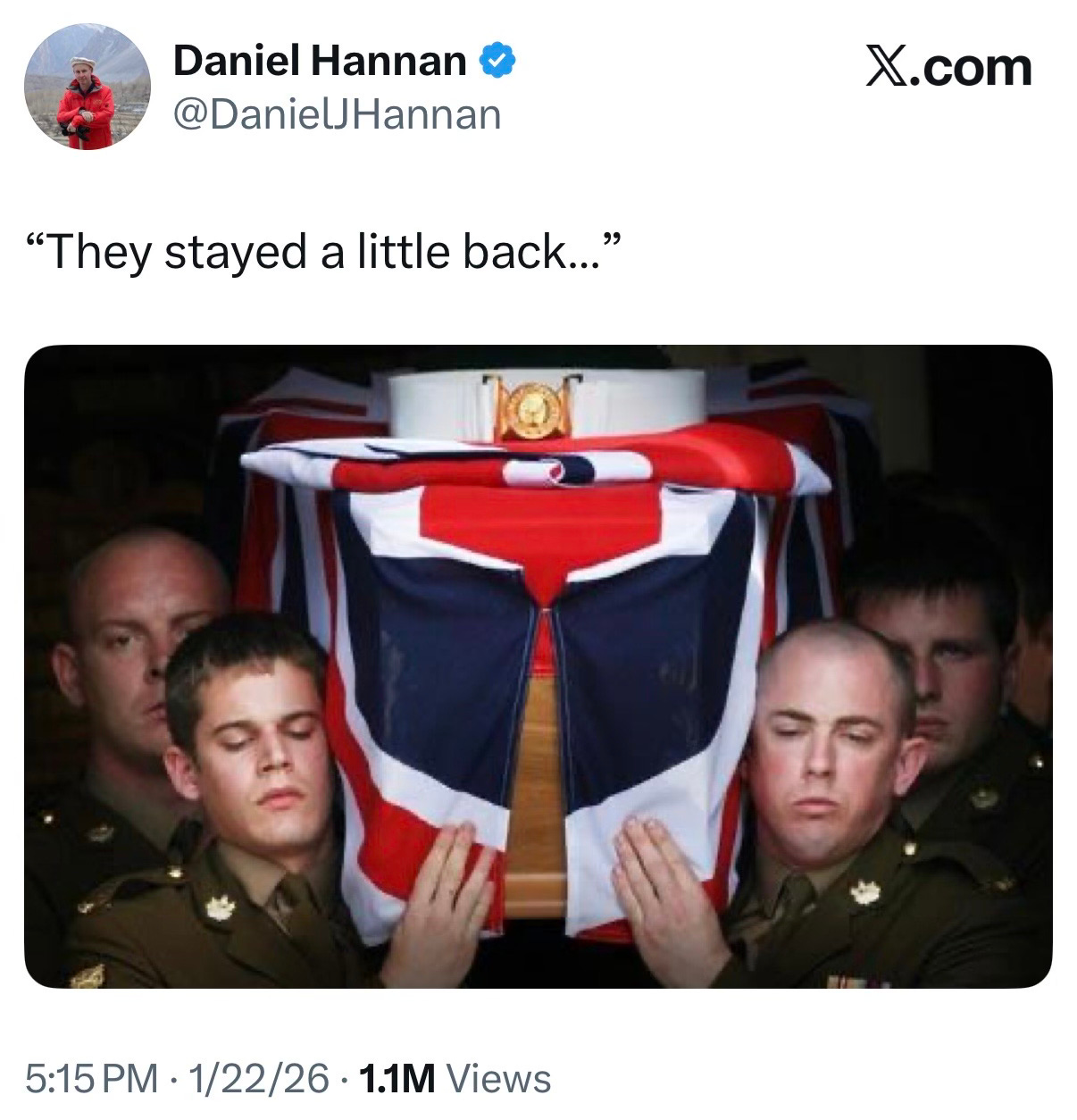
More from President Trump: “They’ll say they sent some troops to Afghanistan or this or that. And they did. They stayed a little back. Little off the front lines.”
But it’s not true.
Take Denmark, the object of Republicans’ wrath lately. That tiny country had 9,500 troops in Afghanistan. Forty-three of them were killed. After the United States, no member of that coalition suffered more losses per capita than Denmark.
(I wrote about this in a report from Copenhagen last year, here.)
***
Over the last week, I’ve had a memory, and I’d like to share it in the form of an excerpt from a journal I wrote in 2008—when I was in Iraq, with a group of fellow journalists:
Our group makes its way to the Faw Palace—one of Saddam’s pleasure palaces. Hideous debauchery and crimes took place here. It is painful to imagine. ...
Americans aren’t the only servicemen here: There are marines from Tonga. They apparently guard the palace. And I just think of laughs around the world: Tonga!
And I remember something that Donald Rumsfeld told me, when I brought up the issue of small countries with him. He said, yes, the countries may be small—and people can laugh. But what if it took some political courage to send troops to Iraq, and some personal courage, too? And what if those troops constitute a decent percentage of the given country’s armed forces? Does anyone ever think of that?
Probably not.
***
This is an answer that Daniel Hannan, the British writer and politician, had to President Trump’s remarks:
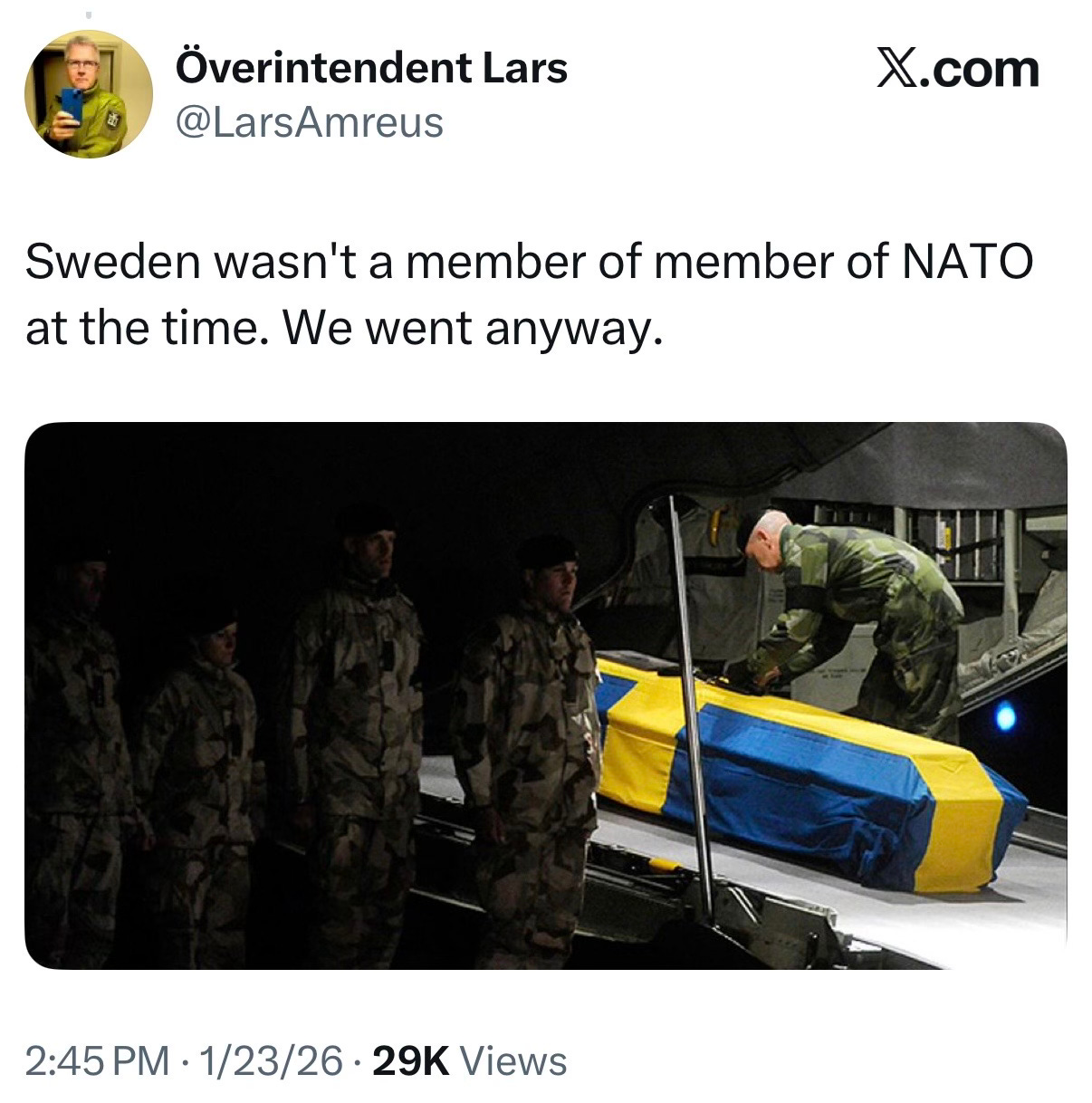
When I circulated and commented on Hannan’s post, a reader responded as follows:
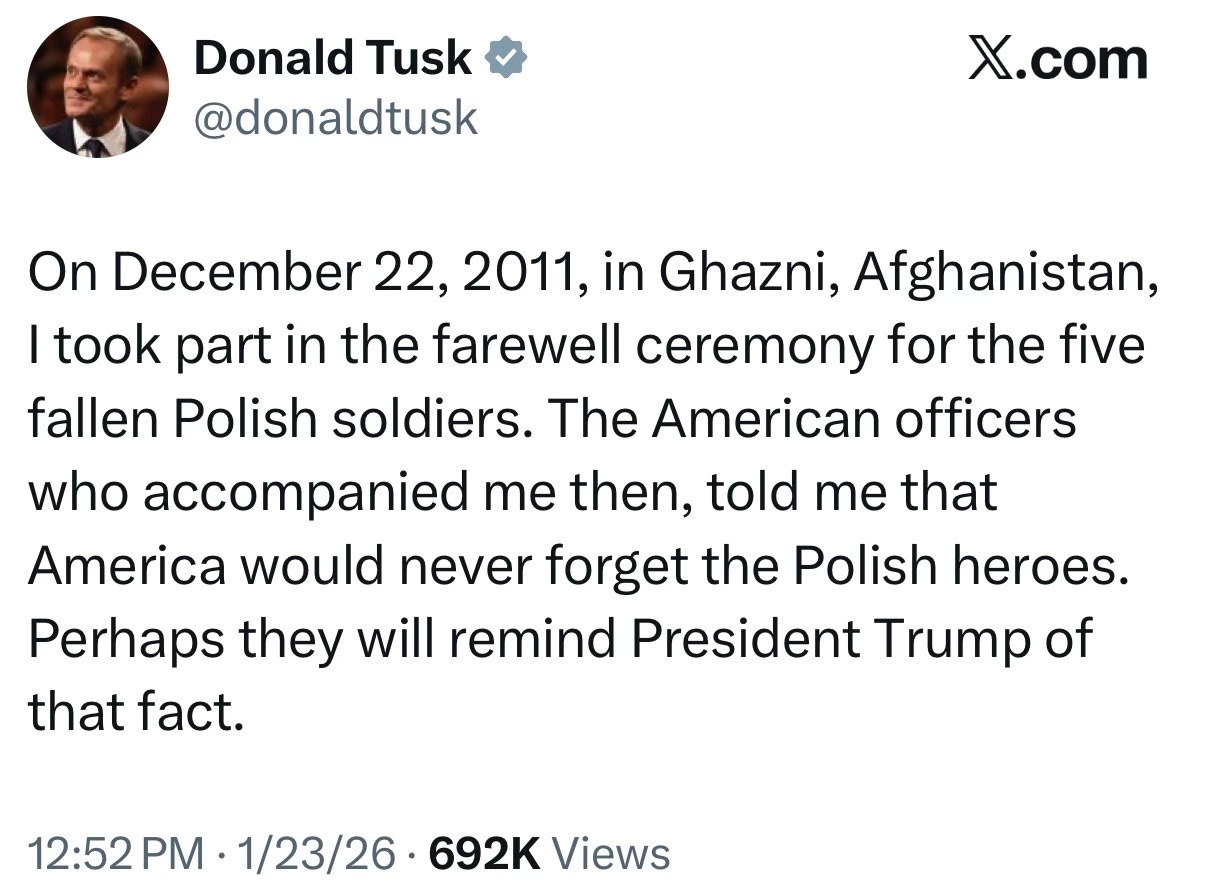
Here is a message from the Polish prime minister:
***
I would like to share a note from a reader of ours—a reader of Onward and Upward—from England. He writes,
What Trump said about NATO soldiers has whipped up people into a rage here in Britain. The usual Trump act is one thing; it’s quite another to insult the families of the dead and mutilated. This has now got to the stage where I have started to see Facebook posts urging people to boycott U.S. products and use their equivalents from other places. I think this is both short-sighted and morally questionable—Trump and his minions are not the whole of the USA—but I worry that this will become a trend.
Maybe I could share, in tandem, the opening of that report of mine from Copenhagen:
Recent weeks have been good for Jolly Cola—a Danish soft drink. Many Danes are boycotting American products, and there is no product that says “America” more than Coca-Cola. In this country, Coke partners with Carlsberg, the Danish brewer—but never mind: The symbolism’s the thing. On the bottles and cans of Jolly Cola, there is a slogan: “A real Danish original—since 1959.”
In addition to boycotting products, Danes are canceling their trips to America. Hundreds have even demonstrated outside the U.S. embassy here. “Back Off, U.S.A,” read a sign. Another sported an old standby: “Yankee, Go Home.”
This is very, very unusual. Denmark has long been a pro-American country, and the Yanks and the Danes have long been close allies. Suddenly, everything is different. There is shock and hurt in this country, especially among people who have been the most America-admiring.
***
Pierre Poilievre is the leader of the Conservative Party in Canada. He has a right flank that is Trump-friendly (very). But he was moved to state the following:
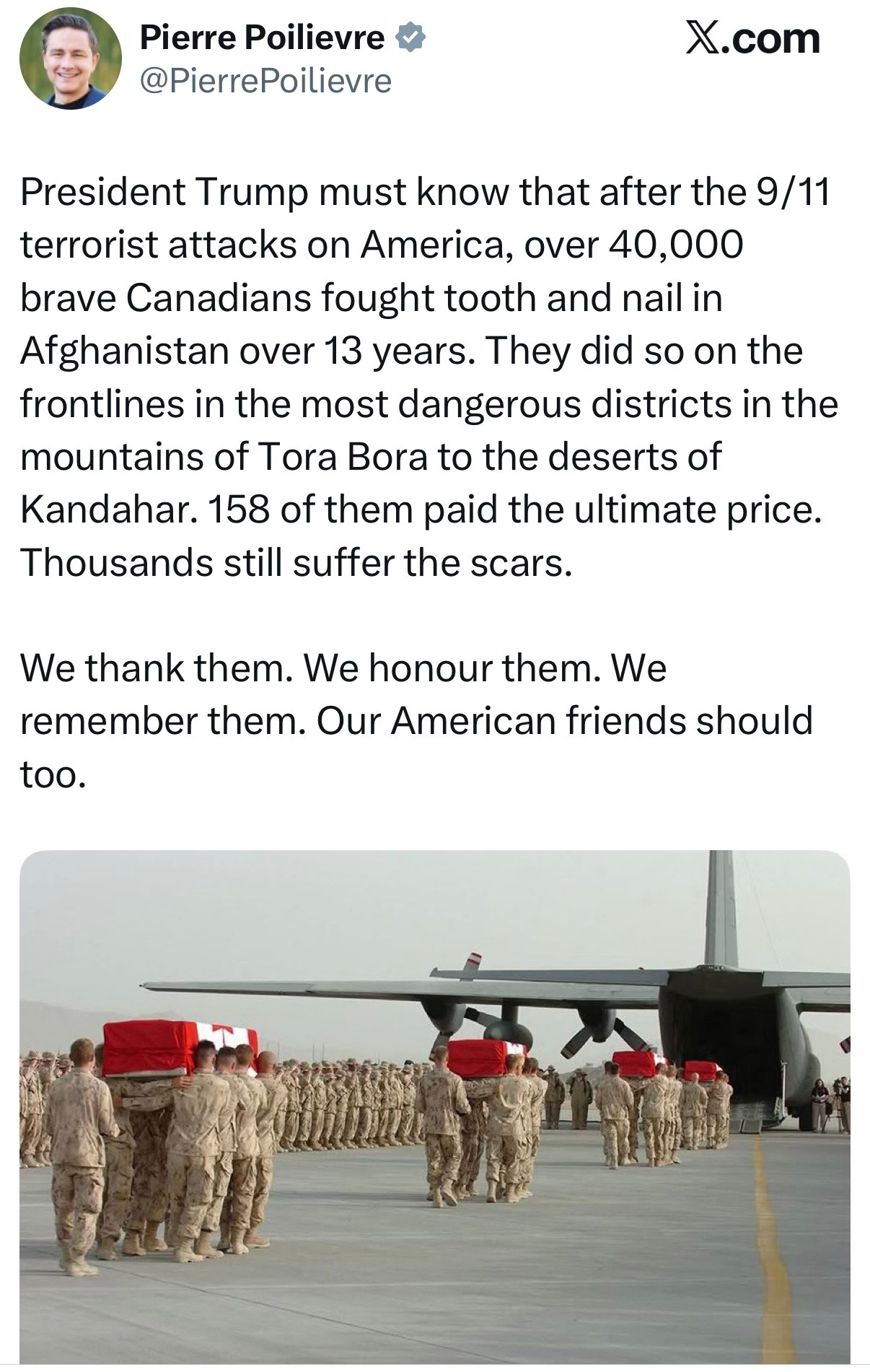
Over the years, I have learned something, from wise heads: We Americans are blessed to have Canada as a neighbor. Despite occasional disagreements, no country could ask for a better neighbor. And they have been a stalwart ally, in matters of war and peace.
(I am practically an honorary Canadian, as a native of southeastern Michigan.) (Although the standard Canadian pronunciation of such words as “about” and “sorry” is ... foreign to me.)
***
I’ve always loved, and quoted, something Donald Rumsfeld said: “America’s not what’s wrong with the world.” The idea that it may not be true any longer, or as true, is ... painful.
***
Yesterday, Stephen Hayes, the editor and CEO of The Dispatch, tweeted, “We were the good guys. We can choose to be again.”
Above, I pasted the opening of my Copenhagen report. Now I’d like to paste the closing:
Two days before coming here, I heard a talk by William McRaven, the retired admiral who commanded our special operations. He is best known for being in charge of the raid that killed bin Laden. He was speaking in New York to a gathering of the Renew Democracy Initiative, an organization chaired by Garry Kasparov, the chess champion who is now a full-time human-rights and democracy champion.
We Americans, McRaven said, have always thought of ourselves as the good guys. We have made mistakes, of course. We are not saints or angels. But on the whole, we are the good guys, standing against the darkness of the world.
To think it might be otherwise—with respect to Ukraine, Denmark, and other arenas—is incredibly bitter.
***
Before I go, maybe I could throw some music at you. In Carnegie Hall two nights ago, Igor Levit played a recital. (He is an eminent pianist.) My post on the evening is here.
While I’m doing music, maybe I could do a little language too?
Levit played two big works: one by Beethoven and one by Frederic Rzewski, an American who lived from 1938 to 2021.
“No one plays these pieces better” than Levit, I say in my post. Here are two more paragraphs:
Now, let me give you a tip, stemming from my thirty-plus years as a professional writer: no one reads. I mean, they read, but they read what they want to read, rather than what you wrote.
If you say, “No one plays these pieces better than Smith,” they’ll think you wrote, “Smith plays these pieces better than anyone else”—when Smith could be tied with Jones, Brown, and a hundred others.
***
A little golf? I had to smile at this kid’s name:
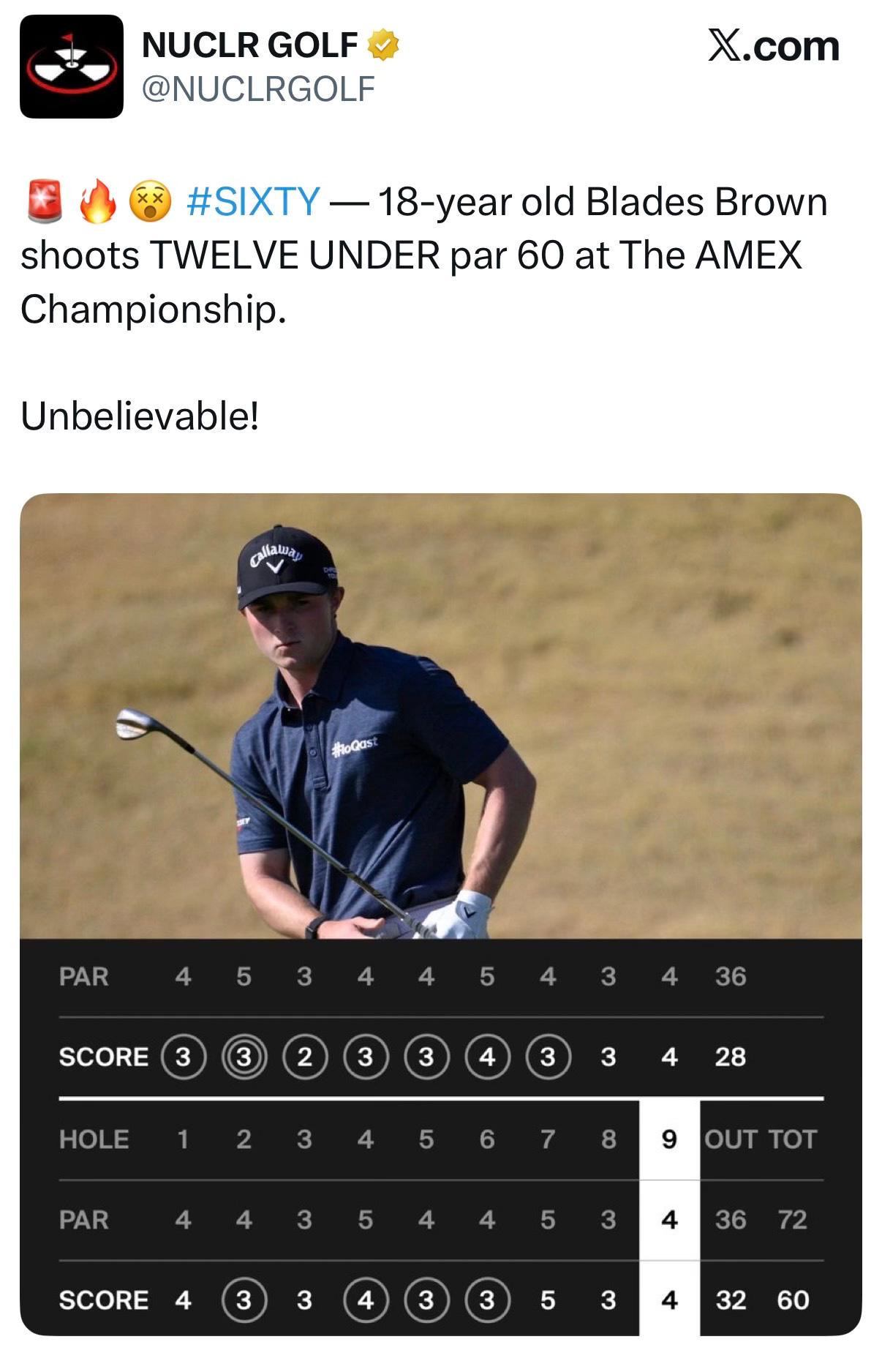
For generations, golfers played with “blades”—“bladed clubs.” Then “cavity-backed clubs” came in, much easier to hit. If Blades Brown shot 60 with the current equipment, I bet he could have shot 70 with the old blades—which would have been ... amazeballs.
***
Well, my own golf was pretty pathetic at the range the other night. But the setting was darn good:

Thank you, Onward and Upward-ers, and I think I’ll be back atcha tomorrow. All the best.
My heart aches for my country.
How did we let the not good guys take over?