



News from Houston, all too typical—all too typical in our country: “Congregation Beth Israel and the school on its campus closed Wednesday after the Houston Police Department informed them about possible threats.”
(That article is found here.)
And it’s not only our own country. The headline over this article reads, “Antisemitic incidents in Canada hit another record high in 2025, Jewish group reports.”
This is an age-old virus, antisemitism. Evidently, it infects even the nicest of countries.
When I made this point on social media, a reader responded,
Get rid of Netanyahu and stop committing genocide. I could be wrong, but I think that is why you are seeing this.
The genocide charge is outrageous—as outrageous as it is routine—but I would like to address something else. Without a sense of history, one might finger Israel as the cause, or one cause, of today’s antisemitism.
But remember: modern Israel was founded in 1948. What about antisemitism—terrifying, murderous antisemitism—in 1848? Or 1348? Or 948? Or 248?
You take my point. There is always an excuse, always a pretext. It did not take modern Israel to occasion antisemitism. In the years directly preceding the establishment of modern Israel, Germany and its allies murdered two-thirds of European Jewry.
I commend to you a book by David Nirenberg, the historian: Anti-Judaism: The Western Tradition.
***
In my column on Sunday, I discussed Nathan Hale and William J. Casey. Hale was the American Patriot and Revolutionary spy, captured and hanged by the British when he was 21. Casey was the CIA director under Reagan.
There is a statue of Hale outside CIA HQ. Casey disliked this statue, very much, because he thought it set a bad example.
On Sunday, I quoted a speech he gave to the Friendly Sons of St. Patrick in 1981:
… it was not Nathan Hale but the Irish tailor, Mulligan, who was the intelligence hero of the American Revolution.
That was Hercules Mulligan, born in Ireland in 1740 and brought to the New World as a child.
Casey went on,
We Irish are too frequently deprived of the credit due us.
When the CIA headquarters were built in Langley, Virginia, Allen Dulles—I believe he was of Welsh descent—had a statue of Nathan Hale erected to inspire American intelligence officers. I think we can do better than Nathan Hale.
It is not so much that Nathan Hale is of British descent. What is important is that Nathan Hale got caught.
Yesterday, I heard from a friend of mine, Deacon Nicholas Dujmovic, now of Greenville, S.C. He writes,
I suspect that I’m your only correspondent who is a former CIA staff historian and an expert on memorials at the Agency. Regarding the Nathan Hale statue at CIA, I was surprised to read that William Casey attributed it to Allen Dulles, because Casey was a pretty good historian himself. The statue actually went up in the fall of 1973, about twelve years after CIA Headquarters was finished and long after Dulles was dismissed as CIA director (because of the Bay of Pigs). It was the idea of Richard Helms and went up when Bill Colby was director.
It’s true that Casey hated the Nathan Hale statue. He was glad it was outside the main building, and his corrective was commissioning a statue of his hero, “Wild Bill” Donovan, the OSS director, which was placed in the main foyer.
What don’t my readers know? Am grateful for them.
***
On social media, a friend was saying that he had just finished a podcast—and he was pleased that he had kept his “um”s to a minimum. “Um”s and such are known as “vocalized pauses.” I learned this term from Bill Buckley. “Iron them out!” he advised a colleague of mine—especially when appearing on television.
They’re kind of natural, “vocalized pauses,” aren’t they?
James Levine, the late conductor, often preceded a statement with an “um.” In fact, someone at the Metropolitan Opera had buttons printed up that said “Um.” She gave the maestro one. He had no idea what it referred to. (She told him.)
***
Let me share something I read the other day. Then I’d like to make a point about our English language.

That “good” in “good for last place” is kind of funny, right?
***
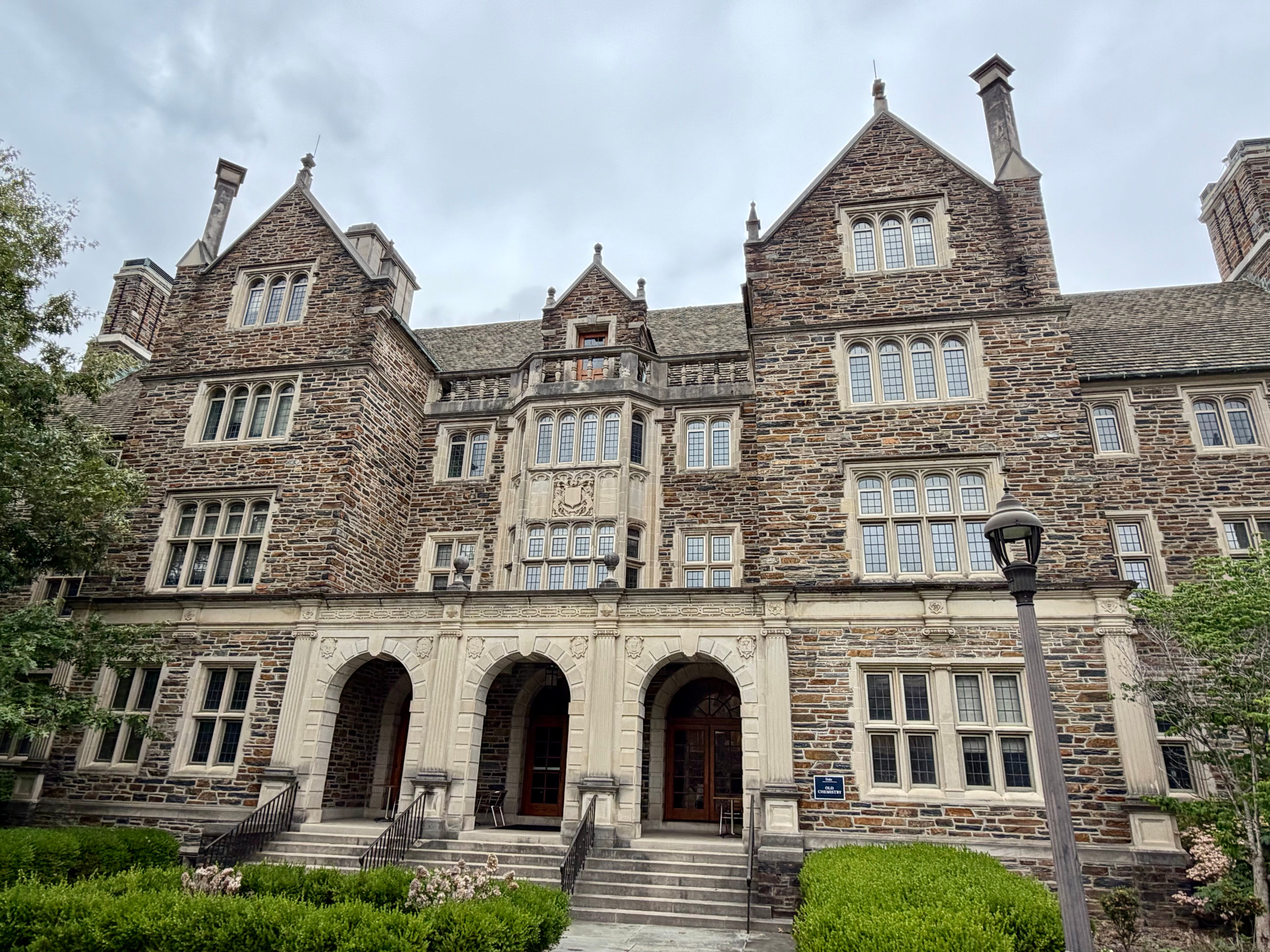
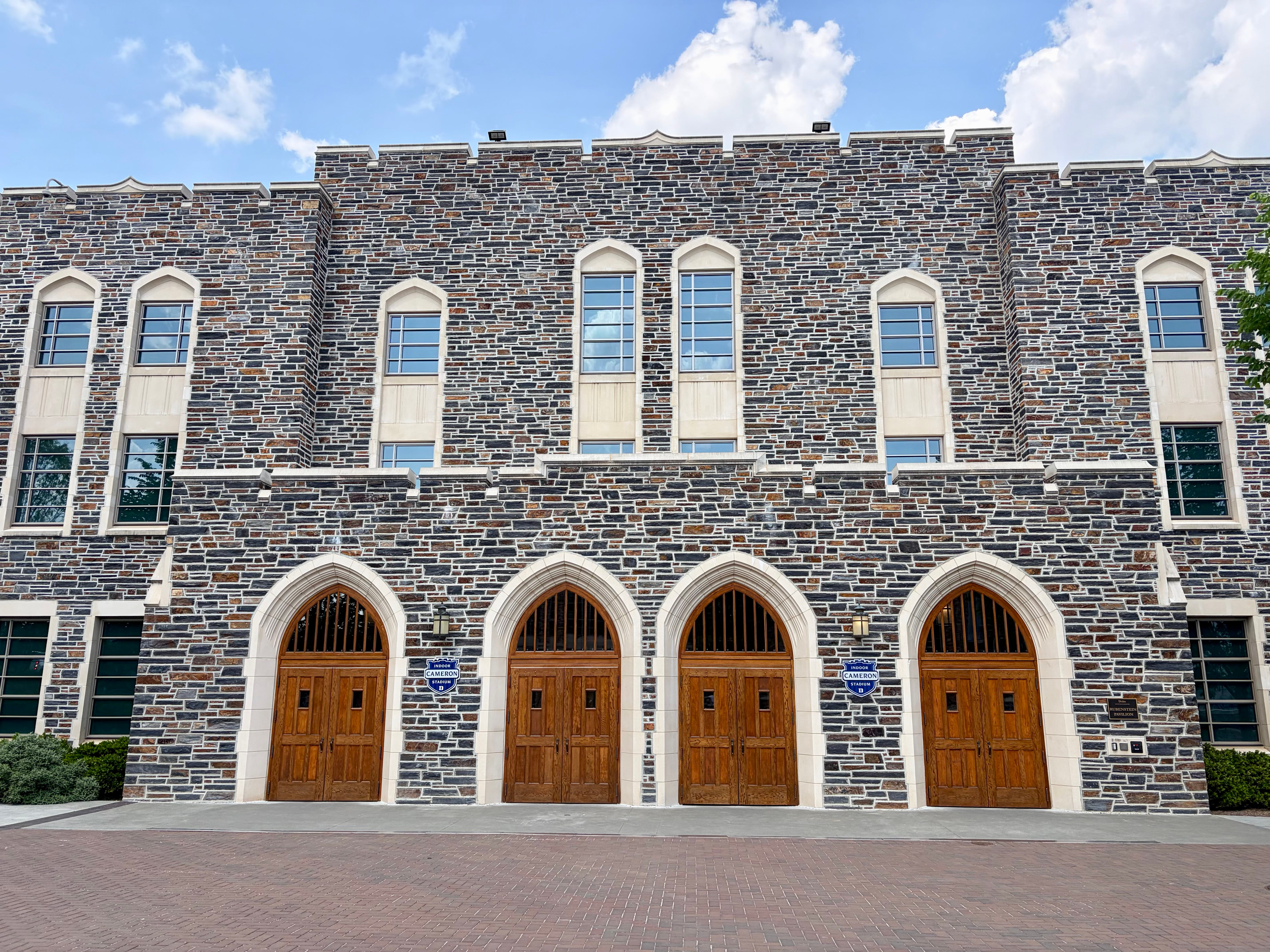
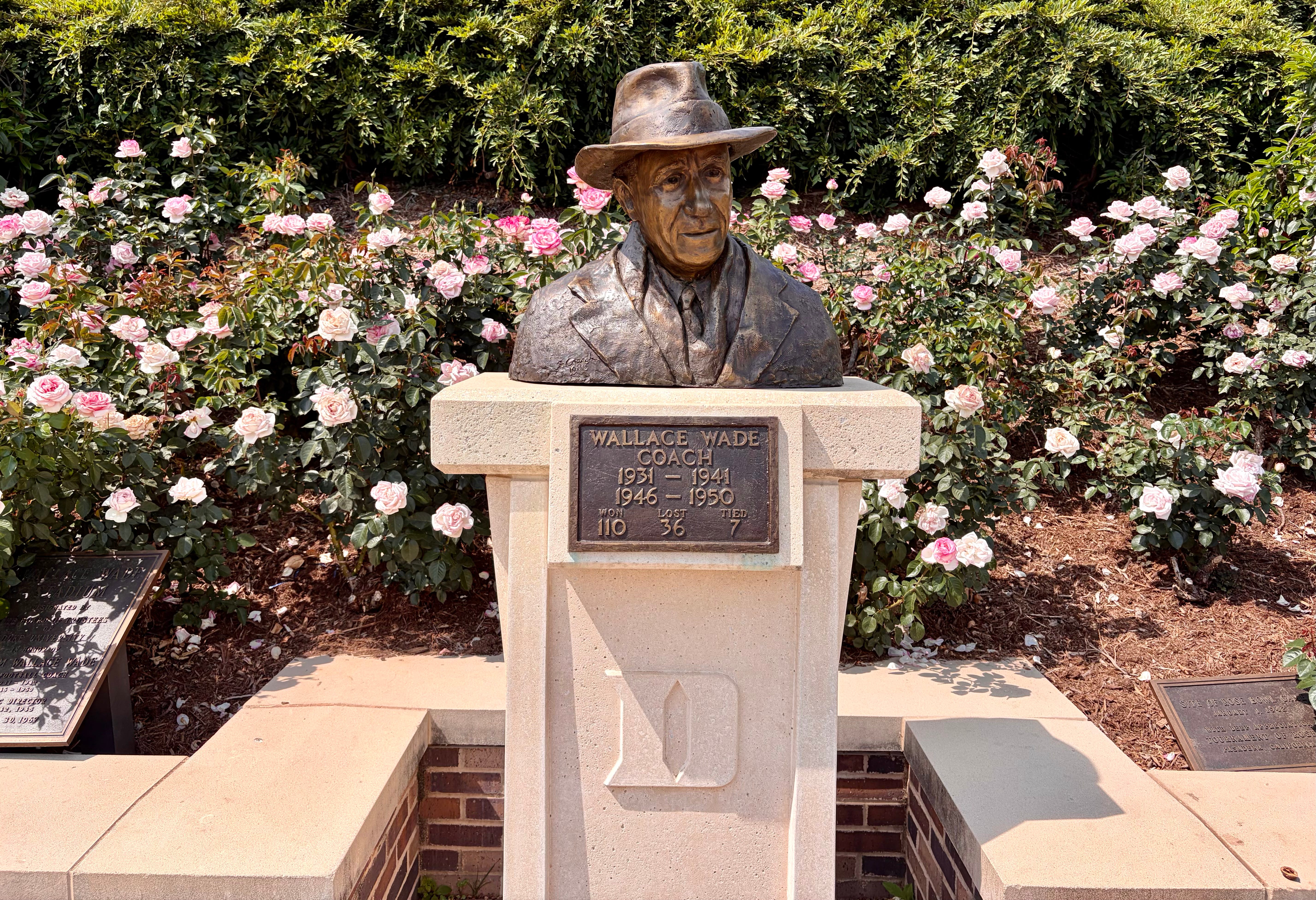
In Sunday’s column, I included a couple of pictures of Duke University. Care for a few more?
I was interested in the “Old Chemistry” building. Is that an old building for chemistry? Or a building in which they teach old chemistry, as opposed to an updated kind? At any rate—handsome:
***
This is the famous basketball venue, Cameron Indoor Stadium. Frankly, I had always thought of it as “Cameron Arena.” But the proper and official designation is “Indoor Stadium.”
***
Here is Wallace Wade, after whom the football stadium is named. I noted the gap: he coached the team from 1931 to 1941, and again from 1946 to 1950.
I looked up the Wikipedia entry for Coach Wade. He indeed served in the Army during World War II. Born in 1892, he was in his fifties.
I fastened on something else in that Wikipedia entry:
Wade played guard on the Brown football team, which went to the 1916 Rose Bowl. One of his teammates at Brown was Fritz Pollard, who went on to become the first African-American coach in the National Football League.
I looked up the Wikipedia entry for Fritz Pollard. Astounding life. His formal name was Frederick Douglass Pollard. He was born in Chicago in 1894, the year before Frederick Douglass died.
***
Check out this sign in Old West Durham. I liked everything about it—including the spelling.

Why not? (“Laundrymat” is probably easier to remember than “laundromat.”)
***
The Raleigh-Durham airport boasts Bond Brothers Kitchen & Bar. The biscuits are truly heavenly, accompanied by some kind of dark jam and honey butter. Right out of Central Casting, if you will allow that formulation …
***
Back home at LaGuardia Airport, I concentrated on something that has long kind of bugged me: the airport is “LaGuardia,” but the mayor after whom it is named is “La Guardia”—Fiorello H. La Guardia.
And wait a second: I now see, on the Internet, that the famous high school named after the mayor—the performing-arts school—calls itself “LaGuardia.” That’s on the website. But the lettering on the building says “La Guardia,” giving the man his space!

Well, all this makes me feel a little spacey myself. See you later.
If if if. That person on social media makes no sense. Since when does Israel and its politics represent all Jews around the world? Presumably, a fair number dislike Netanyahu themselves, given the political tendencies of Jewish people in the United States. But, as you say, people have been finding excuses for at least 2000 years. I suppose I shouldn't expect today's excuses to be any better than those of the past.
A wonderful essay, Jay.
Your writing style reminds me of talking over the fence on a Saturday morning, with a neighbour whose views I admire.
You noted that violent antisemitism is hitting all time highs in Canada, a Country you very kindly referred to as nice.
Synagogues in Montreal, and Toronto have been repeatedly the target of gunfire. Restaurants owned by Jewish folks have been targeted with demonstrations, graffiti, and gunfire. Mobs of anti-Jewish “protesters” block the streets regularly chanting “Death to Israel”, “From the River to the Sea” and, well, you get the drift.
Perhaps less well-known is the number of Christian churches that have been burned to the ground, across the Country. Most will not be rebuilt.
I don’t recognize my Country any more. I am a stranger in my own home.
So, let me thank you for the kind words, but the Country to which you refer died some time ago, and shan’t likely return any time soon.
This essay was a pleasure to read.
Thank you again.