



I had a memory of Cologne Cathedral, sparked by this news report: The cathedral, “a famous German landmark and popular tourist draw, will start charging an admission fee to visitors as church officials struggle with rising maintenance costs.”
One can understand that.
Many years ago, I was on a trip with Paul Johnson, the historian. One of his books is Art: A New History. As we approached Cologne Cathedral, and saw the ugly buildings surrounding it, Paul muttered, “Barbarians.”
That was a great piece of art criticism.
***
Reading about John Cornyn, the Republican senator from Texas, I thought of Earl Long. Cornyn has long been a defender of the filibuster—the filibuster in the Senate. But now, under campaign pressure, he has changed his mind. The filibuster must go.
(To read a news story about this, go here.)
Earl Long was the governor of Louisiana, and a brother of Huey. There’s a famous story about him. There are several versions of it, but the gist of it is this:
Earl has just broken a big campaign promise. A nervous aide says to him, “But Gov’nor, what’ll I tell the folks?” Earl shrugs and says, “Tell ’em I lied.”
***
Every now and then, I make myself read science articles—science articles in the news. Just because I’m not inclined to them, and one should eat one’s vegetables.
But this article was a pleasure to read—more like a dessert. “Ancient coupling may have happened more between human females and Neanderthal males.” That is the headline.
Adithi Ramakrishnan, the reporter, begins,
Humans and Neanderthals cozied up from time to time when they lived in the same areas tens of thousands of years ago. But we don’t know much about who got with whom, or why.
A new genetic analysis offers some ancient gossip …
***
Here is a message from the president of the United States:
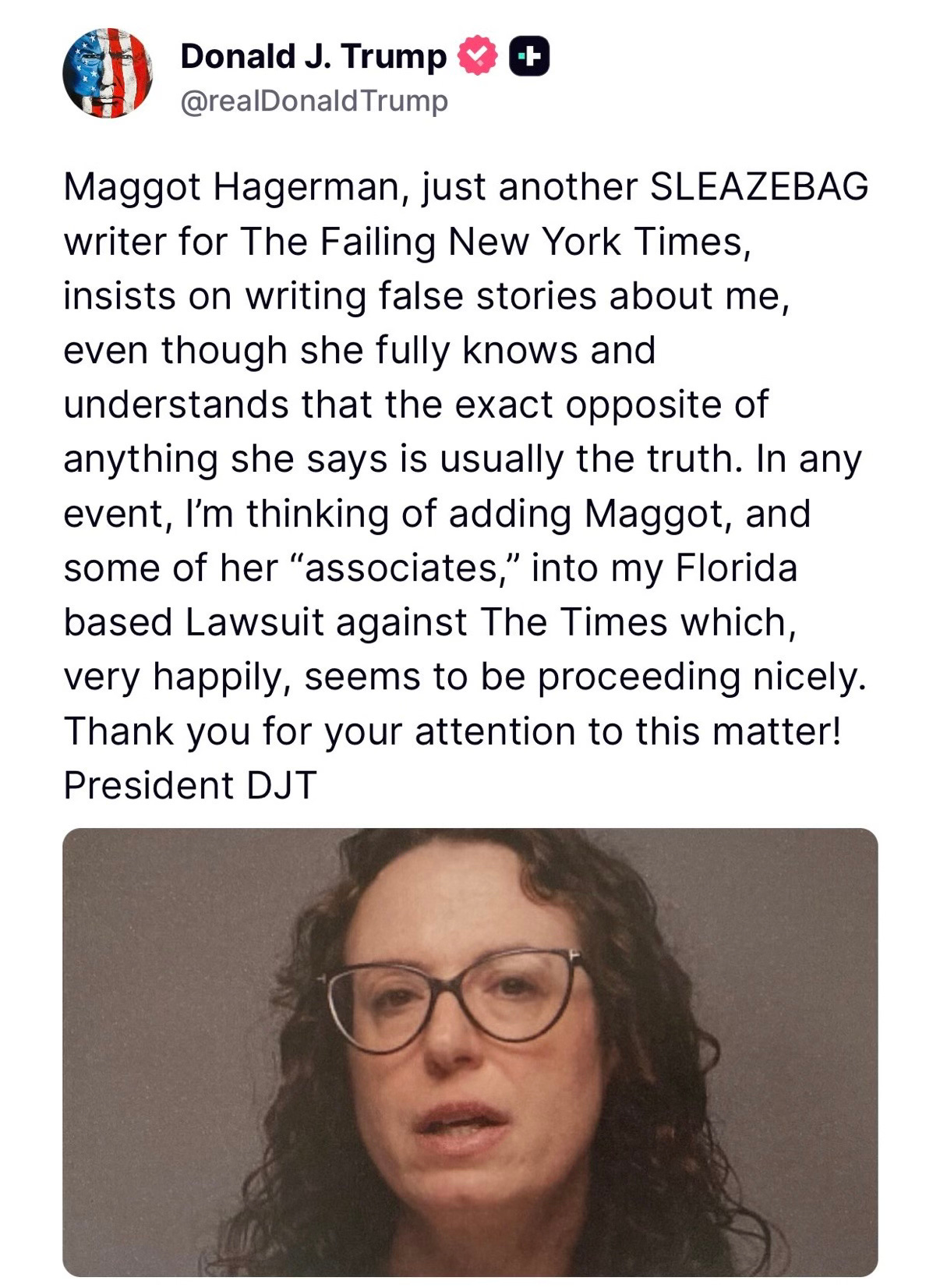
I commented, on social media,
One of the worst things about this era is that it teaches young people that conservatism involves—perhaps even requires—indecency.
I further thought of something that Roger Scruton said—said about Kenneth Minogue, when Ken died in 2013. It was a privilege to know both of these men. (Roger died in 2020.)
Wrote Scruton,
In many ways he was a model of the conservative activist. He was not in the business of destroying things or angering people. He was in the business of defending old-fashioned civility against ideological rage, and he believed this was the real meaning of the freedom that the English-speaking peoples have created and enjoyed.
Scruton further wrote, “For Ken Minogue, decency was not just a way of doing things, but also the point of doing them.”
***
Several years ago, I heard something from a conservative student at the University of Florida. Our conversation went something like this:
“Do you belong to your College Republicans chapter?” (This was from me.)
“No.”
“Huh, why is that?”
“Um, they’re pretty extreme.”
“You mean, they’re rambunctious and juvenile?”
“No. Less innocent than that.”
I thought of my young interlocutor this morning when reading this news story: “University of Florida moves to deactivate College Republicans after report of antisemitic behavior.”
***
For years now, President Trump has expressed his belief in the “racehorse theory” (a phrase he uses). He talks about genetics quite a bit. Especially when he’s talking about immigration.
During the 2024 campaign, he said, “You know, a murderer—I believe this—it’s in their genes. And we got a lot of bad genes in our country right now.”
There are unending examples of such statements from Trump.
Last week, he said to a Fox News host, “A lot of them were let in here, they shouldn’t have been let in.” And “their genetics are not exactly your genetics.”
I said (on social media), “Eugenics from the left, eugenics from the right. An old story. And it has always stunk.”
A young man replied, “I’ve seen racism and antisemitism from the left, but I don’t know that I’ve seen eugenics. Example?”
I answered, simply, that “eugenics was a major progressive cause. For example, the Myrdals wrote an entire book, advocating it. And Margaret Sanger was an ardent eugenicist.”
That book by the Myrdals (Gunnar and Alva) is Crisis in the Population Question. Sanger, as you know, was the founder of Planned Parenthood.
(I wrote about Alva Myrdal a bit in my history of the Nobel Peace Prize, as she won a share of it in 1982.)
***
Maybe I’m right, maybe I’m wrong—but I think I’m right. Not sure. I read this entire article, from the Associated Press. I kept waiting to hear what the sport was. I never did. Never once is the sport identified in the article.
The article is headed, “France wins back-to-back Six Nations titles after beating England 48-46 on last-second penalty.”
The article is 629 words long. The sport in question is never mentioned. I think it should be.
“Last-second penalty” suggests soccer. But 48-46 is high—astronomically high!—for a soccer score.
Via Google, I learned the sport is rugby. (I Googled the words “Six Nations titles.”)
Now, when I was growing up in the American Midwest, we didn’t have rugby. I mean, I knew of its existence, obviously. But I never saw it played. I don’t know the rules, I don’t know the vocab …
Maybe most other people do. Anyway …
***
Care for a little music? Let me throw some reviews at you.
The New York Philharmonic, under Gustavo Dudamel, here.
The Philadelphia Orchestra, under Yannick Nézet-Séguin, here.
Tristan und Isolde at the Metropolitan Opera, here.
The New York Philharmonic, this time under Mirga Gražinytė-Tyla, here.
The Academy of St Martin in the Fields, with Joshua Bell, here.
Dang, that’s a lot.
***
I don’t know rugby and I don’t know chess—despite being affiliated with Garry Kasparov and his organization, the Renew Democracy Initiative. Kasparov was world champ for 20 years. Now he is a world champ in the arena of freedom, democracy, and human rights.
Still, I loved something in an obituary—an obituary of Jan Timman, a Dutch grandmaster. (Not in the sense that Rembrandt and Vermeer are Dutch grandmasters.)
Mr. Timman’s parents may have hoped that he would become a mathematician, but that dream was most likely doomed from the start.
In a book, The Narrow Way (1988), Timman
explained why he preferred being a professional chess player. “There are no school desks or college halls, there’s no pressure to get up early, no duty to give account for anything,” he wrote. “A triumphant feeling takes possession of you. You are your own boss, governed only by your own abilities.”
Wow. The freedom!
Bless you, my friends, and thank you for reading. Talk to you soon.
Oh Mahler. I am not a huge fan of high Romantic German symphonic music. But I sang once in the choir for a performance of Mahler 2. And the thing I found most frustrating wasn't the agonizing wait to get to the point where we all stand up and sing. It is that he wouldn't just end the thing. You have this one glorious, transcendent moment of resolution with the choir in that final movement and then he just keeps churning along for several minutes, dragging out the point. Hmm. Rather like almost all the rest of high romantic German music. Sorry, Jay, it just drives me nuts.
On Donald Trump, conservatism, antisemitism, and eugenics, I have but one comment: each is a product of the organized Left.
Each has been foisted on the Right to some extent, and for some interval, but none has been ever been witnessed by the principled conservatives with whom I am familiar.
There is a university professor in Ontario, Canada, whose name escapes me, who claims that there are over 300 FarRight organization operating in the Province.
When pressed to name the offenders, she cannot. Or refuses. But the narrative persists; the myth further ingrained.
And the beat goes on.