


America is a “universal nation,” yes, but it’s also a specific one, a peculiar one. Here I borrow a word from the King James Bible, which refers repeatedly to “a peculiar people.”
We are a nation “in the air,” if you will—a nation of principles and ideals—but also a nation “on the ground.”
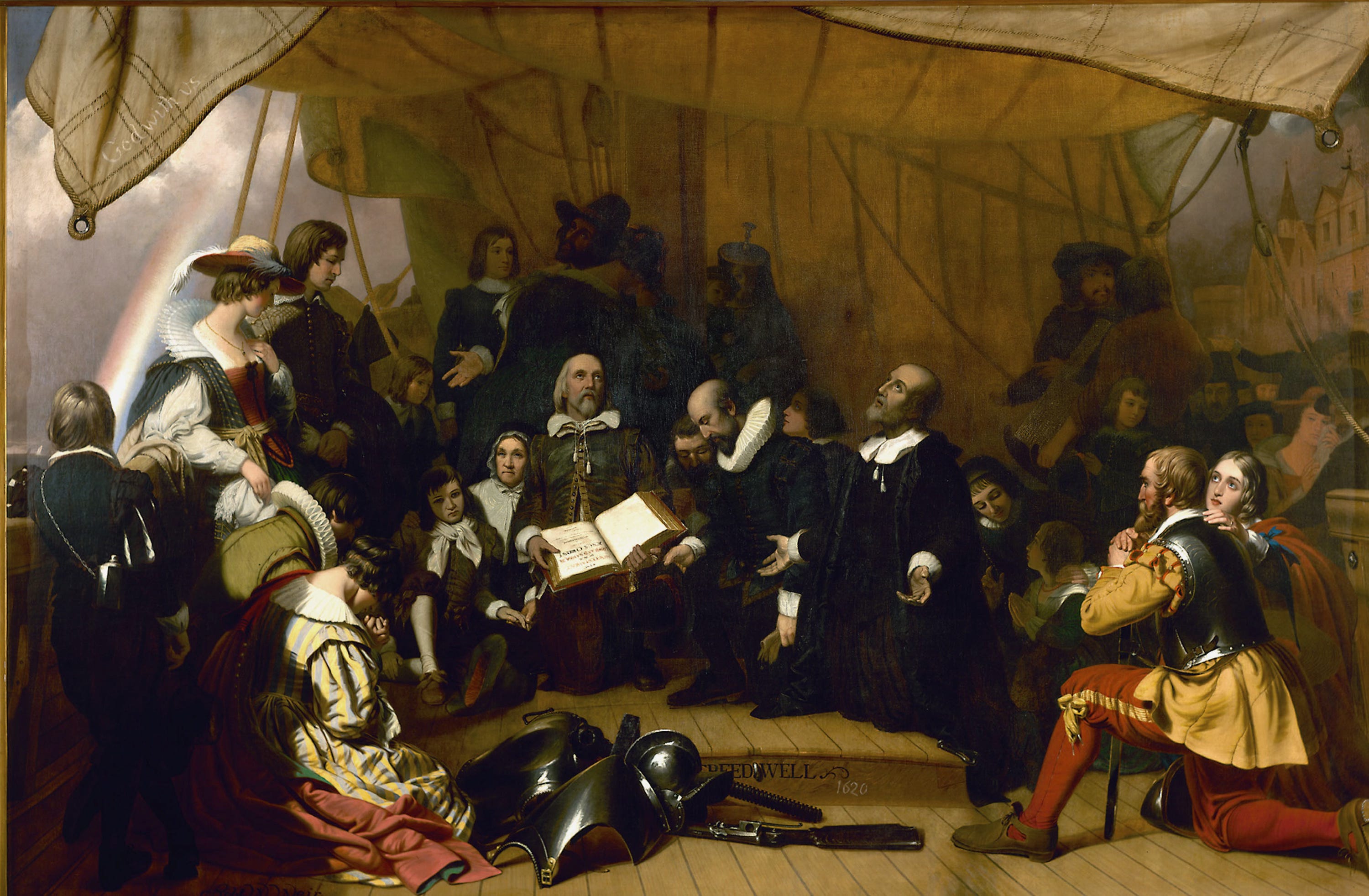
We come from England, and from Plymouth specifically, you might say. We have in our roots the Mayflower Compact and the Plymouth Colony.
A few years later, John Winthrop came, to establish the Massachusetts Bay Colony. Before his group left England, Winthrop said, “… we must consider that we shall be as a city upon a hill. The eyes of all people are upon us.”
Of course, he was borrowing from the Sermon on the Mount, and what could be more universal than that?
Some 150 years after these Pilgrims and Puritans, we had the drama of our revolution. In 1976, our bicentennial year, my parents took us to Boston to walk the Freedom Trail, which traces revolutionary sites. This year—our 250th—a friend of mine has taken his own kids to walk the trail.
Part of our past is our civil war, which drenched America in blood. Is it past, entirely? (Cue William Faulkner, who wrote, “The past is never dead. It’s not even past.”) Newcomers to America often have a hard time understanding our racial sensitivities.
Like many another people, we have our songs: “At the River,” “Shenandoah,” “He’s Got the Whole World in His Hands.” (Spirituals constitute an American songbook unto themselves.) “Blue Suede Shoes,” “Good Vibrations,” “Sweet Home Alabama.”
We have our lines of poetry: “I hear America singing” (“the varied carols I hear”). “A dream deferred.” The “City of the Big Shoulders” (meaning Chicago). When I was a kid, there was an ad slogan, capturing something essential: “Baseball, hot dogs, apple pie, and Chevrolet.”
When I was a student abroad, a lot of my fellow Americans wanted to blend in. They were loath to be taken for an American (and plenty of them had been taught to be ashamed of their country). I stood out like an American thumb, and still do.
At the moment, I am in Italy, where I was a student. You can spot me as an American from 200 paces: shorts, golf shirt, a certain comportment. I ask for ice for my drinks and (sometimes) butter for my bread.
I might as well sing “Yankee Doodle.”
And yet and yet …
“We hold these truths to be self-evident, that all men are created equal, that they are endowed by their Creator with certain unalienable rights, that among these are life, liberty, and the pursuit of happiness.”
I know some people who wish that those words had been omitted from the Declaration. “Airy-fairy rhetoric, universalist hokum.” But as some of us see it: classically and necessarily American.
Important to many of us is what Lincoln said of Henry Clay in his eulogy of him: “Mr. Clay’s predominant sentiment, from first to last, was a deep devotion to the cause of human liberty …” Lincoln went on to say, “He loved his country partly because it was his own country, but mostly because it was a free country.”
You have heard of people who believe that they were “born American but in the wrong place”—meaning that they were born in a different country. I have known such people. Some were able to join us, and become citizens, and some were not.
I remember what Reagan said in his very last speech as president. He quoted a letter he had received: “You can go to live in France, but you cannot become a Frenchman. You can go to live in Germany or Turkey or Japan, but you cannot become a German, a Turk, or a Japanese. But anyone, from any corner of the earth, can come to live in America and become an American.”
Five years ago, I met a computer engineer and tech entrepreneur in Dallas, Mark Haidar. I had a talk with him at the George W. Bush Presidential Center. Haidar is included in a book of Bush’s paintings: Out of Many, One: Portraits of America’s Immigrants.
Mark Haidar—originally “Mahmoud”—grew up in Lebanon. His family suffered many hardships and horrors.
One day, two employees of the United Nations showed up at Mahmoud’s school. “This was the day that changed my life,” Haidar told me. They had brought with them two computers—by which the boy was fascinated.
He found something called “Encarta,” an early Microsoft encyclopedia. He began reading about the United States and discovered the Declaration of Independence—a document that excited him. He knew, in his core, it was true: Human beings have rights that no man or system can negate.
From then on, he had a tradition. Every time he got a new notebook in school—like a spiral notebook—he would write on its cover seven words: “Life, Liberty, and the Pursuit of Happiness.”
America is important to us Americans, needless to say, but it is also important to the world at large: as an example of ordered liberty and human dignity; as an opponent of tyranny; as a haven for the oppressed.
One of the most moving, and painful, reporting trips I have ever taken was to Denmark last year. I talked to a bunch of Danes about America’s new posture toward their country: one of hostility and belligerence.
They were heartbroken. They had loved and defended America all their lives. One of these men was in tears, a sight I will not soon forget.
“So what?” some might sneer. “America First!” Well, America’s openness, generosity, and leadership have benefited one country above all: America.
There is an Italian expression, fare una brutta figura—roughly, to put forth an ugly face. Last week, an Italian friend remarked to me, “I’m sorry to say it, but, these days, America is putting forth una brutta figura.”
What can be done about it? Each of us, as individuals, can put forth the best face we can.
It was Carl Schurz who made possibly my favorite statement ever about patriotism. (He was a German immigrant who became a Union general, a U.S. senator, and so on.) “My country, right or wrong—when right, to be kept right; when wrong, to be set.”
I also like what Miss Julia said. Formally, she was Julia L. Coleman, a high-school teacher and administrator in Plains, Georgia. One of her students was Jimmy Carter, who liked to quote her: “We must adjust to changing times and still hold to unchanging principles.”
I’m going to close with John Winthrop. Before setting sail for the New World, he told his fellow voyagers, “If we mess up this experiment of ours, our name will be mud throughout the world.” I have paraphrased, of course. You want the real stuff, however stern it is?
“… if we shall deal falsely with our God in this work we have undertaken, and so cause Him to withdraw His present help from us, we shall be made a story and a by-word through the world”—a bad story, a negative example.
With freedom comes responsibility. (You have heard this a time or two.) I ask my fellow Americans, aspirant or actual: Would we have it any other way?
Jay, this is simply astonishing writing.
I know you have a message, and that the purpose of the essay is not for you to promote yourself.
Some folks deliver a message with words, with notes, or through the words of others.
But this was an absolute joy to read, and I salute you for the effort.
I am a sixty-three-year-old Canadian who has been warned of the impending demise of the United States for as long as can be remembered.
And, yet, there She stands.
We won the lottery of geography, Brother, stacking up next to you folks.
Happy Independence Day!!
Jay, sometimes you astonish me with the breadth and knowledge. Before I became a regular reader, I thought you were just another music critic. Boy, was I wrong!