



Maybe begin with a little music—by way of a sports story. This one begins,
Neff Giwa sometimes asks himself: “Is this really happening to me?”
Incredibly, yes.
The 20-year-old Irishman, who has never played American football, committed on Sunday to play at South Carolina as an offensive lineman.
No music so far. But hang on:
Giwa, who is also Nigerian, has come a long way—from Tipperary—in a short amount of time.
I salute the reporter, Ken Maguire, from the Associated Press. But does anyone know that song? They once did. We all knew it:
It’s a long way to Tipperary,
It’s a long way to go.
It’s a long way to Tipperary
To the sweetest girl I know!
That song, written in 1912, is associated with World War I (which began two years later).
Would you like to know how the verse starts out?
Up to mighty London came
An Irish lad one day.
All the streets were paved with gold,
So everyone was gay!
Well, they’d have to do some editing today. “… everyone was happy”? But how’re you going to rhyme that, in the second line?
***
When I was young, I was interested in the Upper Volta. It seemed the most exotic of countries. And its capital had my favorite name of any capital: “Ouagadougou.” I always wanted to go to Ouagadougou.
In 1984, the Upper Volta became “Burkina Faso.”
Before I continue, let me record a memory: When stating that the Soviet Union was a very poor country but at the same time a very dangerous one, people would say, “It’s Upper Volta with nukes.”
Well, I met someone from Burkina Faso yesterday—from Ouagadougou, as it happens. That was a bit of a thrill. He had picked me up in an Uber, in Cleveland.
I told the man that I had grown up with the name “Upper Volta.” He was kind of amazed. The country has been “Burkina Faso” all his life.
As he said to me, “I have 35.” He was translating directly from the French, of course—in which you’d say, “J’ai 35 ans,” or (literally) “I have 35 years.”
Before we parted, he said to me, “Bonne fête de Pâques pour demain”—“Happy Easter, tomorrow.” A gent, this ouagalais (this man from Ouagadougou).
(The word Pâques comes from the Latin pascha, meaning Passover.)
***
Here is our president, Donald Trump, on the Somalian community in Minnesota: “They’re low-IQ. I can generalize. They’re low-IQ people. They’re bad people.” (Listen to him here.)
I don’t think a president should talk this way. I don’t think anyone should. Am I an antique?
Yes, and getting more antiquated by the day.
***
I know people who are so accustomed to false charges of racism, they won’t believe that anything is racist. (They won’t believe that anything is fascist either, for the same reason.) This is a glaring fact of politics in our time.
***
My eighth-grade math teacher was a Somalian American (Abdi Bashir). I can tell you, he wasn’t a dummy. I was the dummy. And, patient man, he did his best to help me with algebra, or whatever the infernal subject was …
***
I have been a political journalist for 30-plus years, and a music critic for about as long. In the latter field, I always have to separate politics from art (except on the rare occasions when they intertwine). There are musicians I dislike, personally, or whose politics I abhor, and I have to leave that aside.
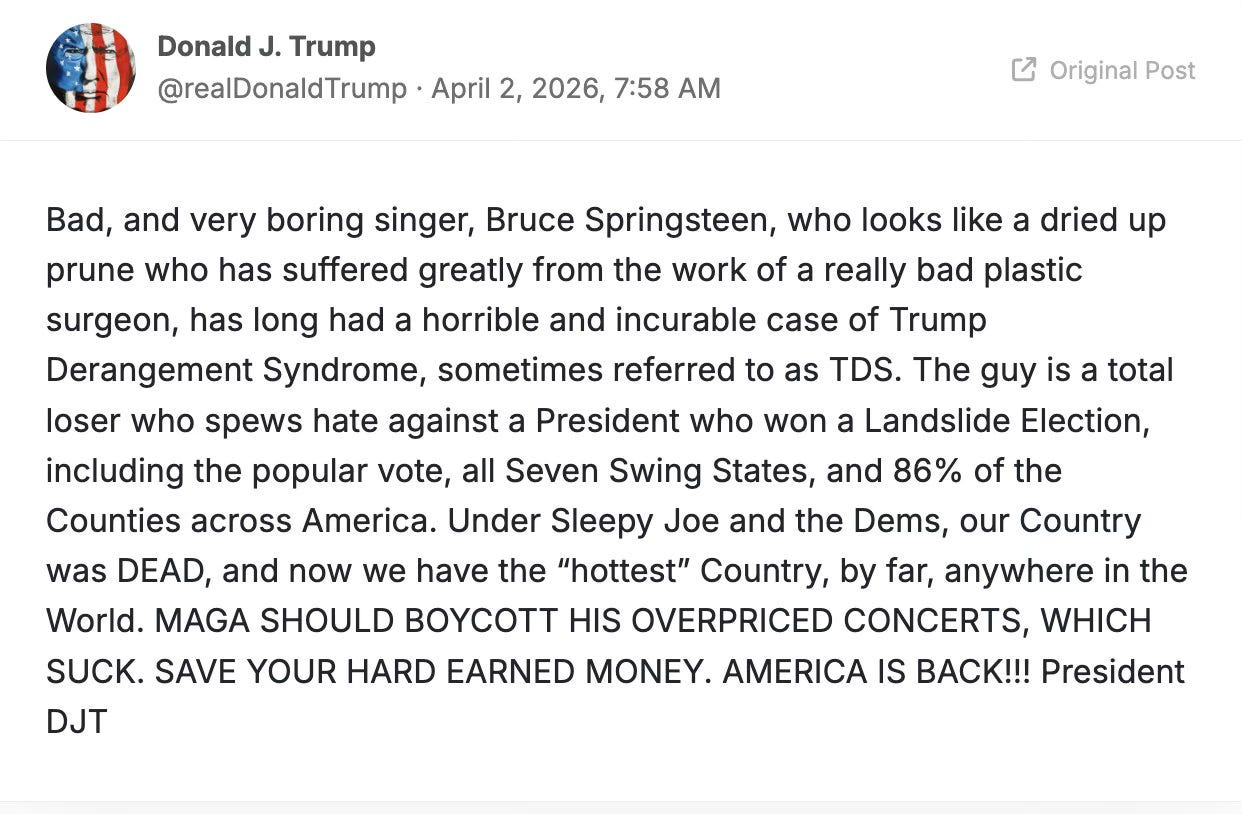
A question (an easy one): If Bruce Springsteen were pro-Trump, instead of anti-Trump, would the president judge him a “bad” and “very boring” singer who “looks like a dried up prune,” etc.?
A few days ago, I had to write about Frederic Rzewski, an American composer (1938–2021) who was frankly leftist and not my cup of tea, to put it mildly. But the fact is: he was a good composer (and a good pianist).
One more remark, before I leave this general subject: There are two pianists I won’t review because they have been so nasty to me personally. It’s not that I don’t trust myself to review them objectively (which I would). It’s just that …
Well, to hell with ’em, you know?
***
A story from my home region:
A suburban Detroit school district has agreed to give First Amendment training to staff to settle a lawsuit by a teenager who said a teacher humiliated her for refusing to stand for the Pledge of Allegiance in protest of U.S. support of Israel’s war in Gaza.
I had a variety of thoughts, one of which was: Barnette. More formally, and fully, this case is West Virginia State Board of Education v. Barnette, from 1943. The Supreme Court said that Jehovah’s Witnesses did not have to salute the flag or say the Pledge of Allegiance—and neither did any other American citizen.
This was in the middle of World War II, mind you.
Here is Justice Jackson:
If there is any fixed star in our constitutional constellation, it is that no official, high or petty, can prescribe what shall be orthodox in politics, nationalism, religion, or other matters of opinion or force citizens to confess by word or act their faith therein.
One more passage:
The very purpose of a Bill of Rights was to withdraw certain subjects from the vicissitudes of political controversy, to place them beyond the reach of majorities …
In the 1960s, young George F. Will titled his Ph.D. dissertation (Princeton) “Beyond the Reach of Majorities: Closed Questions in the Open Society.”
***
There is a lovely custom in Indian culture known as “Shagun.” Say you’re giving a niece $50 for her birthday. You don’t give her $50 but $51. The round number seems too final, too closed. The extra dollar is a head start on the next 50, so to speak.
***
I salute the author of this AP headline: “Louisiana’s crawfish industry feels the pinch of limits on foreign workers.” (Article here, by the way.)
***
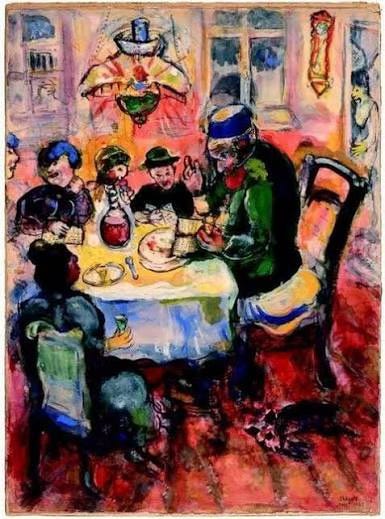
I certainly salute Marc Chagall, for his Passover Seder (1925):
***
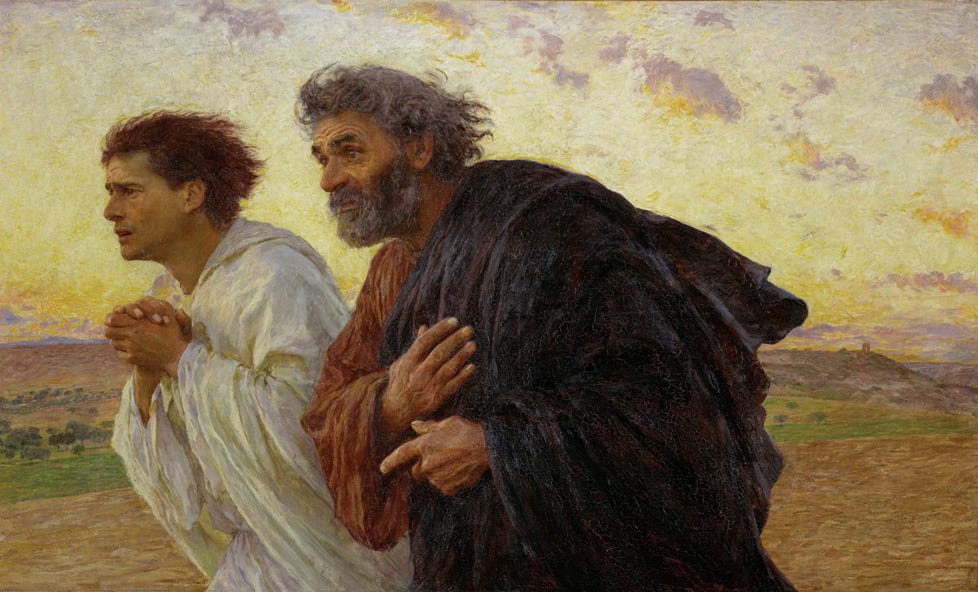
Every year, I return to Eugène Burnand—his Peter and John Running to the Tomb (1898):
***
Every year—ought to be every day—I return to this hymn by Frances Thompson Hill, from the Christian Science Hymnal:
Let us sing of Easter gladness
That rejoices every day,
Sing of hope and faith uplifted;
Love has rolled the stone away.
Lo, the promise and fulfillment,
Lo, the man whom God hath made,
Seen in glory of an Easter
Crowned with light that cannot fade.
And the final stanza:
Living meekly as the Master,
Who of God was glorified,
Looking ever to the radiance
Of his wondrous Eastertide;
Freed of fear, of pain, and sorrow,
Giving God the honor due,
Every day will be an Easter
Filled with benedictions new.
Thank you, my friends and readers. I salute you.
Happy Easter. Your comment about the math teacher hit home. About 10 years ago I ran into my 7th grade art teacher in a restaurant. As we briefly reminisced I commented to her friend at the table with her: "She did the best she could with what she had to work with." The smile of appreciation from the teacher told me she needed to hear that more often from her former students. We were not a talented lot.
On a grey, bleak Saturday afternoon in 1975, my Dad was driving me to hockey practice. I was twelve years-of-age. We were listening to the local London, Ontario AM radio station. A dull, soulless, radio wasteland.
Suddenly this sound came over the tinny speakers in the Oldsmobile Custom Cruiser station wagon like nothing I had ever before heard. It was "Born to Run" by Bruce Springsteen. I was hooked.
I listen to music that I like. I like to think that I listen for excellence, not genre. The creation & execution of music is so far beyond my ability to comprehend, I hold these folks in absolute reverence.
Having said that, I have no interest in a performer's marital status, sexual proclivities, wealth, or personal and political opinions. I am not interested in what Brad Pitt thinks of the filibuster, or what "The Boss" thinks about minimum wage laws or illegal aliens being rounded up and deported.
I appreciate your comments regarding the use of appropriate language, First Amendment rights, and the limits on free expression. Just because we are allowed by law to act in an undisciplined & uncivil manner, doesn't mean we should. Perhaps we should embrace our own personal "common good" and strive to make it foundational.
Donald J. Trump is many things, and among them is that he is a boorish, vulgar, impulsive, charlatan who is unfit to lead such a splendid people, and their Nation. That he does initiate some things with which I am in favour is beside the point; think what he could have accomplished had he been more conventional.
As Tom Waits has commented, "a gentleman is someone who knows how to play the accordion, but doesn't."