


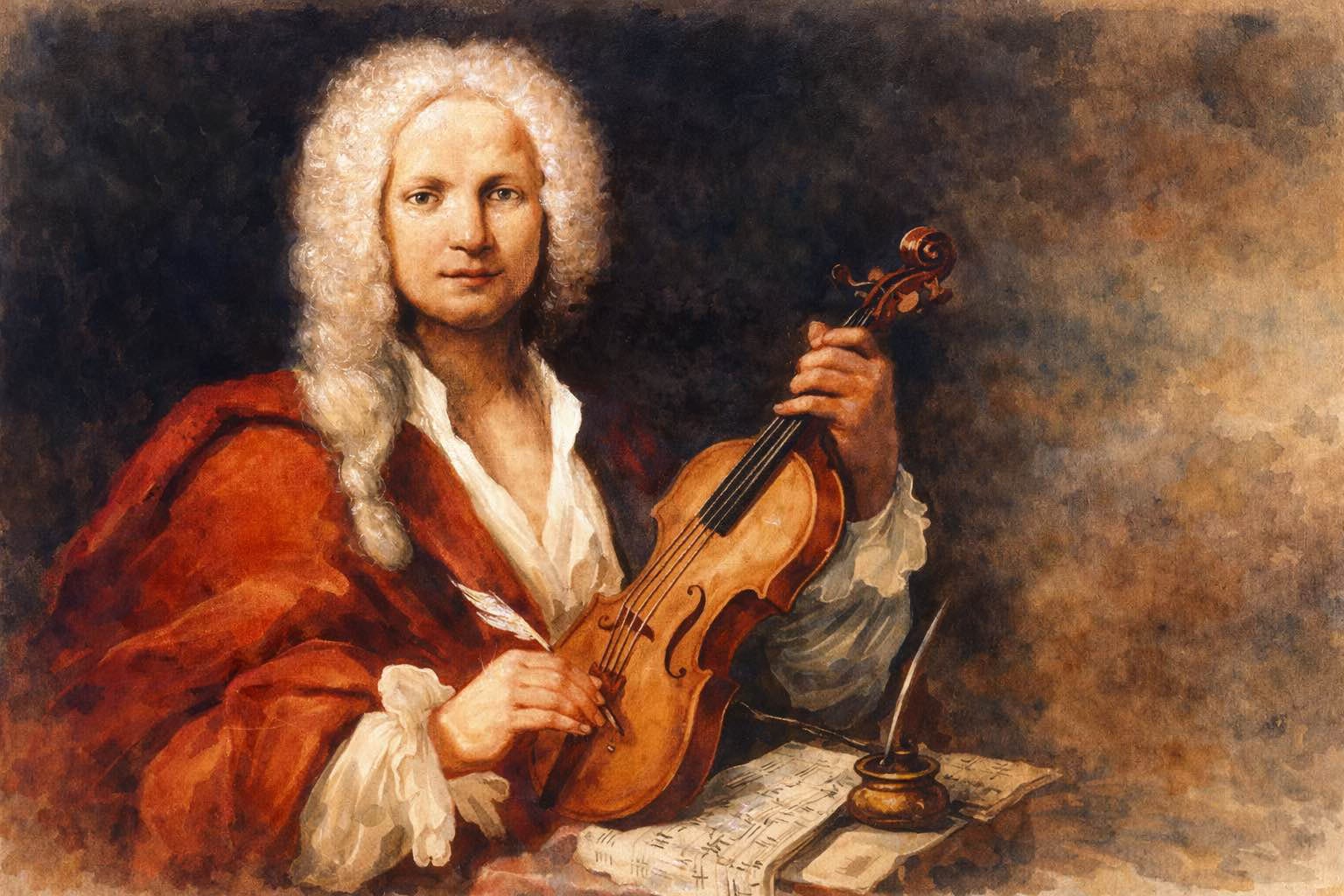
The Ukrainian military has revealed Operation Vivaldi—a series of counterattacks against the Russian invader and occupier. The operation is called “Vivaldi” because it will take place over four seasons—and The Four Seasons is a famous work by that composer, Antonio Vivaldi. It is a group of violin concertos, expressing the various seasons.
To read about the Ukrainian operation, go here.
And I can tell you this: I like Operation Vivaldi a lot better than I do the Wagner Group, which is a Russian “private military company” that complements the official Russian military. Both the official and the unofficial militaries commit barbaric acts in other people’s countries.
***
When I made this point on Twitter—when I stated a preference for Operation Vivaldi over the Wagner Group—Doug Heye replied, “The most Jay Nordlinger tweet possible!”
I guess that is so …
***
Did you hear this story recounted by Mike Pence? He told President Trump he was praying for him. Trump looked at him and said, “Don’t bother.”
I thought of President Wilson. When he was very ill, a group of Republicans went to see him. Albert Fall (a particular antagonist) said, “We’re all praying for you, Mr. President.” Wilson murmured, “Which way, senator?”
***
Yesterday, I was talking with a young friend of mine, with whom I used to discuss language—the finer points of English. In the course of our conversation yesterday, he said, “The reason is that …” Then he paused. He said, “Did you catch that, Jay?”
What a moment. I had drummed out of him “The reason is because …” I could have shed a tear. My living has not been in vain.
Do you know that song?
If I can help somebody as I pass along,
If I can cheer somebody with a word or a song,
If I can show somebody he is traveling wrong,
Then my living shall not be in vain!
To hear Bryn Terfel sing it, go here.
***
Evidently, The New Yorker has fallen for “to advocate for” and “to advocate against.” The mighty, august New Yorker—Mr. Shawn’s magazine—has succumbed.
There is worse news: in the same article, the word “reticence” is used to mean “reluctance.”
Lights out, my friends. We’re finished.
William Shawn is long gone, and so is William F. Buckley Jr. (who esteemed Mr. Shawn).
***
On the street in New York, one young man was thanking another—he said, “You’re a real one.”
I loved that. (Must relate to “keeping it real.”)
***
I once said to the father of a girl I was seeing, “She’s something else.” He said, “True. But I can’t figure out what.”
***
In the Senate, members of the Judiciary Committee were having a discussion with the FBI director about—sorry—bestiality. To read about this, go here.
I have just one, simple point to make: They were all saying “beast-iality.” In truth, that word is pronounced “bess-chee-ality.”
***
Our president likes to call Democrats “Dumocrats”—he’s like that. He also says, repeatedly, “Nobody knows there’s a ‘b’ in ‘dumb.’” He said it again, on the stump, the other day.
For a populist, he takes a very, very dim view of the people. (Or should that be “dimb”?)
***
On the street, I heard a young woman say, “He got off scotch-free!” That’s a variation (on “scot-free”). A legitimate one? No, but I found it charming …
***
Eons ago, when I was a kid, I heard that comedians like to use funny-sounding place-names, the more consonants the better. The two examples most commonly given were “Poughkeepsie” and “Schenectady.”
Yesterday, I was listening to a routine by Aziz Ansari. And he used … Poughkeepsie. He used it in the phrase “kimchi in Poughkeepsie,” which is really inspired.
The better comedians take great care with language. There is poetry in their work. Or: They have a natural, unconscious feel for language.
***
Maria Elvira Salazar has cut a campaign ad. She is a congresswoman from Miami—a Cuban American and a Republican. In her ad, she lightly criticizes President Trump for ICE tactics. She is in a competitive race.
I have a lot to say. But I’d like to confine myself to a point about her name, and its pronunciation. She has a Spanish way of saying it and an americano way. At the end of this new ad, she says it American-style.
Back in 2018, when Salazar first ran for Congress, I went down to Miami to report on the race and to interview her. The candidate, I said, is
known universally by her first name alone—or rather, by her first and middle names together: “Maria Elvira.” She has been a television journalist for 35 years. She is a striking woman with a big personality. How do you pronounce “Elvira,” by the way? Well, in Spanish, it’s “El-vee-rah.” But for Anglo audiences, the candidate goes with “El-vie-ruh.” This name is established in American culture, she points out to me. Think of the country song, a hit for the Oak Ridge Boys in 1981: “Elvira, Elvira, my heart’s on fire, Elvira.” Think, too, of Elvira, Mistress of the Dark, the horror-movie hostess from the 1980s. She brought serious cleavage to television, as the candidate notes.
That was an enjoyable conversation.
***
A quick word about Salazar’s opponent this year, the Democratic nominee: He is Eliott Rodriguez, and he, too, is a Cuban American, and he, too, was for many years a television journalist.
Gives a person a leg up, you know?
So, we have “Eliott,” and “Elliott,” and “Eliot,” and “Elliot”—have I missed one? I wish they could agree, I swear …
***
It is a pleasure, an ongoing pleasure, to read Henry Oliver, of The Common Reader. He has written (once more) about Samuel Johnson. Let me quote from the subheading of his post: “I am unashamed to call him a great man, to say that he is my hero.”
As they say on social media, “Endorsed.” Or “+1.”
***
Did you see this story? Holy cow.
For more than two decades, truck driver Joe Macken spent his free time building a massive scale model of his native New York City out of balsa wood and foam board.
When he finished, his daughter convinced him to show off the sprawling basement creation— encompassing over 800,000 structures—on TikTok. The video clips almost immediately went viral.
Now Macken’s model is on display at the Museum of the City of New York …
Truly wonderful. Hats off, Joe Macken.
***
Congresswoman Haley Stevens (D., Mich.) failed to win her party’s Senate nomination over Abdul El-Sayed, I’m sorry to say—but she is engaged to be married and has hinted that she will honeymoon in her home state (and mine).
Do you know what’s the traditional honeymoon site in Michigan? Saugatuck. (Next time someone quizzes you to that effect, you’ll have the answer.)
***
Here at the end, I’d like to quote from a recent article of mine, then quote a note from a reader.
“Over the summer,” I said,
I spent some time traveling through Italy, and I noticed statues of Verdi—statues in big cities, yes, but also in small towns. There were statues of other composers, too: for example a monumental one of Bellini in his hometown of Catania, Sicily.
And it occurred to me: I have never seen a statue of George Gershwin or Aaron Copland. Or of Charles Ives or Samuel Barber. Or of Stephen Foster or Leonard Bernstein. I live in New York, the hometown of Gershwin and Copland. There is no statue of either of them.
I don’t say this is wrong—a statue is not the only way to honor or appreciate a person—and I don’t say that any of the American composers I have named is the equivalent of Verdi. We’re talking apples and oranges. Still, I find the matter curious.
“There’s a statue of George M. Cohan in Times Square,” says a reader. True, true. The composer of “You’re a Grand Old Flag” (and “Give My Regards to Broadway” and other numbers we could name).
Thank you for reading, my friends, and for subscribing—and for being real ones.
May the Ukrainians be able to Handel the moment.
“For a populist, he takes a very, very dim view of the people.”
All conmen hold their marks in utter contempt. “If you’re dumb enough to fall for this, you deserve what you get.”