



Over and over, the question is, “Who are we? What do we stand for? What is our nature? What do we want to represent in the world?”
With that introduction, a few words about the United States …
Our president has once more posted a favorite meme of his:

I am not used to thinking of our country as a predator nation. A protector nation, yes. A predator, no.
How about this? President Trump crowed about all the oil “we’re taking from Venezuela.” “Billions and billions of barrels of oil.” He then cited the adage, “To the victor belong the spoils.”
Is that part of the American ethos, the American creed? “To the victor belong the spoils”?
I am not used to thinking of our country as a plundering nation, a thieving nation. No, we are a giving nation, a generous nation—and this generosity has benefited us, as much as others.
With some regularity, I quote Ernest Renan, the 19th-century French scholar, who said that “a nation is a daily plebiscite” (or a “daily referendum”). If we don’t like what we are today—we can change tomorrow.
You may have noticed this news: “Greenland issues ‘strong warning’ as Trump-linked oil firm prepares to drill.”
Almost a hundred years ago, we instituted a Good Neighbor policy. When the post-Trump period comes, maybe we should pledge to something similar.
***
More “Who are we, what do we stand for?” and all that …
President Trump posted the below:
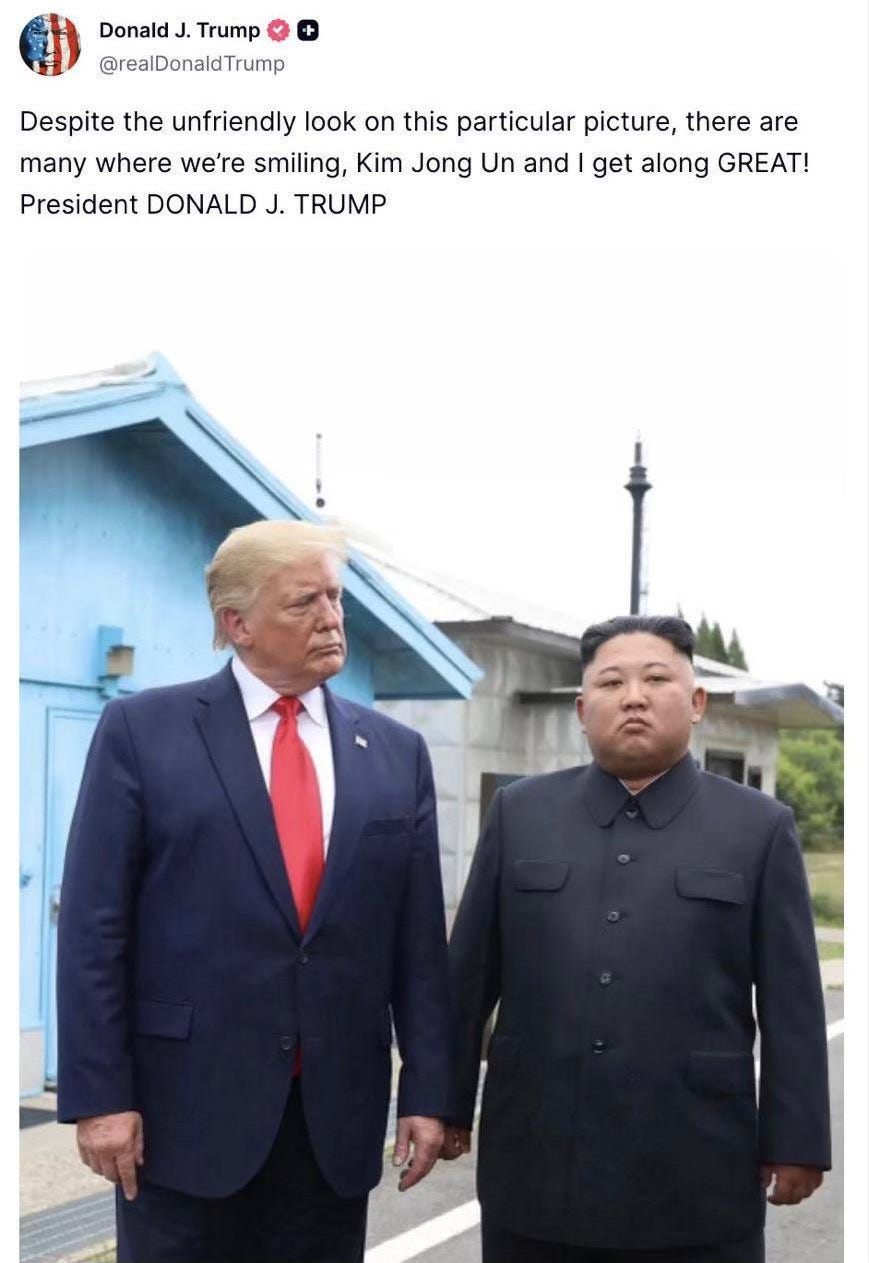
Remember, Kim Jong-un runs one of the most brutal dictatorships on earth. American foreign policy ought to include a streak, at least, of right and wrong. The best “realists” of my acquaintance acknowledge this.
If you were a North Korean dissident, or an inmate in the North Korean gulag, and you heard the way the American president was talking—how would you feel?
In the Soviet gulag, the “zeks,” the prisoners, found out about Reagan. They heard, for example, that the American president had denounced the Soviet Union as an “evil empire.”
This gave them a boost, even if their material conditions did not improve. There is ample testimony on this score.
Not long ago in a column, I was quoting Reagan, who in 1987 said,
Our global commitment to freedom does not mandate the sending of arms or troops, but at the very least it means that any people whose liberty is denied or whose independence is violated—that these people know we Americans are on their side.
Can they possibly know that now?
If you missed the below message from President Trump, have a look, and ponder its implications:
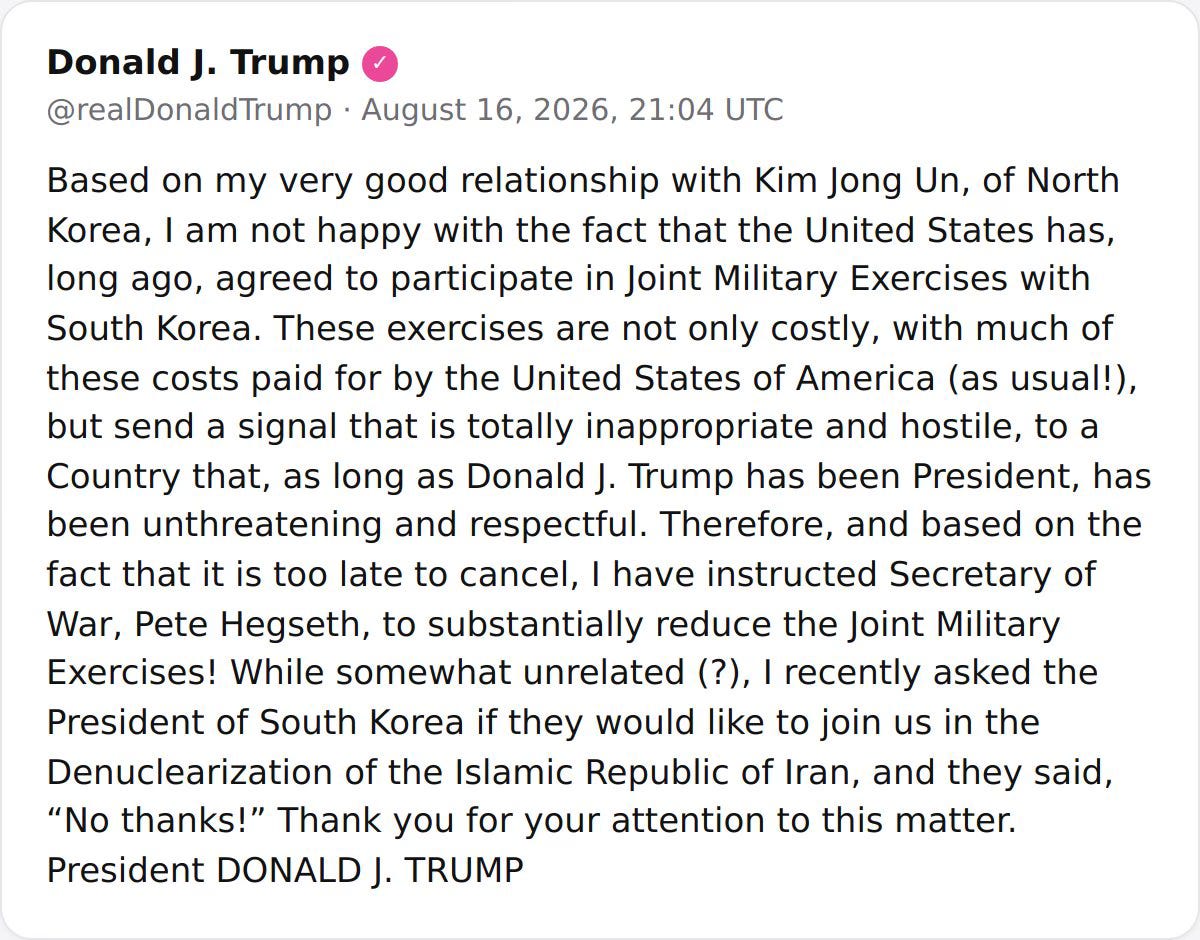
I will be frank: I thought the day might come when the United States ceased to be the leader of the Free World and a deterrent to tyrants. When the United States abandoned the West, so to speak. I admit I did not see it coming from the Republican Party and the Right.
But here we are.
***
With the Republican Party in its current state, we are in sore need of a worthy and sane Democratic Party. Do you recall Ed Koch, the New York congressman, then mayor, who said, “I’m a liberal with sanity”? Ooh, they hated that—the Left, I mean. Bella Abzug and others of that stripe. When Koch said “a liberal with sanity,” they knew he was contrasting himself with them.
Well, we need liberals with sanity. And conservatives with sanity. And sanity altogether. I’m not sure either side is pulling its oar …
***
I have about a thousand more items to share with you, but maybe it would be better to keep this column on the short side. I have laid out some “heavy stuff.” Maybe we can end with language, music, and pictures. Would that be too abrupt, too strange, a pivot? If so, my apologies …
Earlier this month, Merriam-Webster sent out a bulletin saying, “Jane Austen used ‘however’ at the beginning of a sentence, and so can you.” I loved that.
There is this myth, this superstition, that you can’t say “however” at the beginning of a sentence, and that you can’t say “and,” for that matter. Hogwash.
And we all need inspiration, encouragement, from good and great writers.
For years, I wondered, “Can I use more than one colon in a single sentence? Two or even three?” That punctuation sometimes seemed natural, and I am all for naturalness in writing, for writing mimics speech—the spoken word.
Now and then, I’d use two colons in a sentence, and a proofreader would flag it—not disapprove of it, exactly, but wonder, as I myself did, “Can you do that?”
Then I read a novel by V. S. Naipaul—Miguel Street, possibly. And he would do this when it seemed natural and right.
And I never looked back. When you have an Austen or a Naipaul behind you—wow.
***
The Salzburg Festival is staging Ariadne auf Naxos, the Strauss opera. For my review, go here.
Riccardo Muti has conducted the Vienna Philharmonic, and associated forces, in the Verdi Requiem. For my review, go here.
***
Maybe we could have a couple of pictures from Salzburg, before I sign off? I was taking a picture of the entrance to the Mozarteum, because I thought it looked attractive. Then a woman with a multicolored bag emerged. Even better.
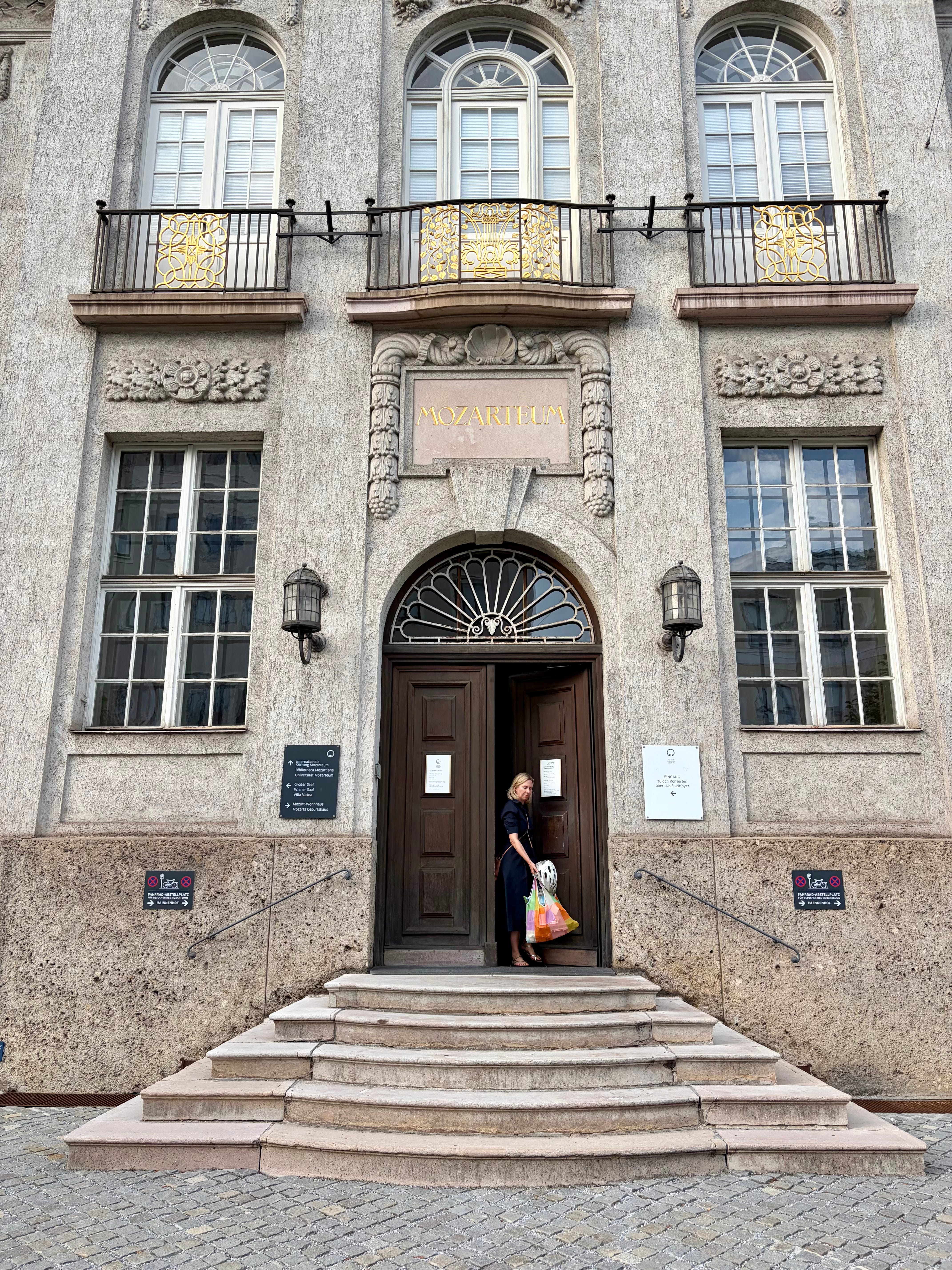
This one looks out from Schloss Leopoldskron, on a calm evening, after storms:

Thank you, my friends—thank you for reading and, if you can/want, subscribing—and I’ll see you later.
The current President of the United States is blatantly irrational: he assails South Korea for failing to join the war he started, while proclaiming his affection for the North Korea dictator who also did not join it. However(!) the real problem in the United States rests not in the chief executive, but in the millions of citizens who display their approval and support of a corrupt, racist, dishonest and selfish bully. The America Trump represents is the America that elected him. And(!) that, my friend, is not the America we remember.
Trump's penchant for cruel people (and cruelty, etc.) makes me ill. He keeps coming up with things I haven't thought of, or maybe I'm just naive.