


I’m not sure what prompted me to do it. It was some thought I had, or something I had read, or something I had heard. I don’t know. But a few weeks ago, I up and tweeted,

That is not a new thought, obviously. Many have had it, or something like it, over the years. In 1992, Francis Fukuyama wrote,
Experience suggests that if men cannot struggle on behalf of a just cause because that just cause was victorious in an earlier generation, then they will struggle against the just cause. They will struggle for the sake of struggle. They will struggle, in other words, out of a certain boredom: for they cannot imagine living in a world without struggle. And if the greater part of the world in which they live is characterized by peaceful and prosperous liberal democracy, they then will struggle against that peace and prosperity, and against democracy.
My little tweet was borderline prosaic. But it … caught on. I was even “trending” for a while.
(A couple of years ago, a friend of mine, who is well-known, was “trending.” I wrote to tell him so. He answered, “You never want to be trending.”)
Plenty of people applauded my tweet. And plenty of people jeered it. “Post-liberals” were furious. I’m talking about nationalists and populists, Trumpers and Orbánites—worse.
They said to me what they’ve said to me for ten years now. I will sum up, in more temperate language than they tend to use:
The old constitutional democracy, the old liberalism, is not working for us any longer. The elites have greater and greater control; the people fall farther behind. Factories are moving out of town, and overseas. The working man can’t get a break. Benefits go to illegal aliens, not our own people.
The 2008 financial crisis, the forever wars, the lockdowns in the pandemic—it all broke us. We can’t afford the luxury of your prissy “Madisonian” structure, your “ordered liberty.” Trump and Trumpism are our last hope.
Here is a pitfall of arguing against the “post-liberals”: you can appear unsympathetic to people’s problems. Their struggles. You can appear callous, looking down from an ivory tower. Everyone’s problems are real, and they are very real indeed to himself.
But I think a little perspective is in order. The idea that America has gotten worse and worse, I don’t buy. We are so much richer, so much fairer. Think merely of life for black Americans! Think of opportunities for women. Think of air travel. Think of all the government assistance (for better or worse). Think of …
I think of our forebears—not many generations ago. Do you mind if I get personal? Do you mind if I tell you about my mother’s relatives?
Her maternal grandfather was George. George Ivan Newton. He had a mom and dad, and an older brother and sister.
His mother died when he was two. She died in childbirth, and the baby died too, we assume. We don’t know anything about the mother—except for two details: she had red hair and rode horses well.
During the funeral—or during the social hour after the funeral—George’s father left him on the rug at a neighbor’s house. Alone. And then he vamoosed.
He took the older children with him. Why he took the son, we’re really not sure. As for the daughter, he probably wanted her to take care of him.
George was taken in by a family—who they were, I’m not sure. I know they did not really treat him as a family member. He worked the farm.
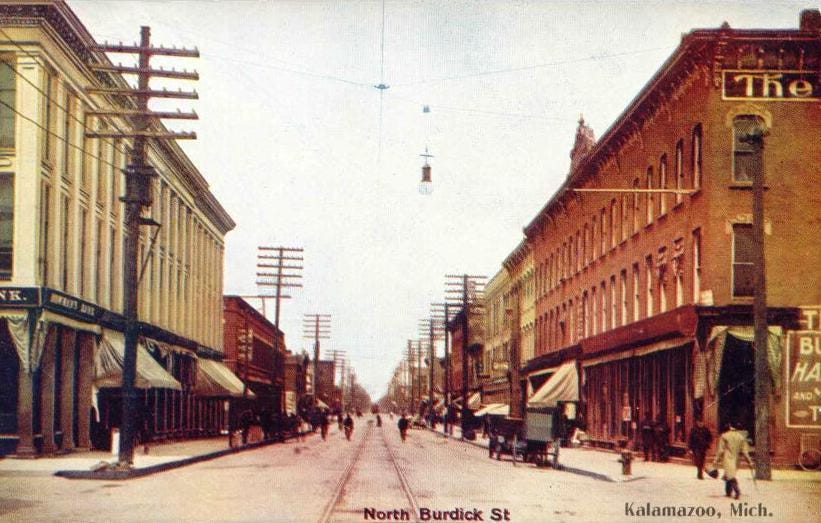
When he turned 18, the family drove him to Kalamazoo—this is Michigan—and left him by the railroad tracks. He had no place to stay and no job.
He walked around for a few days—then found work as a streetcar operator, I believe. (Later, he would drive buses. He was a “motorman,” in a term of the time.)
A fellow worker—perhaps George’s supervisor—learned that George didn’t have a place to stay. He had George stay with him and his family, until he could make other arrangements.
Fast forward years later: This other man lost his job and could not find another. George invited him and his family to live with his own family. That family stayed with the Newtons—with George and his family—for a year. Everyone was fed. Eventually, the man found work.
I am too far ahead in the story. George met Lois, my great-grandmother (whom I knew). (I never met George.) When George met Lois, my mother says, “the sun came out for him.”
They had a son, stillborn. Then they had two girls: my grandmother and my aunt (great-aunt, technically). Both marvelous. But I will speak for a moment about my grandmother.
She must have been the brightest kid in Kalamazoo, and beyond. I could spend an hour on this.
In the fall of ’29, I think—a great time for America!—she entered Kalamazoo College. After three or four months, the college offered her a full four-year scholarship: a merit scholarship, an academic scholarship. She was like that.
George and Lois were wonderful people. But they were ignorant about some things, as we all are, I suppose. They forbade their daughter to accept the scholarship. Why? “We don’t take charity.” Never mind that it was a merit scholarship. “We don’t take charity.”
I don’t really understand this. My great-grandparents had given charity, obviously (in taking that family in). George, certainly, had been helped along the way.
I would like to ask these people about all this. To sit down with them for a long interview, with a tape recorder rolling.
Anyway, my dogged grandmother worked her way through K-College. She played the piano for lessons at a ballet school; she played the organ at movie theaters, accompanying the silents. She would come home at 10 or 11 at night and then begin to study.
She was the valedictorian, of course. I believe she was the first female valedictorian at Kalamazoo College. She had majored in French and biology, with minors in Latin and something else, I think. At some point, she attended lectures by Enrico Fermi, the great physicist.
I believe—I would love to question her—that she was admitted to the University of Michigan Medical School. But the rule was, you could not be a student—a female student—and also married. Because you would be depriving a male student of a place, and he needed to provide for his family.
I’m not sure of this. But that is my vague understanding.

This, I am sure of. My grandfather taught and coached in the public schools. (Later, he would be superintendent of schools and mayor.) My grandmother could not be hired to teach—French, biology, music, Latin, whatever—at the same time. Because the family already had one provider.
I must say, I understand this rule, entirely.
A few words about my grandfather’s family. His parents were Scots. I think one was born in Scotland, and the other here: in the United States or Canada. I’m not sure. My mother remembers that they would say “aye” for “yes.”
They were poor, very poor (as everyone was). They had two sons and one daughter. They lived in Pontiac, outside Detroit.
The boys were very good athletes, and they won athletic scholarships to Albion College. The girl, my aunt Dorothy, had no scholarship. There was no chance of college. So she took the bus down to GM and got a job as a secretary.
She married my uncle Don. He was from Texas. Don’s family had nothing, or next to nothing. They had a rude dwelling with no windows—just a front door. And, in the Depression, they were starving.
Everyone was skin and bones. Today, a leading problem of the poor is obesity. When I mention this to young people, they say, “Food deserts!” They have all been taught to say, “Food deserts!” Poor people don’t have access to fresh food, you see, and they are forced to buy fattening foods at 7-Eleven and the like. They may well buy them with government stamps (or today’s equivalent).
Trust me: our forebears would have thought it very heaven to live in a “food desert.” They had no food.
Somehow, Don heard about a work program in Northern Michigan. Somehow, he got up there. He made 25 dollars a month, and sent 20 back to Texas, so his family wouldn’t starve. He made do with 5.
I am not—I swear I am not—unsympathetic to problems of people today. We have many of them: social media, for one thing. Children and young adults tethered to their phones, not living “real” lives. I am simply asking for a little perspective.
And maybe a little gratitude for the relative bounty of now?
The 2008 financial crisis was, indeed, a crisis. Lots of people suffered. But there was more cushion than in the past—governmental cushion. In the Depression, men jumped off buildings without saying goodbye to their wives and children.
COVID was horrible. The associated lockdowns imposed terrible hardships.
You know what was especially bad about the pandemic, maybe? Millions of people died of the disease. Strange that people seldom mention that. Anyway …
I realize that many students, of all ages, had to attend school via Zoom. I realize that this is suboptimal. But to stay at home and attend school via this magical box? Our forebears would not even be able to comprehend that. To complain about it? I think they would blink at us in amazement.
The “forever wars.” Terrible, yes (as was 9/11). But remember: in earlier wars, there were general drafts. Millions were sent off to fight and die. Slivers of our population were involved in these other wars.
I would talk to servicemen in Afghanistan and Iraq. I’d mention the subject of “war fatigue” back home. Usually, they’d respond with some version of, “What the hell do they have to be fatigued about? They’re tired of hearing about it on the news?”
Though I may complain about the complaining of others, I indulge in complaining myself. (“Call the wambulance! Jay needs help.”) But, lucky bastard that I am, most of my problems are not material. I have had a jolt or two in that department. But compared with those starvers in Texas? Compared with my Michigan relatives who also had stretches of hunger?
I rarely, if ever, heard my grandparents complain about anything. Most of their problems, I think, were not material. Their son died when he was in his early twenties. That was a big problem.
I never heard them talk about it. (Almost never.) I never heard them talk about the other things I have mentioned either. (Almost never.) I got most of it from my mom, who got it from various sources.
My grandmother, this lover of Romance languages, this teacher of French, this child and devotee of European culture, never had the chance to go to Europe until she was in her fifties. When she reached Calais from Dover, she kissed the ground.
I have been to Europe three or four times a year for the last—30 years? (Not to mention my student days in Europe.) I live about an hour away by train from Philadelphia. I have been to Philadelphia—fewer than ten times, surely.
What I would give to give my experience—my experience in Europe—to my grandmother.
I spent a lot of time with my grandparents, and I think I saw them eat in a restaurant about three times. I eat in a restaurant … well, daily.
Several years ago, I sat down with a group of young people in a conference room. They were interns, “fellows,” and junior staffers. Most of them were “post-liberals,” of some kind or another. A few said they were “integralists.” (That word was new to me at the time.) They favored some fusion of church—their church—and state.
They had imbibed the literature of illiberalism. They thought the American Founding was a big mistake, or at least a failed experiment. Limited government, free markets, individual rights, “a nation of laws, not men”—that was pie-in-the-sky stuff, unable to satisfy the needs and desires of the common man.
America had undergone a steep decline, in their minds. “Neoliberalism” had done us wrong. The American Dream had become a snare and delusion.
For young people—many of them, in every generation—it is Year Zero. The world began when they turned 16. Nothing had ever happened before.
Including sex!
Sexual intercourse began
In nineteen sixty-three
(which was rather late for me)—
Between the end of the “Chatterley” ban
And the Beatles’ first LP.
(Philip Larkin, “Annus Mirabilis.”)
The world did not begin in 1963 (the year of my birth, as it happens). Nor did it begin in 1563. Or 863. Or 263. Or 463 B.C.
It took a long, long time to develop our precious liberal democracy. And it can be burned down—by the young and the restless, the heedless and ungrateful—so fast. “A republic, if you can keep it,” said Franklin. Let’s.
THIS
In regards to the self-destruction of a prosperous democracy, a final nail in the coffin of the Mongol warrior ethos was 1/3 of the men joining celibate Buddhist monasteries. "Ah, this ruling the world stuff is dull, I am going to focus on meditation".