


Recently, Cass Sunstein has been writing about “viewpoint diversity”: here and here. Sunstein, as you know, is a legal scholar and a prolific writer. He and I did a podcast a couple of weeks ago.
Viewpoint diversity is a very good kind of diversity, particularly on campus, I think. I have long said something like this: “When I was in college, ‘diversity’ meant a white Marxist, a black Marxist, a Chicano Marxist …”
That is an exaggeration, but it makes a point.
“Survival is not enough.” That is a phrase in our culture. It serves as the title, for example, of a book by Richard Pipes, the historian of Russia and “Sovietologist.” Well, viewpoint diversity is not quite enough either, as Sunstein points out.
A person should be good at what he does.
Is Michael McConnell a superb conservative legal scholar? (I am borrowing an example from Sunstein.) Yeah—but mainly, he is a superb legal scholar.
Sunstein put me in mind of some figures of the past—starting with Edward MacDowell.
MacDowell, who lived from 1860 to 1908, was one of America’s first composers. (First composers of classical music.) His “To a Wild Rose” was once the musical equivalent of a household name. (To hear Van Cliburn play it, go here.)
MacDowell refused to allow his pieces to appear on programs of American music. Let me word that differently: He refused to allow his pieces to appear on programs of music by American composers.
There is a serious difference, right? “The Banjo,” by Louis Moreau Gottschalk, is American music, for sure. But is “To a Wild Rose” American music? Or a piece by a composer who happened to be American?
The latter, I think.
Anyway, MacDowell refused to allow his pieces to be part of “American concerts.” He did not want his credential to be nationality. He wanted to be a composer, plain and simple. He would not accept a “leg up” on the basis of nationality.
Is that too pure? Regardless, I admire it.
Then there is Elizabeth Bishop, the American poet who lived from 1911 to 1979. She refused to allow her poems to be published in anthologies of women poets. She was a poet, dammit.
Too pure? Well, the lady made her choice.
Finally, William F. Buckley Jr.—who is never past, in my book. (Neither are composers, poets, and others, for that matter.) He would sometimes say, “Are you a conservative journalist or a journalist who is a conservative? Are you a conservative writer or, you know: a writer? A writer who is a conservative?”
Big difference. And Bill was definitely the latter: a real journalist, a real writer.
But wait. Do you mind if I revise and extend my remarks a little? In 2002, The Harvard Salient marked its 20th anniversary. The Salient is a conservative publication on that campus—perhaps the only one. In fact, I think it is.
Is the Salient still conservative or more like “rightist”? I don’t know, and that controversy need not detain us now. I’m going back to 2002.
There was an anniversary dinner, and Professor Harvey Mansfield gave remarks. So did I (I blush to say, given the company). Bear with me while I excerpt my speech:
I must tell you, I’ve always been of two minds about conservative papers on campus. I guess I wish they didn’t have to exist; I wish we could be simply part of the mainstream, accepted, unremarkable; I also wish I pitched for the Detroit Tigers.
But I see that progress is being made. Your Ross Douthat, who was an intern of ours at National Review last summer, is a columnist for the Crimson—the big time (sorry). An intern coming to us this summer is Jason Steorts, also a Harvard student. He doesn’t write for the Salient at all; he, too, is a columnist for the Crimson. And I say, Great. Hats off.
But thank God for the Salient: a place to go home to, a refuge when others have shut you out—our Israel.
Let me confess something to you, speaking of the Jews. When I was young—quite young—I was appalled at the notion of Jewish country clubs. I thought that was a disgusting notion: a country club only for Jews? It was unfriendly, separatist, un-American. But when I got a little older, I learned something about the origin of those Jewish country clubs: It’s not that Jews wanted to build them; it’s that they were barred from the other clubs. If they wanted to belong to a club—if they wanted to play—they had to build their own. So they did.
I feel that the same is true with us. We have had to build our own, because we haven’t been let in by others, or weren’t. As I indicated, I’m all for going mainstream, if possible. By all means, avoid the conservative ghetto, or get out of it, if you’re in it—but let us tend that ghetto, for as long as we need it.
Keep it while you need it—that could be a slogan. Suited for a bumper sticker.
I think of a line from John Greenleaf Whittier. (This is a weird column, my friends.) (“Oh, different from the others?” I can hear some say.) Let me paste the concluding stanza of his “Mystic’s Christmas”:
“Keep while you need it, brothers mine,
With honest zeal your Christmas sign,
But judge not him who every morn
Feels in his heart the Lord Christ born!”
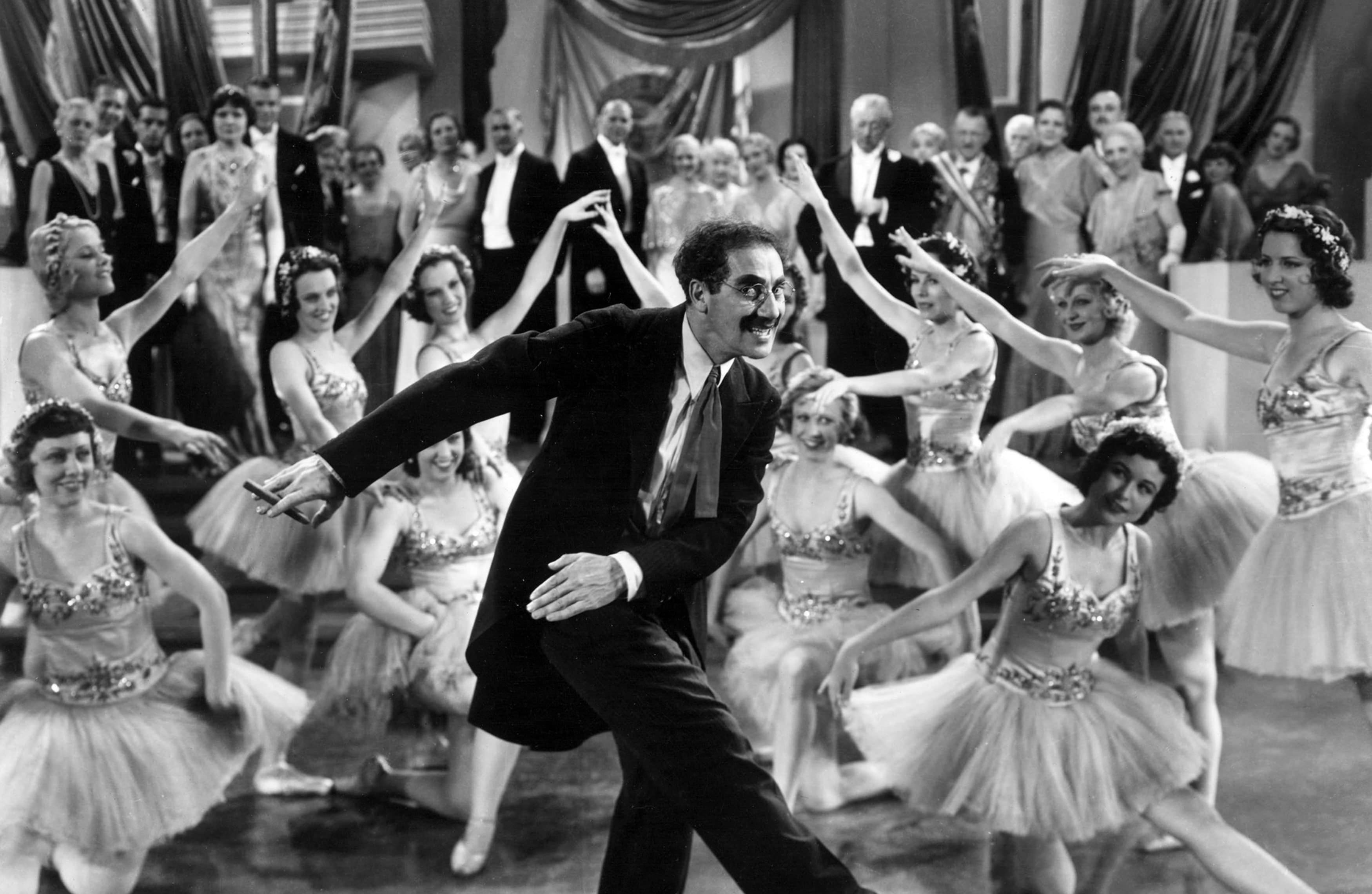
Before I leave the subject of country clubs—Jewish ones: I love the way Groucho Marx skewered prejudice and discrimination with jokes. “My daughter is only half Jewish. Can she go into the pool up to her knees?” “My son is only half Jewish. Can he play nine holes?”
***
Having re-read “The Mystic’s Christmas,” just now, I would like to do a little language. Whittier writes,
“I listen, from no mortal tongue,
To hear the song the angels sung; …
English is such a minefield, isn’t it? Can you say “sung” there, rather than “sang”? No matter how bad you want to rhyme?
And should that be “bad” or “badly”? (I have a lot to say on that subject, but will spare you, today.)
With “to sing,” we have “sing,” “sang,” and “sung.” But with “to swing,” we have only “swing” and “swung.” Little kids, playing baseball, say, “I swang at it.” Why shouldn’t they? The absence of “swang” is a strange lacuna, to use a Buckley word.
Remember when President Reagan said “squoze”? “Squoze” as a past participle for “squeeze”? He sounded like such a Midwestern kid, a Huck Finn kid.
In 1985, he was giving a press conference, and someone asked him about a problem with his nose. Reagan said, “I picked at it and I squoze it and so forth and messed myself up a little.”
One more thing, language-wise, and Reagan-wise—and Buckley-wise. In 1983, the Gipper said, “I’ve had it up to my keister with these leaks.” Bill loved that. He had never heard the word “keister” (a word I grew up with).
I can see and hear Bill chuckling now. Sort of shaking his head as if to say, “That Reagan.”
The Poli Sci faculty at the University of Vermont was a diverse bunch of pinkos, from Leninists to Maoists to Trotskyites. And they were rigorous.
PROF: MR. Taggart, analyze Miss Smith's statement from a Marxist perspective.
ME: Miss Smith and her ilk will be dealt with during the Dictatorship of the Proletariat.
PROF: Excellent.
I once represented the spouse of a man named Keister. Some would say the name fit. I never bothered to ask why his parents hung the name on him.