



Last week, a reporter asked President Trump about Russia’s perpetual murder of civilians in Ukraine. Trump began his answer by saying, “Look, we’re not involved. We’re separated by an ocean.” He went on to talk about hatred on both sides.
Do you think the Ukrainians have any reason for such hatred?
When listening to President Trump, I thought of two quotations. One, you are very familiar with. It was uttered by Neville Chamberlain—a basically good if misguided man—in September 1938: “… a quarrel in a faraway country between people of whom we know nothing.”
I also thought of Ronald Reagan, and his address in July 1987 at the Ukrainian National Catholic Shrine in Washington, D.C. Reagan said:
Our global commitment to freedom does not mandate the sending of arms or troops, but at the very least it means that any people whose liberty is denied or whose independence is violated—that these people know we Americans are on their side.
Yes. These people ought to know, and deserve to know, we are on their side.
By the way, anyone who thinks that a distant conflict can have no bearing on the United States is too ignorant to be anywhere near foreign policy. A conflict can wind up nearer than you think.
Men such as George C. Marshall, and the once-isolationist Arthur Vandenberg, tried to impress this on Americans after World War II.
***
Hussam Luka was one of the nastiest men in the regime of Bashar Assad—and that was one of the nastiest regimes on the planet. The BBC did a lengthy, dogged investigation of him. Guess where this killer, kidnapper, and torturer found refuge? Russia. (Like Assad himself, of course.)
***
I wrote an article about the late senator Lindsey Graham. A “man of our times,” I called him. The article touches on what it means to be a politician—or different ways of being a politician—and I’d like to quote a little:
Congressman Henry Hyde, the Illinois Republican who served in the House from 1975 to 2007, had the job of speaking to new members at their freshman orientation. He stressed one thing: Figure out what you’re willing to lose your seat over. What principle or policy. If there is no such thing, “then you’re going to do damage here.”
I thought you might like a fuller version of Hyde’s remarks. A congressional staffer sent this to me some years ago. Here is what Hyde said on November 29, 1990:
This may sound odd, even ironic. You are here in the flush of victory. And yet it is precisely now that I ask you to contemplate the possibility of defeat—perhaps even the necessity of defeat.
Edmund Burke, in 1774, set forth a model we should all emulate when he told his Bristol constituents: “Your representative owes you, not his industry only, but his judgement, and he betrays instead of serving you if he sacrifices it to your opinion.”
Let me put the matter plainly: If you are here simply as a tote board registering the current state of opinion in your district, you are not going to serve either your constituents or the Congress of the United States weIl.
Your constituents expect you to represent their interests, and that you should certainly do. But you are also a member of the Congress, and your responsibilities are far greater than those of an ombudsman for your district. You must take, at times, a national view, even if, in taking that view, you risk the displeasure of your neighbors and friends back home.
Indeed, I feel obliged to put the matter more sharply still: If you don’t know the principle, or the policy, for which you are willing to lose your office, then you are going to do damage here.
This institution needs more members willing to look beyond the biennial contest for power, more committed to public service as a vocation rather than merely a career.
Well said, right?
***
Let me quote from my article about Lindsey Graham a bit more. I said that, when we assess the senator’s behavior, meaning the mental and political gymnastics he performed to defend and support Donald Trump,
we must also consider the simple matter of partisanship—“the call of the tribe.” (Mario Vargas Llosa used this phrase in the title of a book.) Graham was a Republican, and where his tribe went, there went he.
But he was probably more aware of this than most. He would comment on his own hypocrisy.
Yes.
When Trump and his team covered for the Saudi dictatorship after that dictatorship murdered the journalist Jamal Khashoggi in 2018, Graham said, “If they were in a Democratic administration, I would be all over them for being in the pocket of Saudi Arabia.”
When Trump announced a pullout from Syria later in 2018, Graham said, “If Obama had done this, we’d be going nuts right now: how weak, how dangerous.”
Okay. A friend of mine—a student of philosophy—e-mailed,
It’s a fascinating thing, isn’t it? How Graham managed to be upfront about being a hypocrite. Are those who admit their hypocrisy better or worse than the non-confessional hypocrites? Not a rhetorical question.
I answered,
Somehow, it makes me feel better when a hypocrite acknowledges his hypocrisy, but I don’t know what the philosophical answer is!
My friend answered,
I’m with you; can’t help but prefer the “honest” knave. Yet the trouble with the forthcoming hypocrite is that he may be furthest from redemption, as he seems to confess that the charge of hypocrisy has lost all bite on his conscience.
Smart dude, my friend.
***
Just a little more quoting from my Graham piece, if you don’t mind, and I do it for a purpose:
“You want Graham to have a seat at the table,” I often heard. “You want Graham to play golf with Trump. Better that Graham be in his ear than the isolationists, right?”
Maybe. But Trump has always changed people more than they have changed him.
A reader tells me,
There’s a saying I learned from a youth pastor about 30 years ago: “It’s easier to pull someone out of a canoe than to pull someone into one.”
True dat.
***
My dear friends, I have been in Salzburg for a while, doing some annual work at the festival. For a review, published at The New Criterion, go here. It’s of a concert by the Vienna Philharmonic, conducted by Tugan Sokhiev, with the piano soloist Lang Lang.
***
I will head this column of mine “Taking Sides, &c.” I borrow the phrase from a play, later a movie, about Wilhelm Furtwängler, the great German maestro, and the U.S. Army’s investigation of his conduct during the war.
***
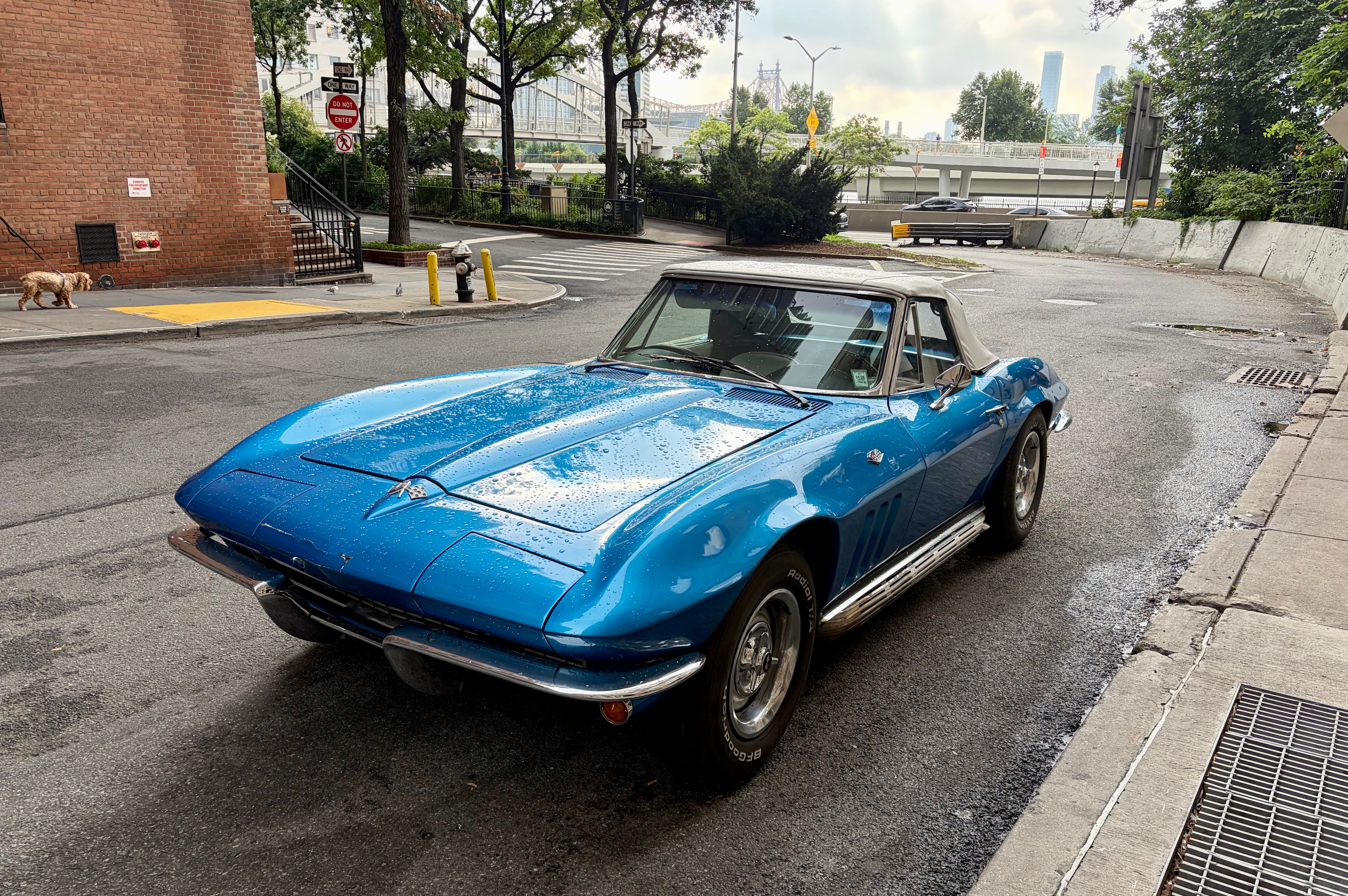
Before I left New York for Salzburg, I saw a sweet ’vette, parked all by its lonesome. What a fantastic machine, right? Possibly even better than the Vienna Philharmonic.
I don't disagree with Jay's assertion the best representatives vote their conscience and mind, not what their constituency wants, unless it agrees with the Congressman's thoughts. Rule by majority is rarely successful as an old saying states "The majority is usually wrong." I think Congressman typically vote with their party, either out of allegiance or fear of losing financial support if they don't. I don't find this admirable and more a contributor to a fading democracy.
Nice 'vette indeed. I am a child of the Gasoline Age; I've criss-crossed the continent astride roaring, thundering steeds of steel, burning dinosaur juice. I know it's coming to an end, but oh! The glory of it! I wouldn't trade my times for any other. See you in the Wind...