



You may have seen this preview of the Trump presidential “library”:

This is perfectly fitting, for Trump. But is it the same for America? I would like to say no. And I do say no. But …
I think of the famous answer from Bill Parcells, when he was asked something like, “Your team is better than its record, right?” Coach Parcells said, “You are what your record says you are.”
There are two major parties in this country. Each represents roughly half the country. One of those parties has nominated Trump for president three times in a row. Never before had anyone been nominated by the GOP three times in a row. Only Trump holds that distinction, that honor.
And I have no doubt that, given the chance, Republicans would nominate him a fourth time.
And the country, in its wisdom, elected him twice. (Once via the Electoral College, but that counts.)
So, you are what your record says you are, right?
This leads me to the arch:

You can read a story about it in the New York Times: “Officials Release Design for 250-Foot Arch in Washington, as Trump Seeks Another Imprint.”
I think this arch is unfitting, out of place. I think it is swollen, elephantine, almost grotesque. Of course, I think the same of Trump’s redesign of the White House. And I think his larding up of that house with gold is something like civic profanation.
But “know thyself” is an important principle. So let me undertake some self-examination.
As a conservative, I am instinctively resistant to change, and that arch changes a stretch of our capital that I know very well, and cherish.
I am also aware that Parisians at first recoiled at the Eiffel Tower. In relatively short order, the tower was part of the furniture, an emblem of the city.
I also know this: that I am against Trump. When I was a kid, I noticed something about myself. Caught myself in something. Lots of people smoked cigarettes then. And it occurred to me that I was bothered by the smoke of people I disliked—and bothered a lot less, if at all, by the smoke of people I liked.
And it was the same smoke (so to speak).
So, I take all this into account. Still, I think the new arch is a gross imposition, and a besmirchment.
David Frum made an observation that caused me to smart:
Something very late Roman about the triumphal arches growing bigger and gaudier as the triumphs themselves grow scarcer and more dubious.
I also smarted at something Simon Schama wrote:
Where’s Edward Gibbon when we really need him?
In early February, I wrote a piece titled “Hail, Caesar? Hell, No.” It ended,
[Trump] is building an arch: a triumphal arch, to be placed near the entrance of Arlington National Cemetery, across the Potomac from the Lincoln Memorial. People are calling this the “Arc de Trump” (get it?)
In October, Ed O’Keefe of CBS News asked the president, “Who’s it for?” Trump pointed to himself and answered, “Me.”
This is not the American way—unless the American people want it to be so. May the republican spirit (note the small “r”) make a comeback.
***
Linda Chavez recorded a podcast with Bill Kristol. This podcast was made for me, as they are two of my favorite people. For a half-hour or so, they discuss their careers and some essential political questions.
Listening to this podcast, I might as well have been eating a hot-fudge sundae. Delicious.
Linda and Bill talk about Democrats who served in the Reagan administrations. (I am being old-fashioned here, describing one four-year term as an “administration.”) Linda herself was a Democrat. I don’t believe Bill was, though he had worked for Democrats: Henry M. “Scoop” Jackson and Daniel Patrick Moynihan.
Bill Bennett was a Democrat. So was Max Kampelman. So was Jeane Kirkpatrick.
I thought of Jeane K., as Linda and Bill talked. I got to know her a bit in her final years. Introducing her once, William F. Buckley Jr. said, “She ought to be woven into the flag as the 51st star.” When I first met her, I mentioned this line—recited it. She said, “That’s the nicest thing anyone ever said about me.” I said, “That’s the nicest thing anyone ever said about anybody.”
Jeane was our ambassador to the United Nations during the first Reagan administration. Through all four of those years, she was a Democrat, as she always had been. She did not change her registration until after she had left government. She was 59. (Reagan had been 51 when he went from D to R.) Jeane remarked, “I’d rather be a liberal.”
(You will find all this in Peter Collier’s biography of Kirkpatrick, which I reviewed here.)
She was a liberal. And also a conservative. These terms can be dizzying. I have written about them many times—here, for example. (“American Conservatism and Liberal Democracy: Why one thing goes with the other.”)
In the podcast with Linda, Bill speaks of “liberal anti-communism.” Once, when I was working for Bill at The Weekly Standard—this was in the mid-1990s—I said to him, “Aren’t we liberals, really? Hasn’t the Left misappropriated the term?” Bill answered, in essence, “Give it up, Jay. You have to use words as they are understood in your particular time and place.”
(I cited this exchange in a 2012 essay called “A World of Labels.”)
Well, words keep shifting on us. And I’d better move on to another subject before I find myself typing yet another article about political terms, starting with “liberal” and “conservative” …
***
Above, I mentioned Bill Bennett. I thought of him the other day when looking at this, um … amazing correction:
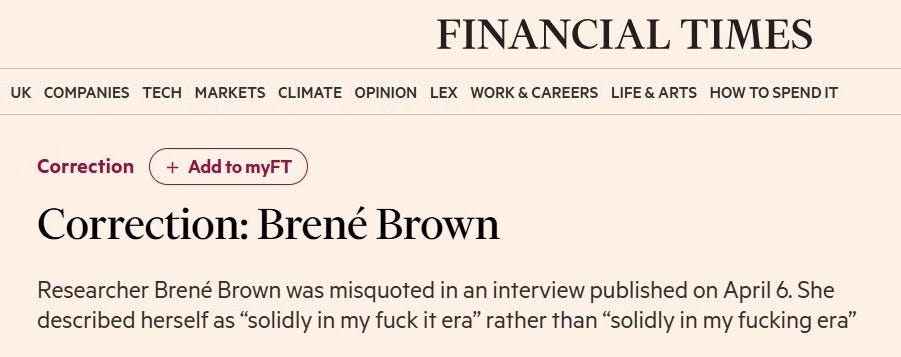
In 1995, Bill was talking to The New Yorker about Pat Buchanan. Buchanan was “flirting” with fascism, he said. Characterizing Buchanan’s ideology, Bill said, “It’s a real us-and-them kind of thing.”
When The New Yorker’s article came out, that line was rendered, “It’s a real S&M kind of thing.” The magazine had to run a correction.
(John Roche once spoke of “Upper West Side Jacobins.” In a Jimmy Breslin column, that line came out “Upper West Side jackal bins.”)
***
May I run something from the comments section? In this article for The Next Move, I made the point that Reagan always distinguished between dictatorships and the people under their boot. He liked to talk over the heads of the dictatorships to the people themselves.
I quoted a New Year’s address he gave to “the peoples of the Soviet Union.” This was on the last day of 1986, over the Voice of America. President Reagan said,
The American people are deeply concerned with the fate of individual people, wherever they might be throughout the world. We believe that God gave sacred rights to every man, woman, and child on earth.
Leaving a comment, Valeriy Ginzburg said that he remembered hearing that New Year’s address.
It was a breath of fresh air. I immigrated to the U.S. in the early 1990s, and was favoring the center-left politicians, but Reagan always was one of my heroes for his undying love of freedom.
Mr. Ginzburg added,
It is terrible that the “leaders” of our country today support dictators and despots all over the world against forces of democracy, decency, and human rights.
Well, that is a theme for later—and yesterday, and now …
***
Maybe treat ourselves to the beauty of spring? Here are two photos I snapped yesterday here in ol’ New York:


***
One of the kids at the golf range is leaving, for another job. You know what he said to me? I think he’s about 20, and he stuck out his hand and said, “You deserve all the finer things in life.”
I could only blurt out, “Same to you.”
Some people were just raised right. Or are natural noblemen.
Later on, my friends, and thanks for reading and subscribing. ’ppreciate you.
Spring blooms > Trump’s kitsch
And it just started with Viktor getting shown the door !
Let freedom reign !