


Two or three times a week, I pass a security guard, who always has a statement for me—or a little speech or homily. He greets me and launches right into it. My friend is in his sixties, I would say, and comes from Trinidad. He is of South Asian background. He is a proud American with high standards and ideals for our country.
Of late, he has been very disappointed.
Last Thursday, he said to me—without even saying hello, I think—“You know, no one has any respect for anyone these days.” He continued,
There’s no respect in this country. Not for older people, not for anyone. When I was growing up, you always greeted your elders respectfully—your aunties and uncles. We called them “ajas” and “ajies.” You respected your parents. You obeyed them. Everyone deserves respect.
In this country, that is all gone. No one has any respect for anybody.
He said this with considerable emotion. I understood him. And I now think of Aretha Franklin, singing “R-E-S-P-E-C-T.”
***
Like you, perhaps, I have been reading a lot about bursts of antisemitism in the United Kingdom. And I had a memory, which I’d like to share with you. I shared it before, in a 2012 column. Allow me to paste:
In 2005 or so, I read an article in The Spectator saying that antisemitism had become so bad in Britain, some Jewish grandparents were urging their children and grandchildren to leave.
I encountered a well-known British journalist at a conference. (Jewish, I should say.) (The journalist, not the conference.) I said, “Is it as bad as all that?” He said, “I would never say this in public, but, to borrow familiar language, they’ll come for them before they come for us.”
What he meant was, British society in general will “come for” antisemitic Muslims and other antisemites before they ever come for the Jews.
In recent years, I have doubted this is true.
***
Something brighter, concerning that country—something I spotted and smiled at on April 30:

Will there always be an England? I certainly hope so.
***
I was talking with a friend about older musicians—people we should see, or hear, while we still can. Some musicians are very long-lived. I thought of Arthur Rubinstein, the pianist, who died in 1982 at 95.
My grandmother told me something interesting: In the 1950s, I believe, she took my dad to a Rubinstein recital at Constitution Hall. (The family lived in Washington.) Rubinstein must have been about 70. My grandmother wanted my dad to hear him before it was too late.
Brahms died in 1897. That was the year Rubinstein arrived in Berlin from Łódź, to continue his studies. He was ten. He knew people who had known Brahms. “For me, he is a contemporary composer,” Rubinstein would say.
That amazed me, when I was growing up.
***
On the subject of music: here is my “New York chronicle,” in the new New Criterion.
***
An obit published yesterday begins,
Nicole Hollander, a biting cartoon artist whose comic strip “Sylvia,” about a big-haired, cigarette-smoking, cat-loving, hyper-opinionated feminist, made her a singular voice on the funny pages for more than 30 years, died on April 23 in Chicago. She was 86.
The cartoonist was born Nicole Garrison. The obit tells us,
She studied painting at the University of Illinois Urbana-Champaign, graduating in 1960 with a Bachelor of Fine Arts degree, and she married Paul Hollander in 1962. Four years later, she earned a Master of Fine Arts degree from Boston University and divorced her husband.
“I thought, ‘OK, I’m an adult, I have a married name, I proved that I could do it, and now I don’t have to do it ever again,’” she told The Chicago Tribune in 1990. (She didn’t.)
That is so cool, right? I wonder what Mr. Hollander thought. (I guarantee you that no one cared or cares. That’s the way it goes.)
(This Paul Hollander is not to be confused with Paul Hollander the sociologist and political writer.) (For a piece of mine about the sociologist and political writer, published in 2004, go here.)
***
A colleague of mine—an excellent writer and editor—texted me, “I think we are the last two people who still use the word ‘healthful’ and I have been weakening in my resolve.” I understand. But it’s a shame—because the distinction between “healthful” and “healthy” was useful.
“Apples are healthful. One a day keeps the doctor away, you know. But how about this bushel? Are they healthy? A few look rotten.”
We are perpetually told that “language evolves,” and so it does. What I object to is the shrinking of the language. Evolution often gives us fewer words, not more. If “healthy” now means “healthful,” we have fewer words. If “envy” and “jealousy” mean the same thing, we have fewer words. If “reticent” is taken to mean “reluctant,” we have fewer words.
I’m for growth, not shrinkage!
***
Up in Harlem, I encountered Hancock Park. A bust of the man duly has pride of place. John Hancock, of the famous signature? The one who signed the Declaration of Independence, so distinctively and memorably? No, Winfield Scott Hancock.
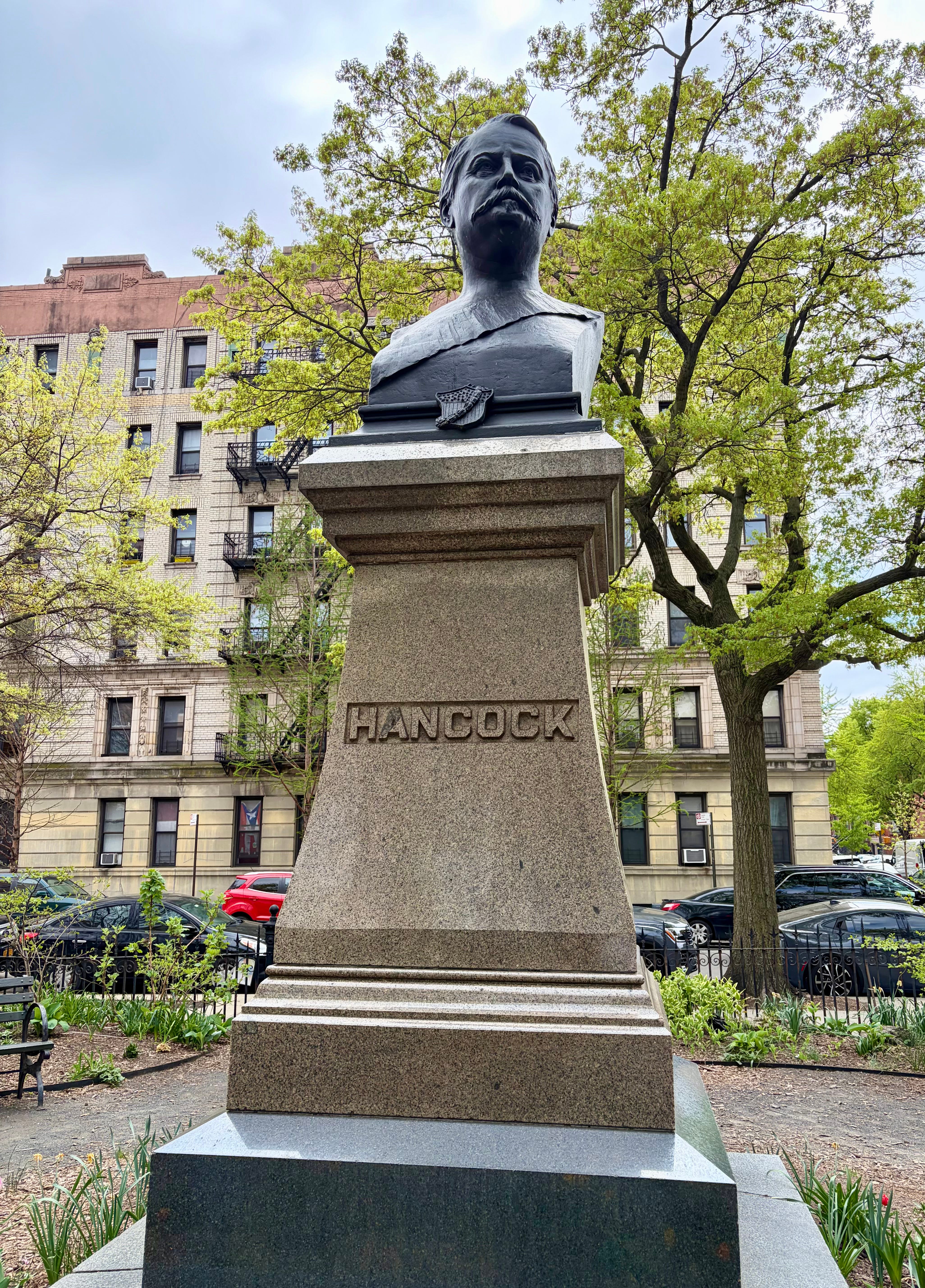
This Hancock was a Union general and the 1880 Democratic nominee for president. (He lost to James Garfield.) He was a lot of other things too. An impressive fellow.
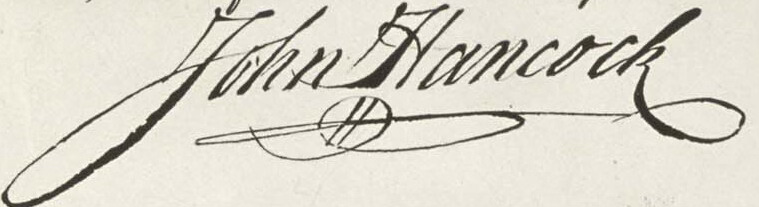
By the way, have you seen John Hancock’s signature lately? As a child, I thought it was magnificent, and, looking at it again, I still do:
***
Before leaving a concert at Lincoln Center, I had to take a whiz. This is what I found:

Call me a dinosaur, call me a mossback—I have called myself no less—but I will never get with this. Ain’t finna happen.
***
For reasons unknown to me, the hashtag PutThatInYourPipe was trending on Twitter. I thought of one of my favorite lyrics of all time. It is by Stephen Sondheim, that master, and appears in West Side Story: “I like the island Manhattan. Smoke on your pipe and put that in!”
That may be my favorite rhyme, along with a line from a gospel song: “Glory, hallelujah. I give my praises to ya.”
Do you have a favorite rhyme? I would love to hear about it: mail@jaynordlinger.com.
And thank you so much for reading and, if you care to, subscribing, everybody. Means a lot to this hopeless mossback.
When I was training to become a pastor, one of my professors said, "Always remember to visit families in your congregation who are doing okay. If you only visit the problems you'll think your church is nothing but problems." Watching the news is like only visiting the problems. There's an awful lot of normal still out there, where children respect their parents and parents are respectable. Visit some normal today.
My favorite restroom sign was seen in at Methodist church in Sanford, North Carolina: "This is your Father's house. Your mother does not live here. Clean up after yourself." The consequences of noncompliance were not specified--but certainly implied.