


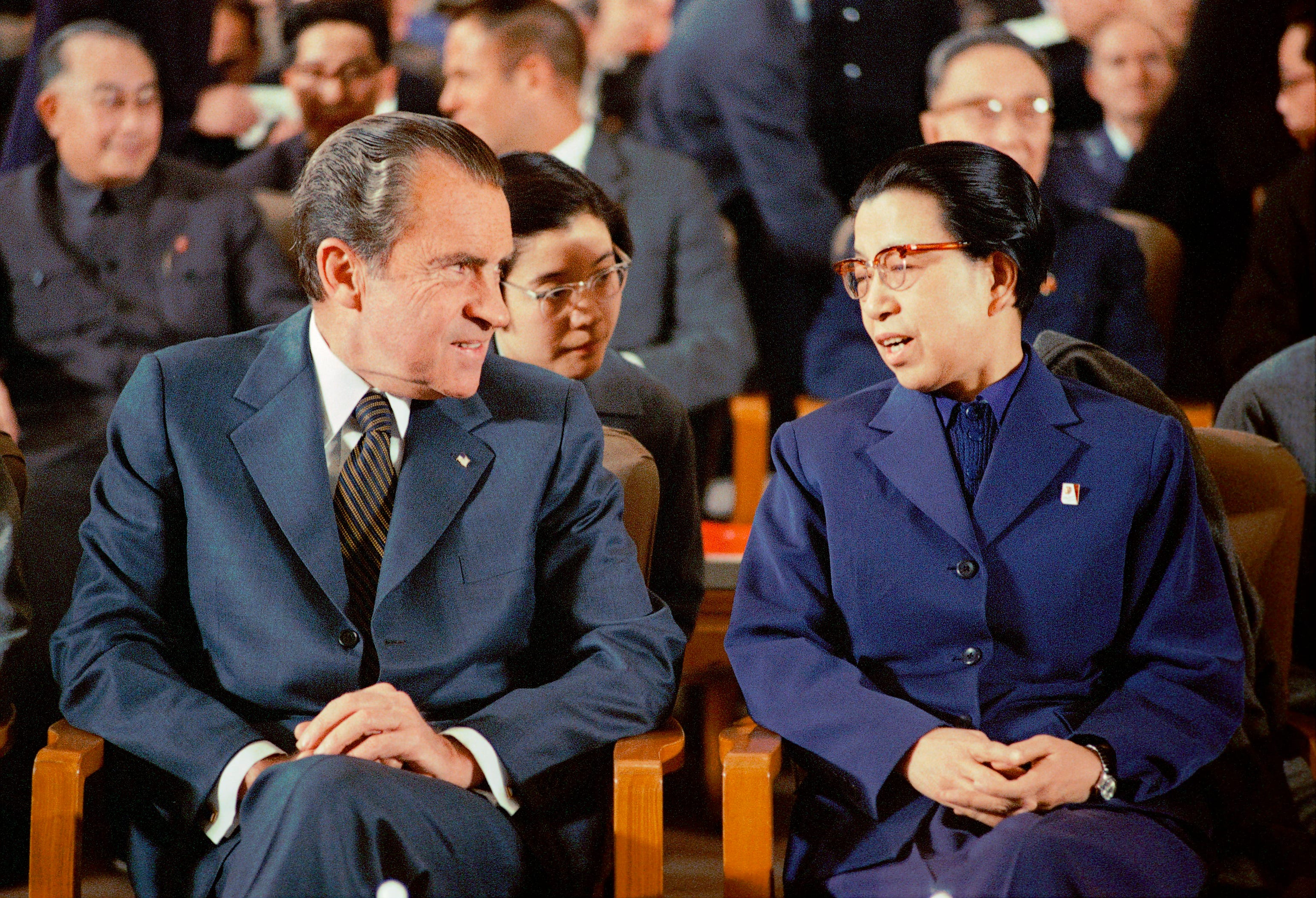
This week, President Trump is meeting with Xi Jinping. U.S. presidents have met with leaders of “the People’s Republic of China”—bosses of the Chinese Communist Party—since 1972. In February of that year, “Nixon went to China,” to use a phrase that soon entered our language. His days in that country were “the week that changed the world.”
That was a popular phrase for some time. President Nixon himself used it.
I have been writing about U.S.-China “summits” since the Clinton years. I wrote about Trump and Xi last May, here. In October 2020, as Trump’s first term was winding down, I wrote a general piece called “Trump and Dictators”: here.
Let me quote the opening of that piece from last May:
Since we are adults, let us stipulate that democracies often have to engage with dictatorships, and that foreign policy is not for the pure. A lot of nose-holding is involved. Paramount is the national interest, and realism is required.
There is a “but” coming—or rather a “yet”:
Yet America has long been a nation apart—not merely “another pleasant country on the U.N. roll call, somewhere between Albania and Zimbabwe.”
That was a line from the first President Bush.
Today, I would like to spend some time on 1972 and William F. Buckley Jr.—who went along on that trip, when Nixon traveled to China and “changed the world.”
WFB “went along” in only one sense, the physical.
I will quote from an article published by the Richard Nixon Foundation (without signature) in 2008:
[Buckley] had been invited to join the trip largely through the influence of Nixon aide Pat Buchanan, who himself had serious reservations about the whole initiative. Apparently the idea was to somehow bring Bill Buckley, and by extension the conservative movement, into the China card fold.
It didn’t work. Buckley didn’t budge. In fact, quite the contrary—he was emboldened in his anti-communism.
WFB did a lot of writing from China, in February 1972, and kept writing about these matters after he got home. Some of the issues are still very fresh: the relationship between the United States and Taiwan; the whys and wherefores of U.S. foreign policy.
To put it mildly, WFB thought that the U.S. had given up too much. What had the PRC given up, in return? Virtually nothing (and maybe we can do without the “virtually”). Henry Kissinger, WFB wrote, “recited Chinese obeisances to the good international life. He might as well have cited the Soviet Union’s guarantee of civil liberties as listed in its constitution.”
Kissinger, in 1972, was Nixon’s national security adviser, soon to be secretary of state. WFB was very critical of “HK” when the latter was in government. Later they became fast friends. I myself was at several Buckley social gatherings at which Kissinger was the honored guest.
In 1972, WFB said that we had, in short, sold out Taiwan. The U.S. and the PRC “issued a communiqué in which the Red Chinese asserted and re-asserted their absolute right to conquer Taiwan.” Meanwhile, we Americans “uttered not one word” on “the applicability of our principles of self-government and independence to the people of Taiwan.”
It was a “staggering capitulation,” said WFB.
But there was worse—the “atmospherics,” if that is not too light a word. We were treating a monstrous, murderous regime as we would a decent, civilized country. Buckley:
We have lost—irretrievably—any remaining sense of moral mission in the world. Mr. Nixon’s appetite for a summit conference in Peking transformed the affair from a meeting of diplomatic technicians concerned to examine and illuminate areas of common interest, into a pageant of moral togetherness at which Mr. Nixon managed to give the impression that he was consorting with Marian Anderson, Billy Graham, and Albert Schweitzer.
(Everyone reading Bill’s words in 1972 would have known those names. They can be Googled today.)
When Nixon toasted “the bloodiest, most merciless chief of state in the world”—namely, Mao—“he did so in accents most of us would reserve for Florence Nightingale.”
One more blast from Bill (the inimitable):
It is unreasonable to suppose that anywhere in history have a few dozen men congregated who have been responsible for greater human mayhem than the hosts at this banquet and their spiritual colleagues, instruments all of Mao Tse-tung. The effect was as if Sir Hartley Shawcross had suddenly risen from the prosecutor’s stand at Nuremberg and descended to embrace Goering and Goebbels and Doenitz and Hess, begging them to join with him in the making of a better world.
Above, I mentioned that Bill had addressed “the whys and wherefores of U.S. foreign policy.” Let’s get into it this way (and bear in mind that “Hangehow” is a previous rendering of “Hangzhou”):
A reporter seated at the table with me in Hangehow, after listening to Mr. Nixon’s toast to Mao Tse-tung, whose revolution he bracketed with George Washington’s, leaned over and said: “That should dispel the last suspicion that there is a trace of ideological conviction left in Richard Nixon.” He wasn’t suggesting that Nixon is not committed, within the United States, to the usual ideals—self-government, a private sector, a bill of rights. Merely that he is utterly indifferent to whether these ideals are practiced elsewhere in the world: indeed, that he apparently cares not at all if these ideals are persecuted in other parts of the world. How far, far away Nixon is from being the “last Wilsonian” that Garry Wills thought him to be, a year or two ago.
All right, here is WFB on schools of foreign policy:
There is the school of thought that says we should go out with our Marines and make the world safe for democracy. The soldiers in that school are very few, and tatterdemalion, and there are volunteers only when freedom in Israel is jeopardized.
That is the kind of barb you can hear today (sometimes with justice, usually not).
Continues WFB,
There is the school at the other extreme, which is quite simply indifferent to the practices of other governments—the school in which Richard Nixon has apparently enlisted.
And in between?
In between there is the main army, composed of those who, while not prepared to go to war merely to relieve an oppressed people, are prepared to distinguish between those governments that make an effort, however clumsy, to acknowledge the role of the individual, and those others that make the individual the objective of their extirpative passions.
Lately, I have been quoting from a speech that President Reagan gave in 1987. He gave it during Captive Nations Week at the Ukrainian National Catholic Shrine in Washington, D.C.:
Our global commitment to freedom does not mandate the sending of arms or troops, but at the very least it means that any people whose liberty is denied or whose independence is violated—that these people know we Americans are on their side.
On March 1, 1972, two days after Nixon’s China trip ended, the New York Times published a report headed “William Buckley Critical.” WFB was a household name. He made news, and his opinion counted.
The Times’s report, written by Bill Kovach, was filed from Manchester, New Hampshire, where WFB was endorsing a candidate in that state’s Republican presidential primary, to be held on March 7. That candidate was John Ashbrook, a congressman from Ohio. Ashbrook was mounting a challenge to Nixon from the president’s right.
(We had different ideas of “left” and “right” in those pre-Trump days.)
The Times report begins,
William F. Buckley Jr. charged today that President Nixon’s desire for political publicity at home had forced him into concessions in Peking that undermined the “whole moral basis” of United States treaty commitments in Asia.
In a scathing commentary based on his observations as a member of the press party on the trip, the columnist, publisher of the influential conservative magazine National Review, accused President Nixon of making consort with the devil and “doing it with the excessive moral enthusiasm that marks Mr. Nixon’s approach to all problems.”
Before we end, I’d like to fast-forward to December 1972, when WFB made an appearance at Harvard. Here is the Crimson (the student newspaper):
A crowd of 400 filled the Currier House Fishbowl last night to hear William F. Buckley Jr. state that Nixon’s trip to China marked an historic turning point in American values.
At a talk originally scheduled for a 25-member Institute of Politics seminar, Buckley said that Nixon “managed first to explain, then to tolerate, then to apologize for that which was formerly thought axiomatically repugnant.”
Buckley said the United States had shown for the first time a willingness to grant totalitarian systems moral parity with Wilsonian democracy. The change may have augured the end of “the Wilsonian idea” in this country, which prescribes limits to state intervention in the lives of citizens, he said.
Pause for a moment. Today, “Wilsonian” is a swear word on the American right. This was not always so.
A bit more, from the Crimson’s report:
Asked if the United States should have continued to ostracize China instead, Buckley replied, “No, I was trying to suggest that the Chinese leaders have not earned our admiration.”
This week, President Trump will meet with the leader of a one-party dictatorship with a gulag (laogai, in China). That dictatorship is committing genocide against the Uyghur people.
I will quote Roger Wicker, the senior senator from Mississippi. He is a Republican of the pre-Trump variety (and thus rare). Yesterday, Wicker said the following:
I know the president intends to discuss trade and AI with the Chinese leadership—and rightfully so. Perhaps some progress will be made. But, during every minute of dialogue, our commander-in-chief should keep in mind that his guest is a brutal, unelected, and oppressive dictator who seeks to dominate his neighbors and whose military arsenal is aimed directly at the United States of America.
Thank you for returning to the NR of my youth, Mr. Buckley certainly still more than relevant.
An outstanding and timely piece, Illustrating the worst of many bad decisions Nixon made. Oh for the days of Reagan's moral rectitude and commitment to good over evil.