



Few can predict what history will say, but it occurred to me that this might be a historic tweet:
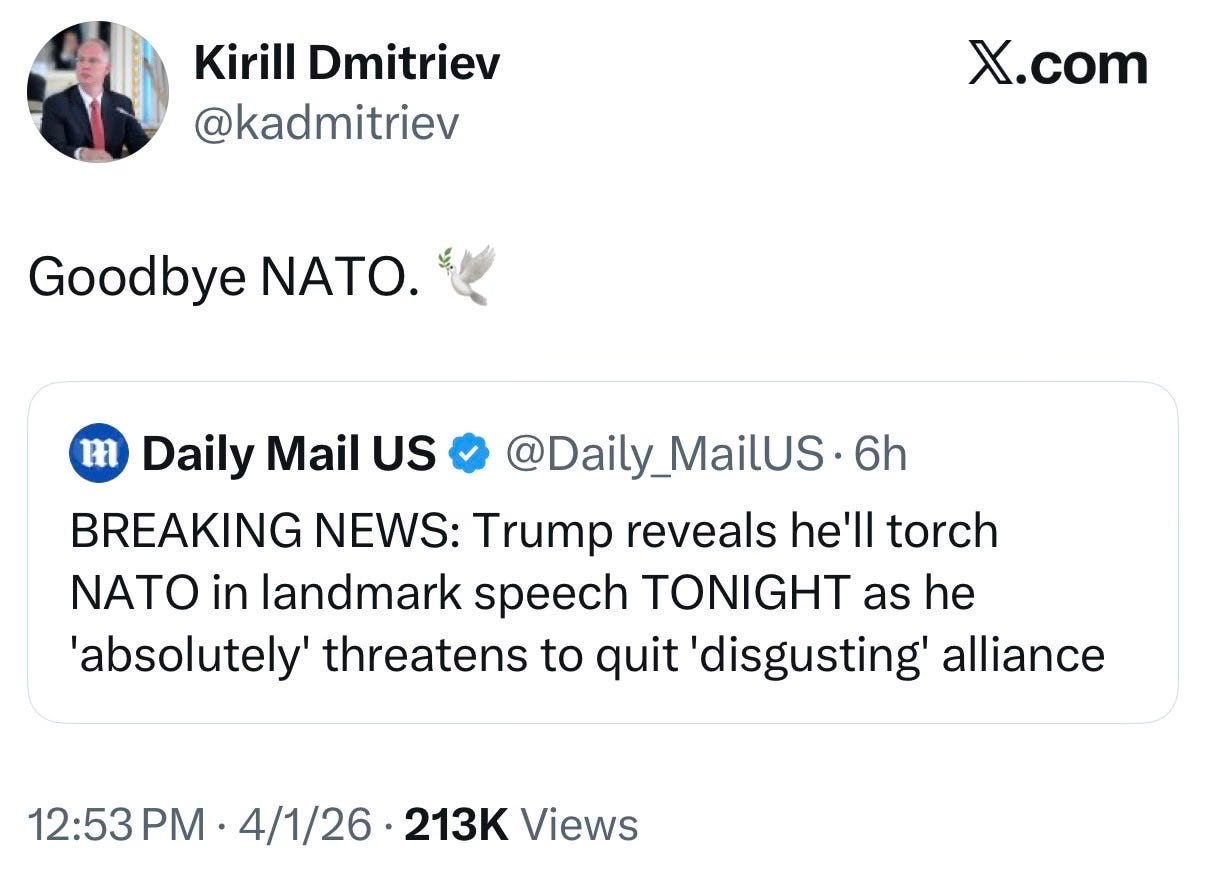
Kirill Dmitriev, as you know, is Putin’s envoy to the United States. A money-man, he is known as “Putin’s wallet.” His counterparts are Trump’s business partner, Steve Witkoff, and his son-in-law, Jared Kushner.
It is sometimes hard to know that Dmitriev, on one hand, and Witkoff and Kushner, on the other, are on different sides.
For many years, Russia and our nationalist-populist Right have shared a goal: the destruction of NATO. The day seems to be upon us now. All of my life, I had heard conservatives say, “NATO is the most successful military alliance in history. And it has benefited, more than any other country, the United States.”
I believe that conservatives were right on this—as on so much else.
In the State Department, there is an official named Darren Beattie. He is no mere Internet troll. He has a B.S. in math from the University of Chicago and a Ph.D. in political theory from Duke.
Here is a sample of his handiwork:

Here is another:
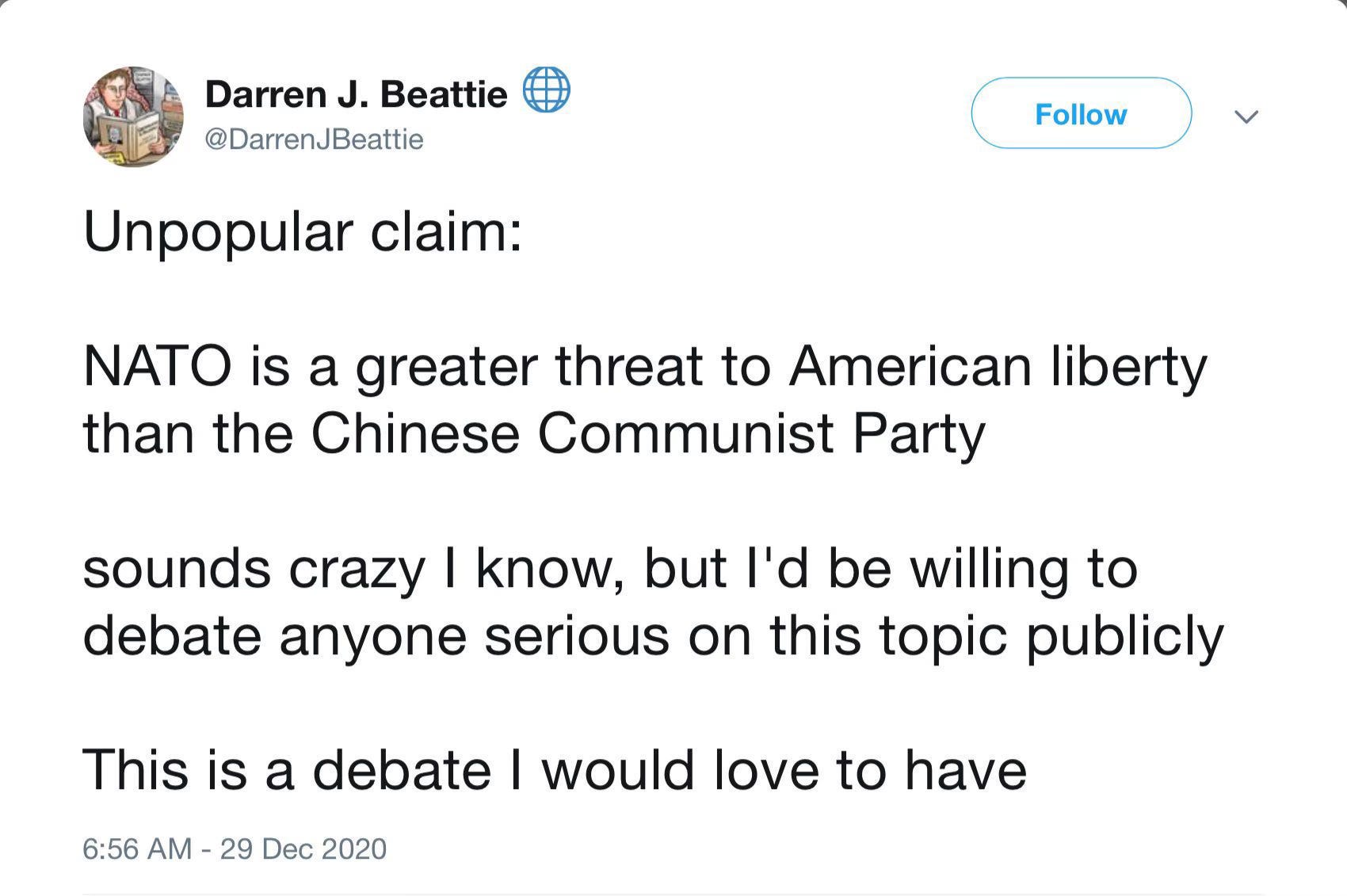
Here is a third:

(Lloyd Austin is the retired U.S. Army general who served as our defense secretary in the previous administration.)
Putin’s Russia, and other enemies of America and the West, could never destroy NATO. Only America can accomplish that.
***
About Péter Szijjártó, I have written many times. He is Hungary’s foreign minister—more specifically, and more personally, he is Viktor Orbán’s foreign minister. In November 2021, as Putin was massing troops along the Ukrainian border, Szijjártó received the Order of Friendship from the Kremlin.
Boy, has he earned it.
There are now recordings of Szijjártó in conversation with Putin’s foreign minister, Sergey Lavrov. (Go here or here or elsewhere.) The two foreign ministers work hand in glove. If there are EU sanctions on Putin’s oligarchs and Lavrov wants them lifted, Szijjártó takes care of it.
(Similar favors are done in Washington, of course.)
In a touching comment, Szijjártó said to Lavrov, “I’m always at your service.”
Some years ago—2016, I think—I was on a magazine cruise. We were docked in Budapest. One of our guest speakers was Foreign Minister Szijjártó. I took a walk around Budapest during that hour. It was just a private protest—I told no one, except for Mona Charen, I think.
But I thought that American conservatism was being corrupted by Orbánism, and, obviously, the condition has become much worse in the ensuing years.
In a report for the Washington Post, Catherine Belton has chapter and verse, or many chapters and verses: go here. Belton’s report could serve as the basis of a book on the close marriage between the Orbán government and our “post-liberal” Right.
That report is headed as follows: “In Hungarian election, Trump and Putin are backing Viktor Orbán.” Both the Kremlin and the White House are pulling out all the stops to reelect their man to a sixth term in office.
This is a curious pass, or at least an important one.
Last week, Johan Norberg wrote,
Orbán’s Hungary is often praised on the American right. But after 16 years, we know what that model delivers. My new study shows it is the opposite of the American tradition of rule of law and free markets.
Yes, but that is precisely the appeal, for many.
In any case, Norberg is an excellent scholar at the Cato Institute, and I commend his study, here.
***
Did you see this? “Perfect homework, blank stares: Why colleges are turning to oral exams to combat AI.” My urge is to quote the entire article, but the gist is this:
Students are using artificial intelligence to do their homework. Or rather, AI is doing it for them. That “homework” is very good—perfect, in fact. Professors then question the students about the material. And the students are dumbstruck. They stare blankly.
I like the idea of oral exams. It sounds pure.
And talk about pure, baby: “A college instructor turns to typewriters to curb AI-written work and teach life lessons.” (Article here.)
At long last: my hour cometh. Or rather, returneth.
***
In a column last month, I spoke of Yiddish. I did not speak Yiddish, mind you, and I do not. But I addressed the subject. Time was, there were many, many Yiddish-speakers in New York. Jimmy Cagney was one.
That personification of the Irish American? Yes. He grew up on the Lower East Side, with Yiddish all around.
Today, there are lots and lots of Spanish-speakers in New York. I have a Romanian friend who speaks “restaurant Spanish,” as they call it. He has worked around Spanish-speaking waiters, busboys, and cooks for years. His Spanish is better, actually, than “restaurant,” I think.
A friend of mine in California has sent me a clip of Colin Powell talking about Yiddish, and speaking some. Powell was a New Yorker. To watch that clip, go here.
Writes my friend,
Where I live now, Spanish is our Yiddish equivalent … One thing I’ve noticed is that the children of Spanish-speaking immigrants seem to speak English perfectly. It wouldn’t surprise me if in 2126 Spanish is as forgotten in California as Yiddish is in New York in 2026.
***
A matter of English, real quick? A reader writes that he hears “He graduated high school,” “She graduated college,” etc.
He says that these phrases don’t grate on him as “not that big of a deal” does—but they still bother him. He misses a “from” (“graduated from college”). And there ought to be no “of” in “not that big a deal”!
I agree with our reader.
But ours is not to reason why when it comes to idioms. Idioms are idiomatic. That is their nature. It’s in their very name.
(By the way, my grandmother and other real grammarians would want you to say, “She was graduated from college.”)
***
At the end here, maybe I could throw a little music at you—in the form of my “New York chronicle,” published in the April New Criterion. I have a few rude questions in this piece. Here is one of them:
[W]hat is Dutch music? Why have there been so few Dutch composers, especially given that country’s prevalence in art? There was Sweelinck, born in 1562, and, in our own day, Louis Andriessen (1939–2021). But not many others.
While I’m being rude: have Dutch writers contributed to world literature? Again, this is curious, given that country’s proud role in art.
If you can help me out, lemme know. (And I apologize to all Dutchmen, whose country I esteem and enjoy.) Thank you for joining me today, guys. And I appreciate your subscriptions, which are meaningful and helpful.
Later on.
The last period of music where the low countries were relevant was probably in the 15th century, with the Franco-Flemish school. Du Fay, Binchois, Busnoys, Ockeghem, Obrecht, Josquin, and the boys. At least some of them were even born there as opposed to only flourishing there.
I reckon that's a decent enough output to last 500 years or so. It doesn't answer the question of why they haven't been active since, however.
The current elected leader of the United States campaigned on a platform of bigotry, racism and thuggery. His followers elected him to office twice, well aware of his nature and character. Ironically, a majority of his adherents profess to be disciples of the One who counsels that they be "poor in spirit, meek and merciful peacemakers." We know what is wrong with the president, but what has happened to those who choose to be ruled by him?