


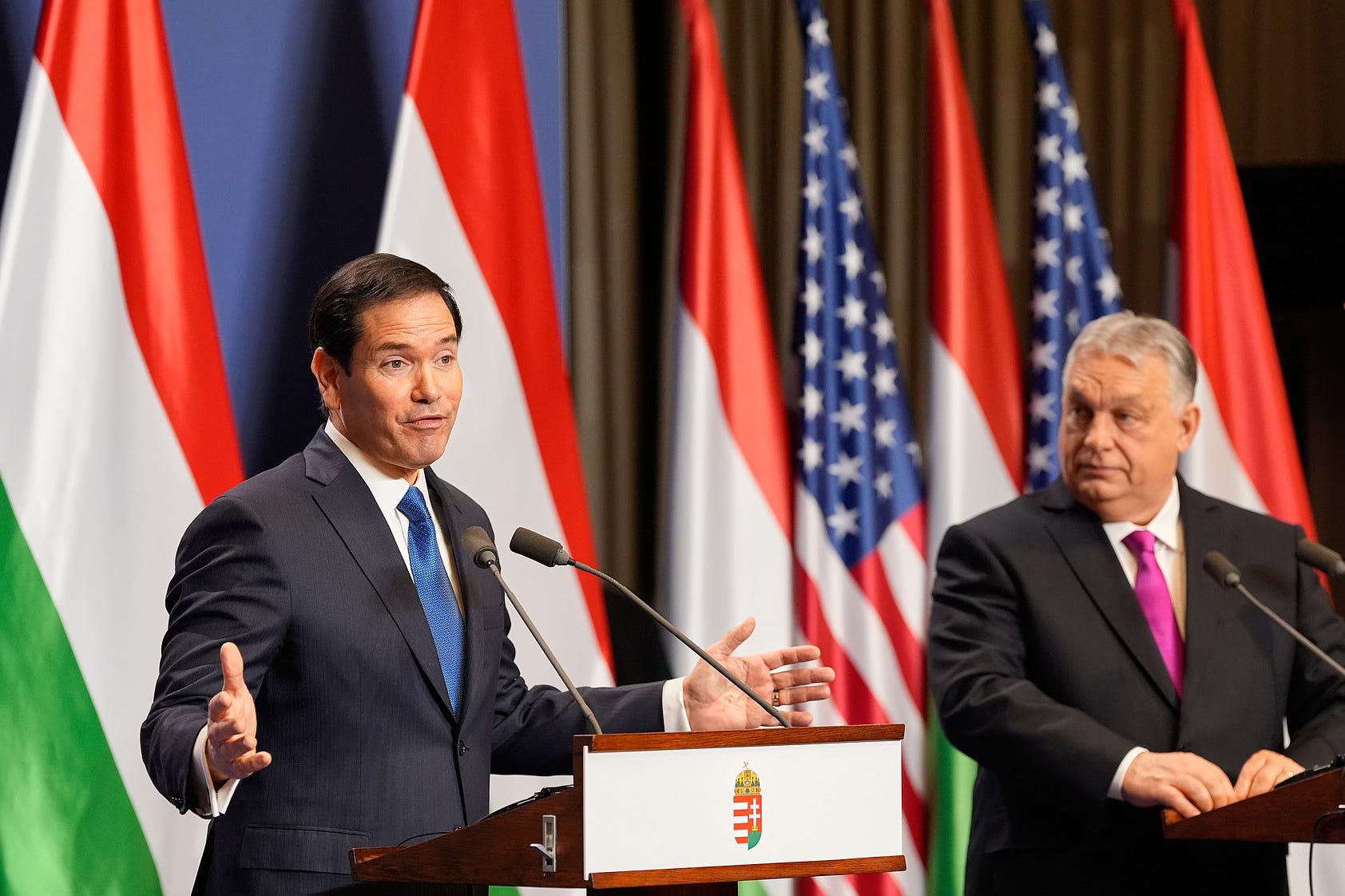
Here is a headline that indicates an abnormal time: “Rubio plugs Orbán’s bid for another term in Hungary’s elections.” The article, from the Associated Press, begins,
U.S. secretary of state Marco Rubio on Monday enthusiastically endorsed Hungarian prime minister Viktor Orbán’s bid to serve a fifth straight term after the April elections, emphasizing during a visit to Budapest the strong personal relationship between the nationalist leader and U.S. president Donald Trump.
“Nationalist leader” is one way to put it. Too benign a way, in my judgment.
After the Munich Security Conference, Rubio traveled to two nations: Slovakia and then Hungary. The leaders of those nations—Robert Fico and Orbán—are the most Putin-friendly in Europe (if you don’t count Alexander Lukashenko, the dictator of Belarus). They are faces of the post-liberal Right, and obviously aligned with Trump’s Republican Party.
In Budapest, standing alongside Orbán, and, in part, talking directly to him, Rubio said, “We want this country to do well. It’s in our national interest—especially as long as you’re the prime minister and the leader of this country.”
Thus did the U.S. secretary of state, in effect, campaign for Orbán.
Young people may not realize how unusual it is for a secretary of state to do such a thing. To intervene so sharply and directly in an allied country’s elections.
Is the United States an ally of Hungary? Or of Viktor Orbán and his party?
Rubio also said, “The prime minister and the president have a very, very close personal relationship and working relationship, and I think it has been beneficial to our two countries.”
Addressing Orbán directly, Rubio said, “That person-to-person connection that you’ve established with the president has made all the difference in the world in building this relationship. President Trump is deeply committed to your success, because your success is our success.”
Did he mean Hungary’s success? Or Orbán’s personally? Obviously, the latter.
While most of the Republican Party is attached to Orbán, Senator Mitch McConnell is a Republican who has his number. As he said in 2024, Orbán and his party “have cozied up to America’s greatest strategic adversaries”—namely, Russia, China, and Iran.
Orbán is a pretty sick figure for a U.S. administration to rally around. But imagine if a Democratic administration, and a Democratic secretary of state in particular, intervened in an election for a favored politician in an allied country. Republicans would cry, at a minimum, “Diplomatic malpractice!” And they would be absolutely right.
Earlier in my life, I knew people who liked Israel, or had a kind word to say about Israel, only if the Labor Party was in charge. Or only when Likud was in charge. But real friends support Israel whatever the political weather.
I knew people who liked the U.K. when Labour was in charge, or when the Conservatives were in charge. Again, that was conditional, or situational.
As I see it, Marco Rubio was not only campaigning for Orbán but also, in a sense, campaigning for himself. Orbán is a nat-pop pin-up. He is a darling of CPAC, the Heritage Foundation, and other elements of what still calls itself the “conservative movement.” The 2028 Republican presidential primaries will be a nat-pop palooza.
“Who is the nat-poppiest”—the most nationalist-populist—“of them all?”
Obviously, Vice President JD Vance is an American Orbán. Pur et dur. Rubio has a Reaganite background, making him suspicious. He will have to prove his nat-pop bona fides, as he is doing over and over.
Can the Trump administration and the GOP put Orbán and his party over the top in the April elections? We will soon see.
In a column, George F. Will wrote, “Putin’s only sympathizer in the European Union, Hungary’s Viktor Orbán, might now have firmer support among American authoritarians (‘national conservatives’) than among Hungarians.”
***
You may well have seen this news:
Russian opposition leader Alexei Navalny was poisoned by the Kremlin with a rare and lethal toxin found in the skin of poison dart frogs, five European countries said Saturday.
Those countries were the U.K., France, Germany, Sweden, and the Netherlands. The United States did not join. But we’re “not disputing” the Europeans’ report, Secretary Rubio said.
Which is big of us, I guess, all things considered.
***
Donald Tusk is the prime minister of Poland—a very different leader from Orbán, Fico, and their like. Standing with Ukrainian president Volodymyr Zelensky—literally and figuratively—Tusk said, “Some say that Ukraine should be grateful for everything” (meaning, allied support). “The truth is exactly the opposite. The rest of us should be grateful to Ukraine.”
Yes. Ukraine is on the front lines of a war involving us all, whether we like it or not. It is a war launched by Putin against the Free World. Putin is joined by his allies: China, Iran, North Korea—the worst of the worst. On our side, the Ukrainians are doing the fighting, sacrificing, and dying. What they ask of us is support—or, in the case of the United States, non-hostility.
Over and over, Trump, Vance, and other members of their party claim that Zelensky and the Ukrainians are ungrateful. This is a lie, of course. But it is a lie that is repeatedly asserted, leading millions to believe it.
A few months ago, our president wrote, “UKRAINE ‘LEADERSHIP’ HAS EXPRESSED ZERO GRATITUDE FOR OUR EFFORTS.” And you may remember this infamous, foul message from the White House a year ago:
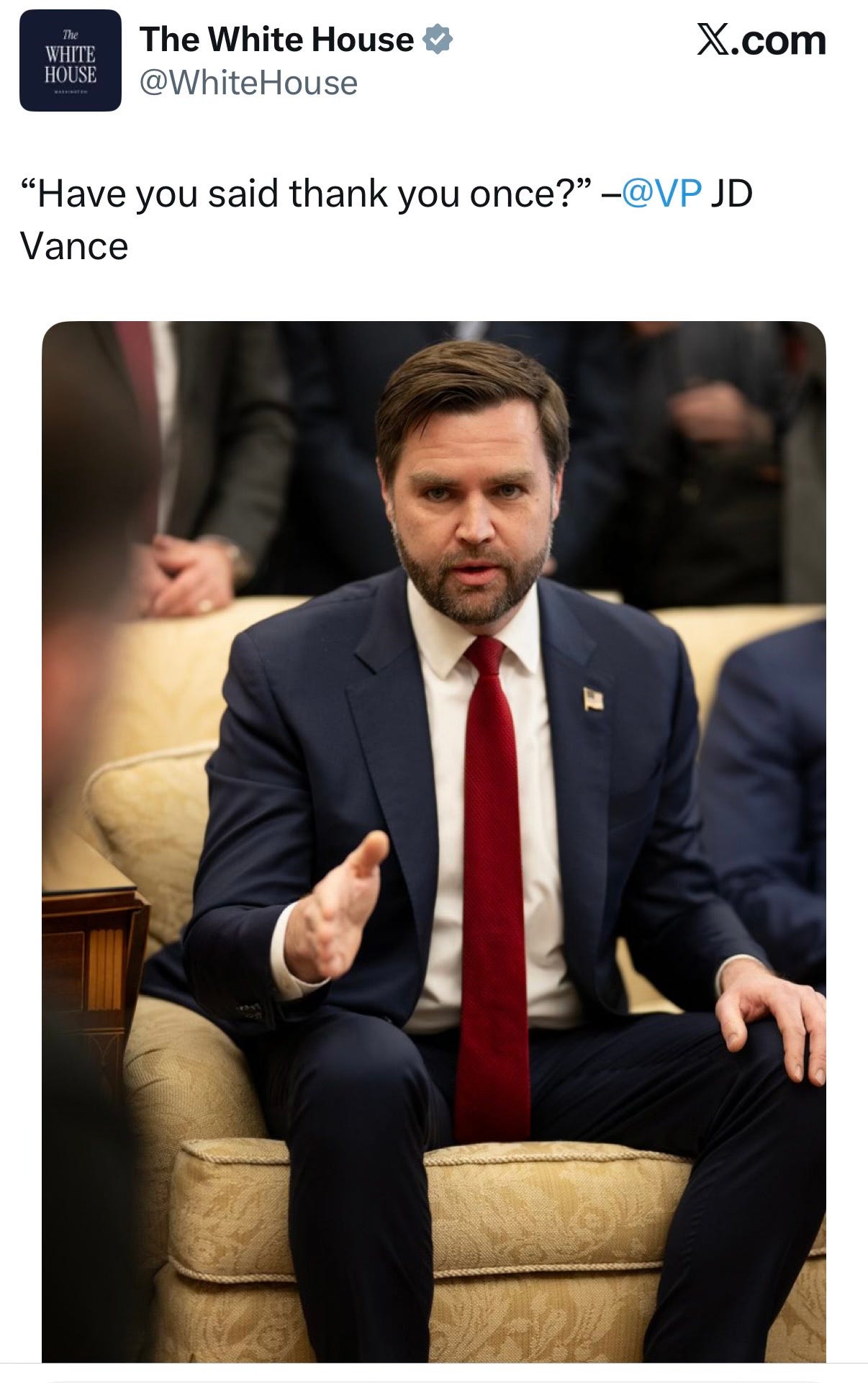
If you would like to know the truth, consult this article, for one: “Fact check: 78 times Zelensky has expressed gratitude to the U.S.”
In any event, Donald Tusk is right. The Ukrainians are obviously grateful to those who support them, as they struggle to save their country—their freedom, their independence. But it is we who ought to be grateful to them.
***
Wolfgang Ischinger is an interesting cat. He is a German diplomat who has been his country’s ambassador to the United States and also to the United Kingdom. He has been deputy foreign minister. And also the chairman of the Munich Security Conference.
Born in 1946, he went to high school in Illinois—Watseka (whose population is today about 4,500)—as an exchange student.
Last week, he said, “We Europeans are now relearning that, if you want to be successful in this world, we need a diplomacy that is underpinned with sufficient military power.”
I thought of Frederick the Great, who said something that Herr Ischinger can surely quote by heart: “Diplomacy without arms is like music without instruments.”
As I like to say, Frederick was a musician—a composer and flutist—who had side gigs as a military commander and king.
***
This has been a sober, even a dark, column. Maybe I could give you something sweet—as in Sweetwater.
The other day, I was corresponding with a reader, who had subscribed to Onward and Upward. Her last name is Nevins. I said, “Any relation to the historian Allan Nevins, by chance?” She said, “As far as I know, I am not related to Allan Nevins. But the lead singer of the ’60s rock band Sweetwater, Nanci Nevins, is my father’s first cousin. That’s as close to a brush with fame as I get.”
Marvelous. Enjoy Nanci Nevins and Sweetwater in “Day Song”: here.
***
I’ve been talking about Russia and Poland, among other countries. In Jersey City, N.J., there is a memorial to the Katyń massacre (in which the Soviets killed about 22,000 Poles). I took a picture of the memorial last week, with Lower Manhattan in the background:

And here is a picture of Lower Manhattan from a 64th floor:

Thank you for joining me, dear readers. Appreciate you, muchly.
"To intervene so sharply and directly in an allied country’s elections."
Like President Clinton did in Israel's election?
Good article. Ideal length, appreciate the pictures.
Also, re Sweetwater, "The original members of the band were Nancy "Nansi" Nevins ...". All the sources online have "Nancy" or "Nansi"; none has "Nanci".
In the past two decades, is there a bigger chameleon in politics than Marco Rubio?