


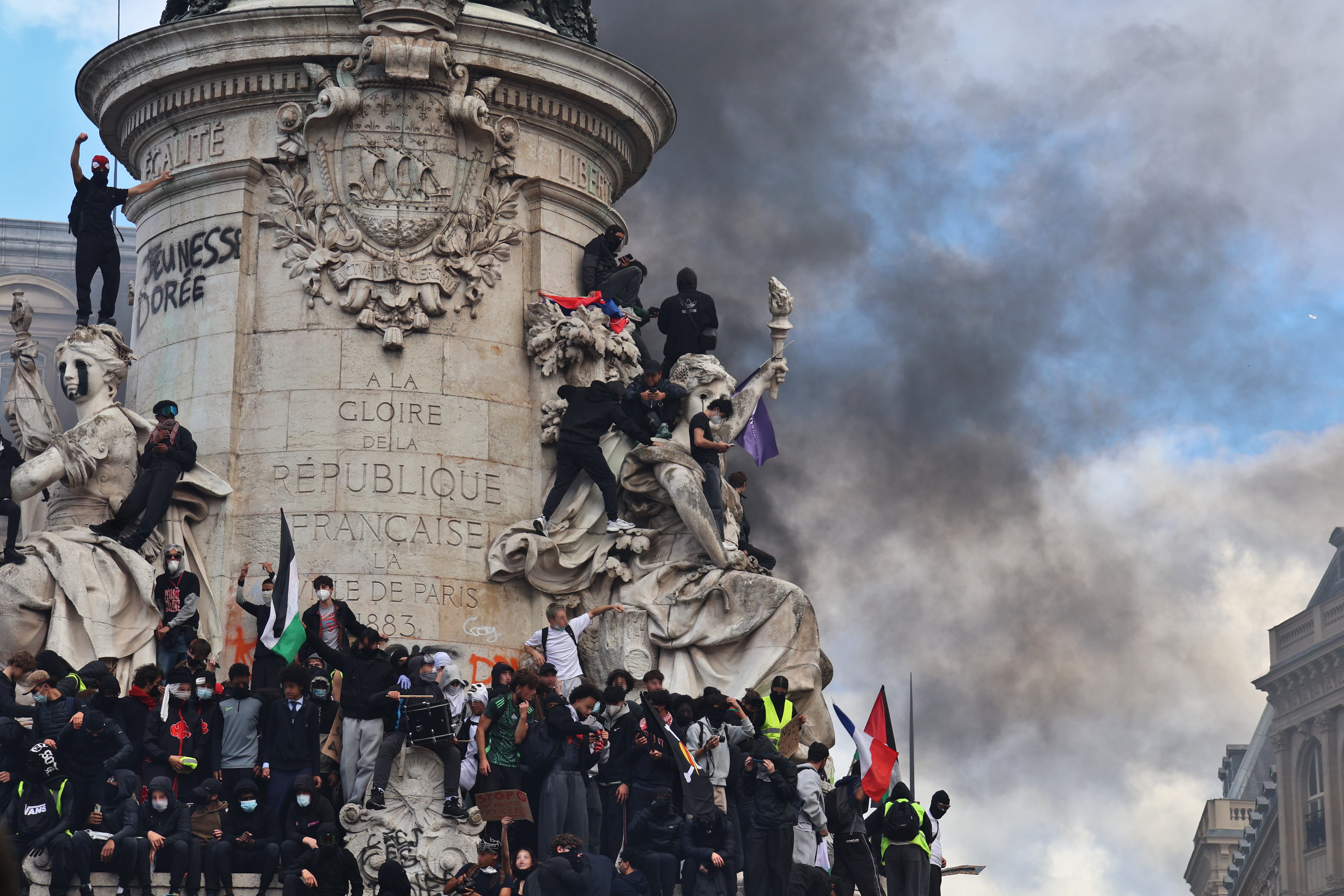
About the turmoil in France, I have nothing original to say, because there is nothing original to say. But the unoriginal things—the platitudes, if you like—are very important.
Over the decades, brutish types have given “law and order” a bad name. This is too bad. Law and order is a beautiful, wonderful thing. Indispensable, too. Without law and order, a free society—a society worth living in—is impossible.
A government must afford its citizens physical protection. Without this, nothing else really matters. “Ordered liberty” is the name of the game—our high ideal. Both the noun and the adjective are crucial.
Franklin D. Roosevelt spoke of “freedom from fear.” Lots of people have laughed at this, for understandable reasons—it seems a little gauzy, a little pie-in-the-sky. But I believe I know what FDR was getting at.
If you can’t feel safe in your society, you are not properly free.
Civilization will not defend itself. It needs guardians, protectors. If the French government won’t defend French civilization, who the hell will?
Maybe there should be une mission civilisatrice in France.
Everyone says that if “mainstream” parties won’t keep law and order, the people, in their desperation, will turn to extremists to do the job. And everyone is right.
***
Kimberly Guilfoyle has led an interesting life—probably too interesting for her own good. She was married to a possible future president: Gavin Newsom, the California Democrat. She was engaged to another possible future president: Donald Trump Jr. She was in the heart of MAGA. She served as ambassador to Greece. (“Served” is not the right word, at all, but roll with it.) Now she has been fired.
She is corrupt to the gills, of course. But who isn’t in TrumpWorld?
Guilfoyle should write her memoirs—telling all, in an unvarnished way. They would sell like hotcakes (including to me). And I believe they could render a public service.
How did she end up in the places she ended up in, with the people she ended up with, doing the things she did?
Fascinating.
***
Did you catch this story in the Wall Street Journal? “Ken Paxton Partied in Dubai With Fugitives Ahead of High-Stakes Texas Senate Race.” As I see it, populism is such a weird phenomenon—weird politically and psychologically. Populists rail against “elitists.” Yet the heroes of populism—they tend to live in ways that, in their extravagance, their sheer let-them-eat-cake gall, would make “elitists” blush, or retch.
An amazing con they got goin’, the populists.
***
A headline from the Associated Press: “House Speaker Mike Johnson draws on faith as he fights to hold the Republican majority.” (Article here.)
I will be blunt: Give me hard-boiled atheists who support the Ukrainians against their murderers over these a-holes “of faith” who have aligned our country with Putin.
***
For the last ten years, I have heard more about Carl Schmitt than I had heard in the preceding 50 years of my life. Schmitt is hot. He was a German philosopher and an unrepentant Nazi. The kids—you know, the “youths”—have discovered him. Because of course they have.
Cass Sunstein, the legal philosopher, has scribbled a primer on Schmitt: here. Recommended.
***
While I am recommending Sunstein, let me tell you something—something odd: I have never much been interested in the Jefferson-Hemings question. This is odd because (a) I love American history and (b) isn’t everyone drawn to a sex scandal?
(“Sex scandal” is too trite a phrase for the Jefferson-Hemings matter, I acknowledge.)
Anyway, Professor Sunstein drew me in, here. The Jefferson-Hemings story is one of the most American stories imaginable …
***
Today is not the day to air the question of capital punishment—not in this column. I am against capital punishment, in a somewhat complicated way. But I have great respect for the arguments in favor of it—as articulated, for example, by Walter Berns, whom I have long admired.
For a few days this month, we were debating the merits of live-streaming an execution—the execution of the Fort Hood shooter, Nidal Hasan. The live-streaming, once on, is off. The execution is still on.
What if the execution—the attempted execution—of Christa Pike had been live-streamed? Might that have helped the anti–death-penalty cause? To refresh your memory, here is an article from September 30: “Tennessee Fails to Execute Woman After 2 Doses of Lethal Injection.”
They called an ambulance—an ambulance to an execution. When they failed to kill her, twice, they called an ambulance, to take her to the hospital. How screwed up is that? Why not just plunge a knife into her heart?
The death penalty is a ghastly business. I am not saying it is unjust. But it is ghastly, and there is no point hiding it. If it’s right to do, it’s right to do out in the open.
Is it?
***
Every week, there is a stream of stories detailing corruption in and around the Trump administration. A recent sampling:
“He Crafted a Crypto Law for Trump—as His Company Got Millions From a Crypto Giant.”
“Secret documents reveal donors behind $330 million for Trump’s ballroom.”
“White House preservation group took $2.5M from man who wanted to demolish East Wing.”
“Trump meme coin buyers vie for dinner with the president. Many appear to be overseas.”
“A Billionaire Wanted a Trump Pardon. His Family Gave Alina Habba a $50 Million Deal.”
I want to make a brief, gooey point: I’m grateful for a free press. So grateful. Without it, a democracy has no chance. People may not care about corruption—but at least they are without the excuse of ignorance.
***
General Mike Flynn gave us a MAGA statement for the ages. It should have its own special page in Bartlett’s. Flynn, you recall, was Trump’s first national-security adviser. He is Putin-friendly, to put it mildly.
When Mike Pence blasted Trump for betraying the Ukrainians and bolstering Putin, Flynn blasted Pence, on a variety of fronts—including this: “You certified an election the base rejected.”
Did you know that the Republican Party “base” has a veto over American elections? My civics teacher never told me that …
***
I, for one, am tired of hearing about the midterm elections. I want to get right to them, know the results. I think of a line from James Bond, in GoldenEye (1995): “No more foreplay.”
***
Most people, including Republicans, I gather, are expecting a Democratic wave. But you never know—until the votes are counted.
***
Recently, Matt Labash, my old friend and colleague, was communing with Rilke. In his column, Matt quoted a letter that Rilke sent to a friend whose brother had committed suicide.
To read the entire letter, go here. I will quote just a little of it:
All our true relationships, all our deepest experiences stretch across the whole. Across life and death. We must live in both, be deeply at home in both. …
Resolve to be brave. Be brave this very evening. Play Beethoven.
He, too, belonged to the whole.
Yes, he did. Matt had a question for me: What piece by Beethoven might go especially well with Rilke’s letter? There were so many candidates. I settled on this: the third movement of the String Quartet No. 15 in A minor, Op. 132. Beethoven wrote this music in gratitude for recovery from a serious illness. He gave the movement this heading: “Holy song of thanksgiving of a convalescent to the Deity, in the Lydian mode.”
Well, that’s a “mic drop,” so I’d better sign off. Thank you, my friends, for reading, and for subscribing if you can/want. Appreciate you, mucho. And thank you, Matt. And thank you, Beethoven. And Rilke.
Montesquieu held that love of the laws was the indispensable spring of a successful republic; without it the republican form cannot be sustained. The view that mere legal force (or some other passion) suffices applies, in his analysis, to monarchy, not to republican government. It appears l’ecoles in France, as in the United States, no longer teach the habits of the heart necessary to sustain any republic, ie civic virtue.
"Cass Sunstein, the legal philosopher, has scribbled a primer on Schmitt" and "Professor Sunstein drew me in" to the story of Jefferson-Hemings, too.
One of the few bright spots in the rise of illiberalism is recognizing the kinship between fellow liberals. In the before times, I had known of Sunstein as one of conservatives' "better opponents" – a worthy opponent for liberals with more conservative dispositions and policy preferences.
When I read his essay on the Jefferson-Hemings story (a story I wasn't inclined to dwell on, either), or when I read his reminiscences of the intellectual ferment at the University of Chicago, including his admiration for his more conservative colleagues, I read the "voice" of someone who's charitable and honorable, a complete human being, a mensch. And I think of the importance of institutions like the University of Chicago in bringing out the humanity in their members.
Institutions don't bring out our better selves automatically, of course. The fear that they might bring out our worse selves is sometimes warranted. Institutions can be corrupt. And the populist suspicion that they all must be corrupt, somehow, is one way to corrupt them, by discarding the discernment to recognize the better institutions.