


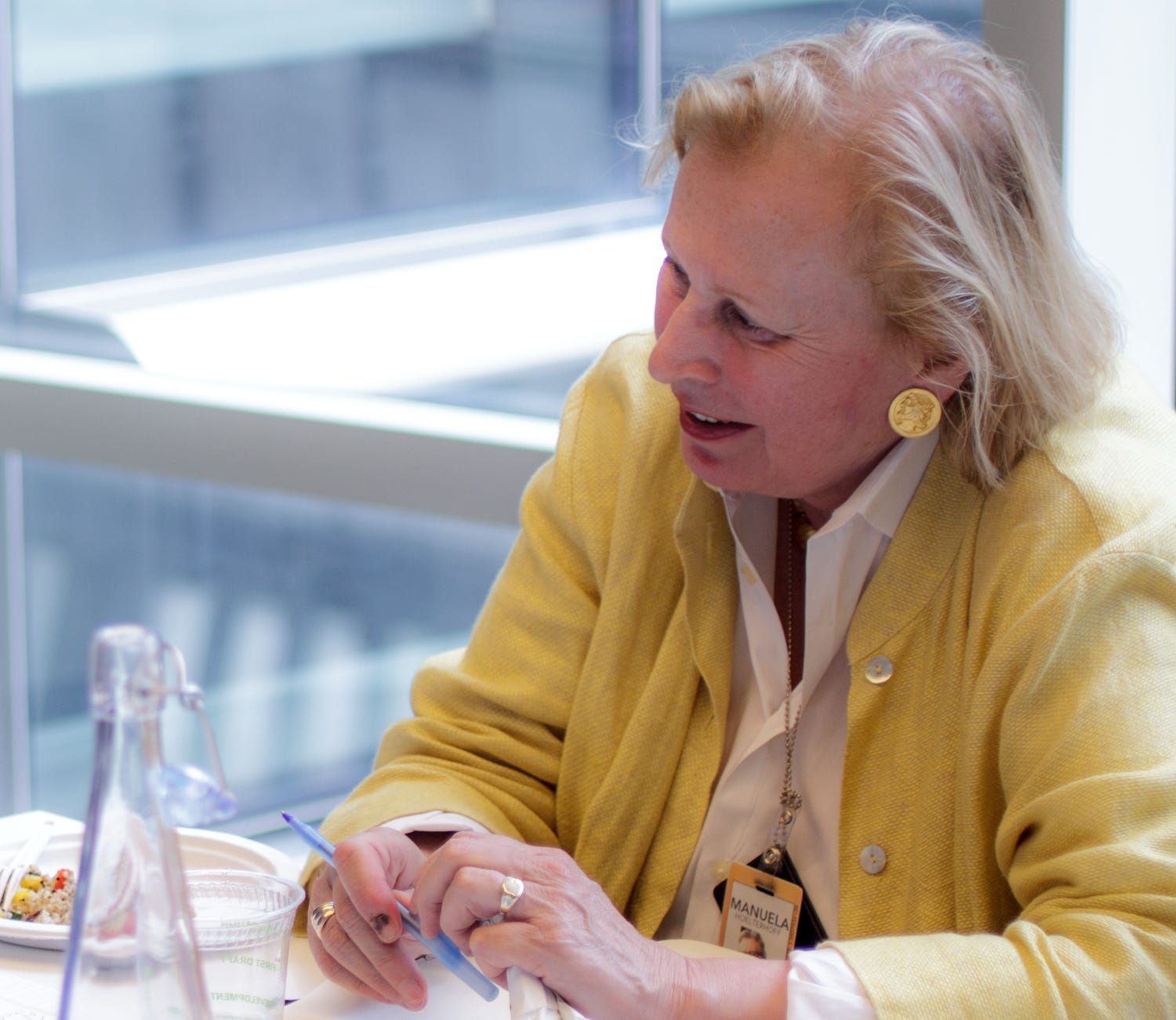
A little excerpt, please, from an article I wrote in 2014:
Manuela Hoelterhoff reminded me recently of why she has long been one of my favorite writers (and people). This piece, at Bloomberg, is 100 percent Hoelterhoffian. It’s bitchy, bright, informed, and delicious.
A sample from Mani’s piece:
Who wants to hear an opera called “Albert Herring”? Indianapolis Opera found out and had to cancel its spring production. This piece has been boring since Benjamin Britten finished it in 1947. Why did you folks not know this?
In 2022, Mani’s friend Sheila Nadler, a mezzo-soprano, died. This is how she began her appreciation:
Sheila Nadler (Ida! to her closest friends) passed away on June 25 at the age of 82 having avoided salad her entire life. I knew the end was near when even a large bag of Reese’s peanut butter cups failed to rouse the usual smile of delight. Her favorite meal consisted of two helpings of mac and cheese washed down by a tall glass of vodka with very little ice. Tuna melt would do in a pinch. Astonishingly, she never got large.
Yesterday, on social media, I wrote,
Manuela Hoelterhoff passed away earlier this week. The word “unique” is both overused and misused, but she was: unique. She was a superb and stylish writer. Sharp, in more than one sense (bright, and prone to barbs). She won the Pulitzer Prize, for criticism, in 1983. I met her in the mid-1990s. We talked for 30 years—mainly about music, but also about life, with its bumps and bruises.
Yeah.
Mani was born in Hamburg in 1949. Her mother was Latvian, her father German, a veteran of the war. Mani knew about the horrors of life. A beautiful thing happened to her: her family came to America, in 1957.
She loved music and words (a powerful combo). Naturally, William F. Buckley Jr. gave her her start in writing. I say “naturally” because Bill was a keen spotter of talent, and a nurturer of it. Tremendously talented himself, he made room for the talent of others.
In the late 1990s, Mani wrote a book called “Cinderella and Company,” about the opera world. Reading that book—especially, but not only, if you are inclined toward the subject—is like eating candy.
WFB called himself “a performing writer.” So was Mani. He was musical, in his prose, and so was she.
“The cardinal sin of performance,” said Franz Liszt, “is dullness.” If Mani was ever guilty, I never saw it.
She was sometimes cross with me—she was sometimes cross with everyone, I think (and I am sometimes cross with myself)—but she was also very kind. Our correspondence is full of fan mail, running in both directions.
It was a goal of hers to get me a Pulitzer Prize. That she felt this way, was a prize itself.
She said one of the nicest things ever said to me. When I told her, in an e-mail, that I had been divorced, she answered, “Oh, Jay. I wish I were younger and straight.”
Let me provide you some samples of Mani—further samples—almost at random.
“Lincoln is on for 12:30,” she wrote. “Is that okay?” My answer: “Absolutely. What’s Lincoln?” Her answer: “A great restaurant at Lincoln Center, just opened, next to the Beaumont. Wear shoes.”
During the pandemic, she wrote, “I am about to go swimming in a too tight suit thanks to a slothful three months.”
She was free, generous, with compliments. “How are you, handsome man?” “Hi, princeling.” “Thanks so much for that nice mention, oh perfect man.” (I had cited her in an article.) But she also thought I dressed too casually, and too sloppily, and she was right.
In her last months, she gave me not one but two shirts. In an e-mail, she said, “I have a gift for you—something that will make you sharper albeit not necessarily smarter.”
Years ago, she wanted me to meet a friend of hers at the Salzburg Festival. From New York, she wrote to the two of us,
Please meet tonight if possible. Jay is wearing a shortsleeved shirt and chinos and has blond hair. [It had been a while, actually.] Francesca has black hair and has great shoes.
(That was true.)
Another note, responding to a review of mine:
Superb. Charming, eloquent, and smart. But please! The lighting! It’s an effing performance. How about a little mood? Even before I became a hermitess I stopped going to lieder recitals.
Please write about this topic.
Another:
That set is ghastly. Ghastly. And the director is a grim, arrogant, and unmusical dimwit.
This isn’t on you!!!!
Jay!!!!
Last summer, I reviewed a concert that included a Bruckner mass. The contralto in the mass was Wiebke Lehmkuhl. Mani wrote (her mind, and pen, worked in interesting ways),
WIEBKE. I love that name.
Hitler loved Bruckner.
(No fault of Bruckner’s, of course. But still true. Mani was perceptive, and biting, about the Third Reich and music.)
Though she did not stint on praise, as you have seen, one of her persistent criticisms of me was that I am “too nice.” (Would that it were so.) When she detected that I was trying to rise above a certain situation, she wrote, “You’re not being noble, I hope. … Listen to Mani!”
When she was your advocate—she was your advocate.
I could go on. In the face of a brutal illness, she was brave. Tough. In addition to music and words and her friends, she loved animals (who were also her friends).
Beagles were her favorite breed of dog, I’m pretty sure. Not long ago, she gave me socks—socks!—festooned with beagles. She loved animals across the board, I think. Including the farm animals at her place in the country.
She once wrote me, simply, “You endure and endure.” Yeah, you too, Mani. Auf Wiedersehen. Thank you for your friendship.
It is very difficult not to like someone witty. She was an odd but most welcome presence in a world with so many obtuse people. What you see is what you get.
Wonderful: wish I'd known her. By your friends shall you be known....