


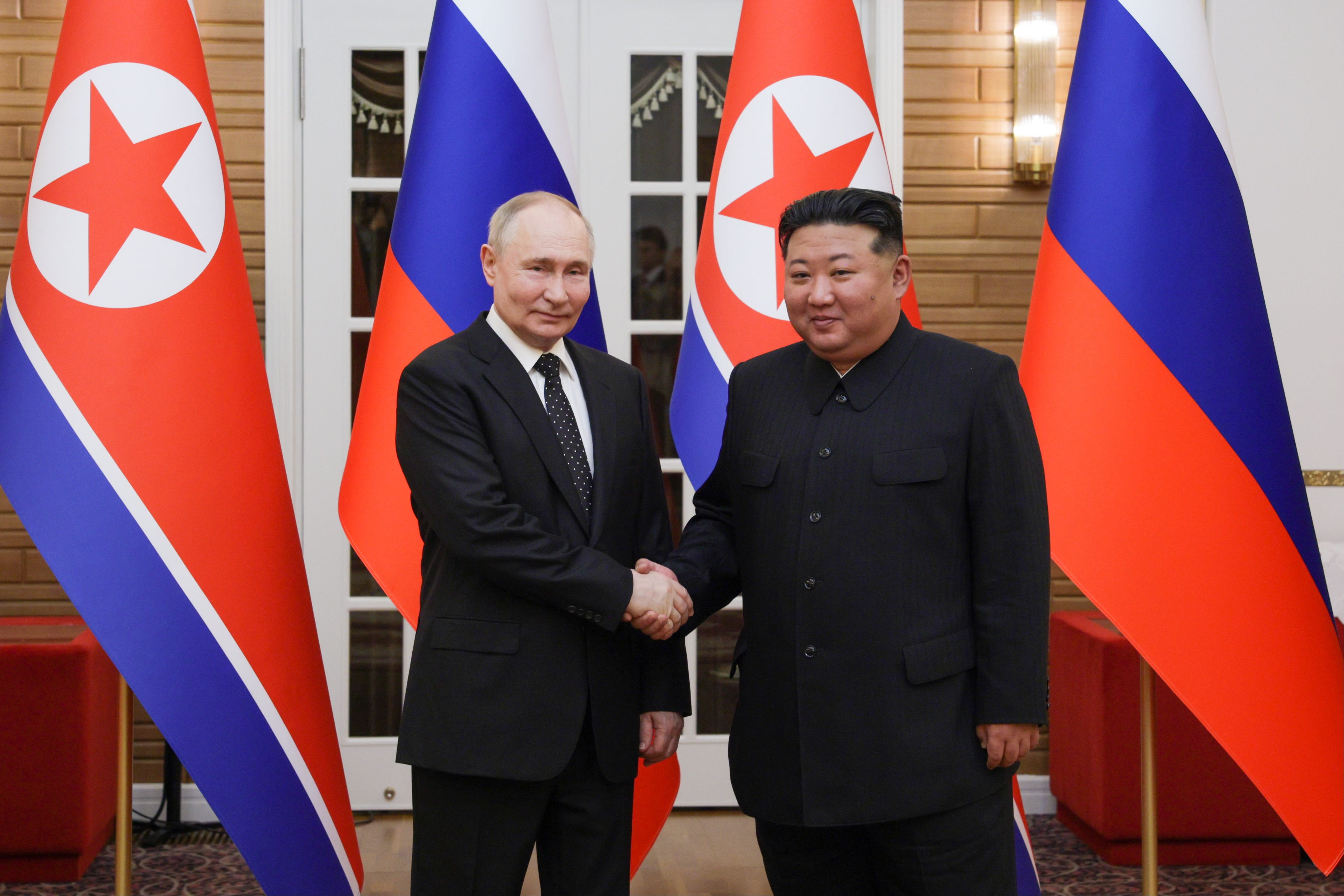
In recent days, videos have shown North Korean soldiers arriving in Russia—ready to be sent to Ukraine. “Ready” is not quite the word. I’m not sure “soldiers” is either. These men are fodder. They are being sent into Putin’s war to kill and be killed.
I feel sorry for them. Obviously, I hope the Ukrainians can overcome them, but I feel sorry for them. It is wretched to be born North Korean.
We might say, too, that it’s wretched to be born Russian—especially if you are male, without privileges, and subject to the draft.
In the Ukraine war, the worst of the worst are allied: Putin, North Korea, China, Iran … The Free World ought to come to Ukraine’s defense, for Ukraine is defending the Free World, whether that world knows it or not.
One more thing, before I move on. This is an item from Meduza, the Russian news organization in exile: “Russia’s Culture Ministry denies distribution license for film about woman who leaves North Korea.”
Kim Jong-un scratches Putin’s back, and Putin scratches his. I hope they lose—Putin, Kim, Xi Jinping, the mullahs. The whole blood-soaked crew.
***
I know many people who feel they have lost their parents or grandparents to the media they consume—to the irresponsible media those elders consume. Maybe you know of such cases, too.
It is a source of sadness and frustration for many. Agony, even.
Now, the American situation is very different from what Hungary has been. Still, I thought of our country, and this phenomenon, when reading a report out of Budapest: here.
I will quote the first three paragraphs:
As thousands swarmed the streets of Budapest last weekend to celebrate the defeat of Viktor Orbán, Balasz said he could not help thinking of his great-grandmother—now in her 80s, living in a rural town in Hungary’s deprived east. For her, having consumed little but state media for the past decade, the victory of Péter Magyar was not cause for joy, but for crippling fear.
Throughout Orbán’s reelection campaign, the media controlled by his governing Fidesz party depicted Magyar as a reckless enemy of peace, bent on dragging Hungary into the war in neighboring Ukraine. Balasz, a 42-year-old financial analyst who gave only his first name, said he was shocked by the extremity of the “lies” his great-grandmother was told each day …
“It’s like, you’re old, you’re in the countryside, you’re poor, you have, like, two TV channels, you’re listening to state radio” … The Orbánist propaganda, he said, reminded him of the sort peddled by the Communist authorities in the Soviet Union.
***
May I quote some Daniel Hannan to you? This is always an advisable move. In a column published last week, he writes,
Imagine it was someone other than President Donald Trump. Suppose a different leader were posting deranged rants in the small hours, insulting the spiritual leader of 1.3 billion Catholics, threatening entire civilizations with annihilation, and comparing himself to God. What would be the reaction?
We all know the answer. Both parties would be rushing to bundle him out of office before he did irreversible harm to the republic. Yet, as we all also know, different rules apply to Trump.
Hannan makes a point, or implies a point, that I have long made. Actually, I’m not sure I have long made it. I have long thought it. I will make it now.
For a while, I would say of my colleagues in the conservative movement, “They would never tolerate this in a Democratic president.” But the truth was even worse, if you will: They would never tolerate it in any other Republican president either.
Not Bush (either one). Not a Dole or a McCain or a Romney.
Nope, only Trump receives this strange exemption.
Why? Well, that requires psychological examination—even spiritual examination—and we might engage in that another time …
***
On April 15, Tax Day, Mayor Zohran Mamdani of New York circulated a video. It showed him outside a rich person’s apartment building, making a bogeyman out of that person and enthusing about taxing the rich.
Mamdani has his charm. He’s also a demagogue. And either you’re allergic to demagogues or you aren’t. And I am highly allergic.
I am also allergic to the politics of envy.
Moreover, I think this: to bogeyize a private citizen is un-American, illiberal, and dangerous.
(You will not find “bogeyize” in a dictionary. It is a Buckley word, like many excellent words.)
Remember: Demagogues start with easy targets—some Richie Rich, for example—and then, somehow, get to you …
***
I am not entirely sure of the proper use of “shibboleth.” I know that this word is subject to misuse.
Let me ask you: Is denial of the 2020 election a Republican shibboleth?
I was watching a video of Kevin Warsh, President Trump’s nominee to be chairman of the Federal Reserve. In testimony before the Senate, he refused to say whether Trump lost the 2020 election.
Back to “shibboleth.” Here is the relevant page in Merriam-Webster. There are several definitions—nuances, shades. I’m still not sure …
***
A column by Gerard Baker taught me the word “cacology.” Baker writes, “There are those who think Vance’s cacology might be the result of rising alarm in his fertile mind that he is falling out of favour with the boss.”
(The column was published in the Times of London: hence, “favour.”)
“Cacology,” according to Merriam-Webster, is “bad diction or pronunciation.”
By the way, many people equate “diction” with “enunciation.” It also refers to choice of words.
***
Have you seen this story?
The F.B.I. began investigating a New York Times reporter last month after she wrote about the bureau’s director, Kash Patel, using bureau personnel to provide his girlfriend with government security and transportation …
If Nixon has been reading the news of late, he must be thinking, “They made me resign? They were going to impeach me?”
***
Bear with me for a second, please. I was in Kyiv for several days at the end of 2019—talking with people about the war (which Russia began in 2014), talking with them about relations with the United States, etc. It was an illuminating and moving visit.
When Russia launched its full-scale invasion in February 2022, I think I felt it all the more acutely, having been in Kyiv. This is not necessarily right. War—savage, murderous aggression—is just as bad in Syria or Sudan, where I have never been. But …
This story from a few days ago arrested me: “Gunman shoots several tourists at historic pyramids in Mexico, killing a Canadian.” I was there—at Teotihuacán—about this time last year. (For my relevant journal, go here.) Reading the story, I could picture it all.
***
“Texas can require public schools to display Ten Commandments in classrooms, court rules.” This story quotes Ken Paxton, the state’s attorney general, and a moral train wreck (which does not curb his popularity, apparently). Said Paxton: “The Ten Commandments have had a profound impact on our nation, and it’s important that students learn from them every single day.”
Well, I think the same thing applies to attorneys general.
And to us all, heaven knows …
***
Maybe I could close with a speck of music. The Metropolitan Opera has staged Eugene Onegin, that masterpiece by Tchaikovsky (based on that masterpiece by Pushkin). My review is here. A number of issues arise.
Should that be “arise” or “arises”? But we’re done with language today.
Later!
I just processed a press release for Eugene Onegin, which can be seen at our local, rural community college. Onscreen only of course, but still. So many of our kids will never get to an event like this in person, never mind get to NYC or the Metropolitan Opera. It's a gift.
And I'd say "arise" because it's connected to "number of," which is more than one. (but not at the level of "a gazillion." Just "some.")
Gerard Baker’s articulate intelligence and knowledge-based wisdom are a balm for the soul. I’m thankful Jay included the link to Baker’s London Times column in his own very thoughtful, beautifully written, and interesting column.
A Google AI overview on the subject of noun-verb agreement for the noun “number”:
Number can be either singular or plural depending on the phrase structure. “A number of” acts as a plural quantifier (meaning “several” or “many”), requiring a plural verb. Conversely, “The number of” acts as a specific, singular count, requiring a singular verb.
• Plural (a number of): “A number of students are absent.”
• Singular (the number of): “The number of students is ten.”
Key Distinctions:
• A number of (plural): Treats the group as individuals (e.g., “A number of people are”).
• The number of (singular): Treats the group as a single entity or total (e.g., “The number of people is”).
• As a noun: The word number is technically singular, but acts functionally based on the article before it.
• Plural form: “Numbers” is always treated as plural.